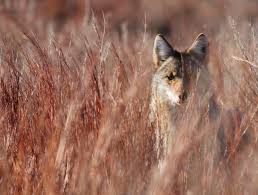
Tupelo Coyote by Wren Tuatha

We were tracing Jack’s Creek
where the woods abducts it from the rolling
hills of dairy cows and tobacco.
I on the asphalt, you behind the tupelos.
You stalked me like a fan
afraid to ask for my autograph.
Those alien eyes,
calculating,
measuring my marrow
bend after turn, always
thirty paces aside.

Now you trot out in the farmlands,
legs like tobacco sticks, mapping the median line.
I am roadside, reading.
You are storybook real.
I speak to you, familiar,
as if you are the family dog.
Your answer is a glare-beam
that rips me, rights me.

You put me in the landscape,
that’s all.

(First published in Canary, A Journal of the Environmental Crisis. Upcoming in The Paddock Review, the new journal of Finishing Line Press.)

Wren Tuatha’s poetry has appeared or is upcoming in The Cafe Review, Poetry Circle, Peacock Journal, Coachella Review, Arsenic Lobster, Baltimore Review, Pirene’s Fountain, Loch Raven Review, Clover, Lavender Review, Autumn Sky Poetry Daily, The Bees Are Dead, and Bangalore Review. She accepts that coyotes want nothing to do with her.

Three Poems by Yehuda Amichai

Half the People in the World

Half the people in the world love the other half,
half the people hate the other half.
Must I because of this half and that half go wandering
and changing ceaselessly like rain in its cycle,
must I sleep among rocks, and grow rugged like
the trunks of olive trees,
and hear the moon barking at me,
and camouflage my love with worries,
and sprout like frightened grass between the railroad tracks,
and live underground like a mole,
and remain with roots and not with branches, and not
feel my cheek against the cheek of angels, and
love in the first cave, and marry my wife
beneath a canopy of beams that support the earth,
and act out my death, always till the last breath and
the last words    and without ever understandig,
and put flagpoles on top of my house and a bob shelter
underneath.    And go out on rads made only for
returning and go through all the apalling
stationscat,stick,fire,water,butcher,
between the kid and the angel of death?
Half the people love,
half the people hate.
And where is my place between such well-matched halves,
and through what crack will I see the white housing
projects of my dreams and the bare foot runners
on the sands or, at least, the waving of a girl’s
kerchief, beside the mound?

(Translator unknown)


Wildpeace

Not the peace of a cease-fire
not even the vision of the wolf and the lamb,
but rather
as in the heart when the excitement is over
and you can talk only about a great weariness.
I know that I know how to kill, that makes me an adult.
And my son plays with a toy gun that knows
how to open and close its eyes and say Mama.
A peace
without the big noise of beating swords into ploughshares,
without words, without
the thud of the heavy rubber stamp: let it be
light, floating, like lazy white foam.
A little rest for the wounds – who speaks of healing?
(And the howl of the orphans is passed from one generation
to the next, as in a relay race:
the baton never falls.)

Let it come
like wildflowers,
suddenly, because the field
must have it: wildpeace.

(Translated by Chana Bloch)


My Child Wafts Peace

My child wafts peace.
When I lean over him,
It is not just the smell of soap.

All the people were children wafting peace.
(And in the whole land, not even one
Millstone remained that still turned).

Oh, the land torn like clothes
That can’t be mended.
Hard, lonely fathers even in the cave of the Makhpela
Childless silence.

My child wafts peace.
His mother’s womb promised him
What God cannot
Promise us.

(Translated by Benjamin and Barbara Harshav)

( Yehuda Amichai, 1924-2000)

For the Union Dead by Robert Lowell

Relinquunt Ommia Servare Rem Publicam.

(They gave up all to serve the Republic.)

The old South Boston Aquarium stands
in a Sahara of snow now. Its broken windows are boarded.
The bronze weathervane cod has lost half its scales.
The airy tanks are dry.
Once my nose crawled like a snail on the glass;
my hand tingled to burst the bubbles
drifting from the noses of the crowded, compliant fish.

My hand draws back. I often sign still
for the dark downward and vegetating kingdom
of the fish and reptile. One morning last March,
I pressed against the new barbed and galvanized

fence on the Boston Common. Behind their cage,
yellow dinosaur steamshovels were grunting
as they cropped up tons of mush and grass
to gouge their underworld garage.

Parking spaces luxuriate like civic
sandpiles in the heart of Boston.
a girdle of orange, Puritan-pumpkin colored girders
braces the tingling Statehouse,

shaking over the excavations, as it faces Colonel Shaw
and his bell-cheeked Negro infantry
on St. Gaudens’ shaking Civil War relief,
propped by a plank splint against the garage’s earthquake.

Two months after marching through Boston,
half of the regiment was dead;
at the dedication,
William James could almost hear the bronze Negroes breathe.

Their monument sticks like a fishbone
in the city’s throat.
Its Colonel is a lean
as a compass-needle.

He has an angry wrenlike vigilance,
a greyhound’s gentle tautness;
he seems to wince at pleasure,
and suffocate for privacy.

He is out of bounds now. He rejoices in man’s lovely,
peculiar power to choose life and die
when he leads his black soldiers to death,
he cannot bend his back.

On a thousand small town New England greens
the old white churches hold their air
of sparse, sincere rebellion; frayed flags
quilt the graveyards of the Grand Army of the Republic

The stone statutes of the abstract Union Soldier
grow slimmer and younger each year-
wasp-waisted, they doze over muskets
and muse through their sideburns…

Shaw’s father wanted no monument
except the ditch,
where his son’s body was thrown
and lost with his “niggers.”

The ditch is nearer.
There are no statutes for the last war here;
on Boylston Street, a commercial photograph
shows Hiroshima boiling

over a Mosler Safe, the “Rock of Ages”
that survived the blast. Space is nearer.
when I crouch to my television set,
the drained faces of Negro school-children rise like balloons.

Colonel Shaw
is riding on his bubble,
he waits
for the blessed break.

The Aquarium is gone. Everywhere,
giant finned cars nose forward like fish;
a savage servility
slides by on grease.

The ancient owls’ nest must have burned.
Hastily, all alone,
a glistening armadillo left the scene,
rose-flecked, head down, tail down,

and then a baby rabbit jumped out,
short-eared, to our surprise.
So soft! a handful of intangible ash
with fixed, ignited eyes.

Too pretty, dreamlike mimicry!
O falling fire and piercing cry
and panic, and a weak mailed fist
clenched ignorant against the sky!

(Robert Lowell, 1917-1977)
 

Willow by Anna Akhmatova

And I grew up in patterned tranquility,
In the cool nursery of the young century.
And the voice of man was not dear to me,
But the voice of the wind I could understand.
But best of all the silver willow.
And obligingly, it lived
With me all my life; it’s weeping branches
Fanned my insomnia with dreams.
And strange!–I outlived it.
There the stump stands; with strange voices
Other willows are conversing
Under our, under those skies.
And I am silent…As if a brother had died.

(Anna Akhmatova, 1889-1966)