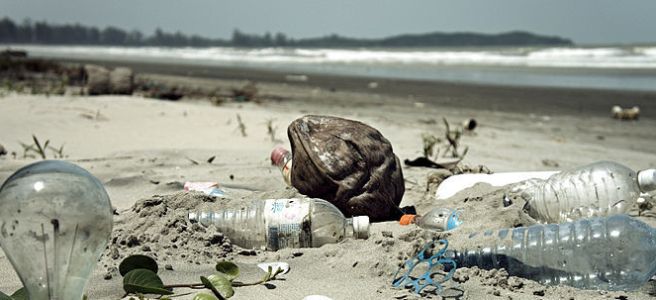
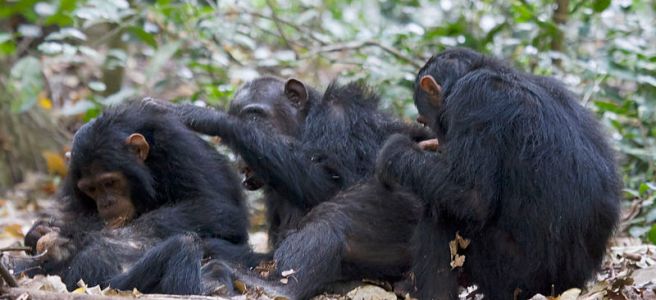
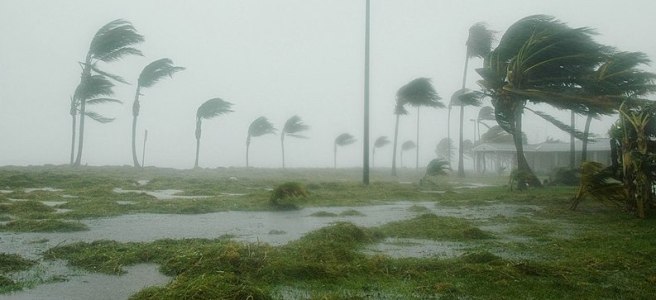
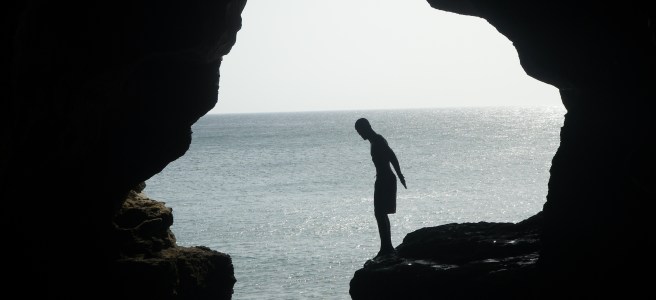
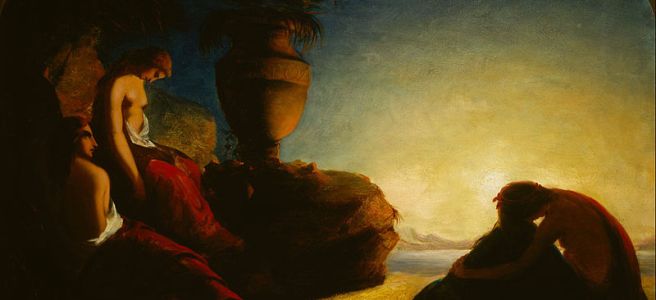
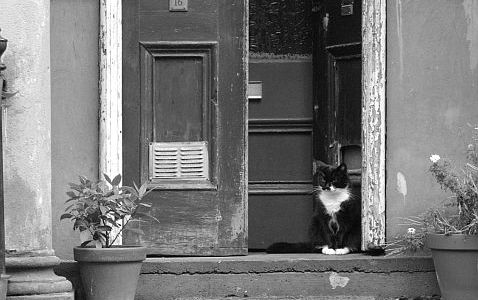
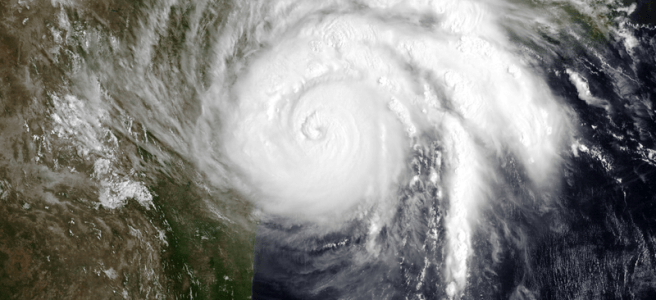
chimerism by Beth Gordon

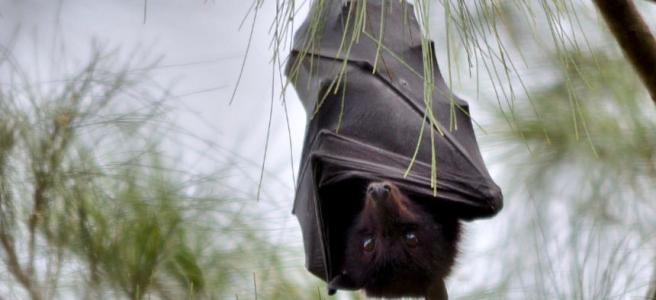
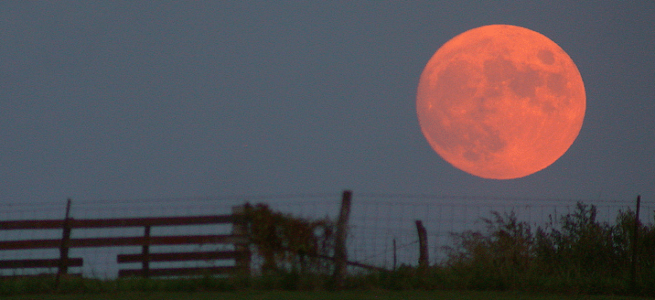
fresh-boiled bats exit the atmosphere hungry balls of sonar an endless Icarus
serenade crystal quartz and crystal water vie for room in a melting
womb the vanishing twin reimagines landscape compositions still life
with skeletal bears flocks of flesh-gorged vultures empty mockingbird
nests you say sand you say snow you say white swallows white with no hope
of flame of reunion at journey’s end you say they died of broken hearts I say
we will roam future streets frozen ghosts in frozen ghost towns we will search for dead things forever floating in jars if this was a list it would be endless


Beth Gordon is a writer who has been landlocked in St. Louis, Missouri for sixteen years but dreams of oceans daily. Her work has recently appeared in Into the Void, Quail Bell, Calamus Journal, By&By, Five:2:One, Barzakh, and others. She can be found on Twitter @bethgordonpoet.


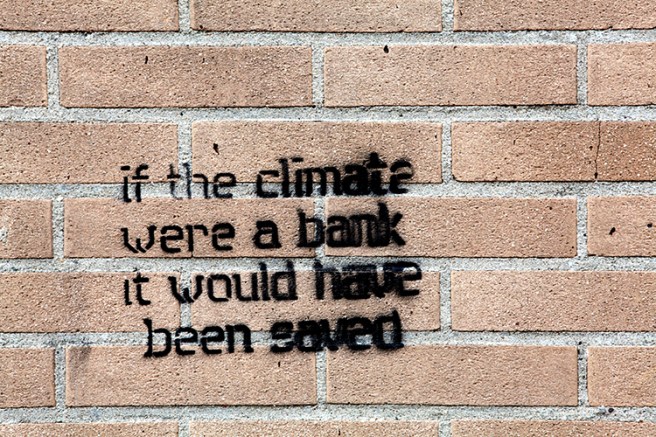
climatechange705


Related Article: It’s so hot in Australia that bats’ brains are frying

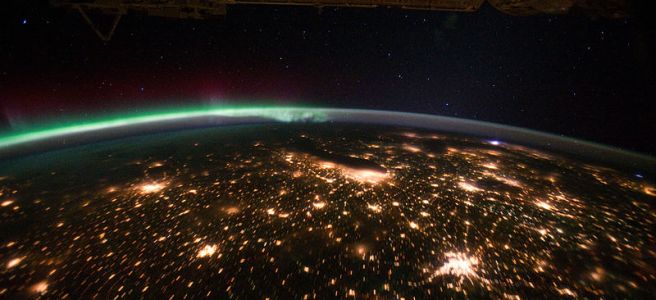
Images via Wikimedia Commons.

Oxtail Soup by Tanya Ko Hong

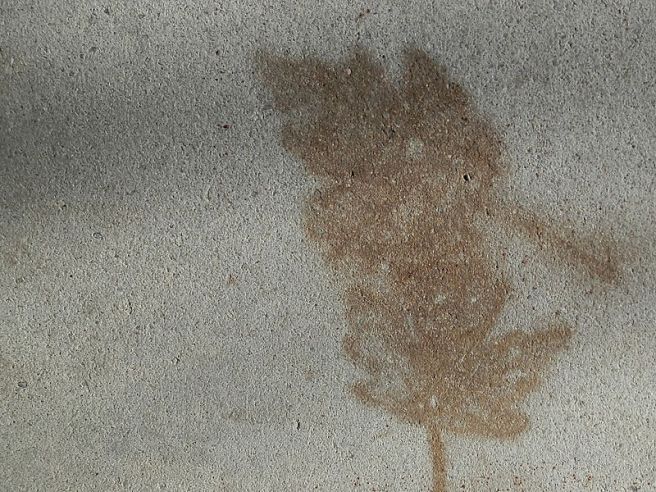
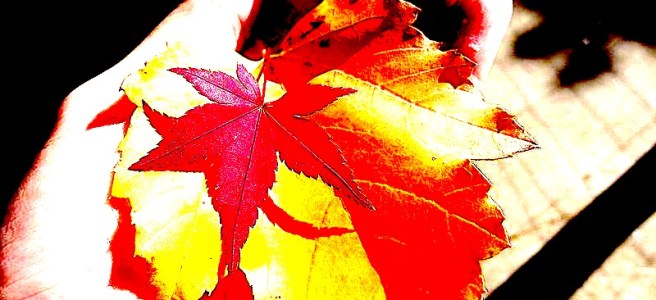
Leaf_Print_on_Sidewalk oxtail soup_02

I look at the bruise on my left hand
dark purple

mung—holding in the pain
silence of sorrow
ashes spread on the ocean
settling in layers
palimpsest of lives
like maple leaf

impressions left on the sidewalk after
they’ve blown away
a raven on the roof that said
Disconnect the phone

Turn on the gas
making Oyako Donburi
tears come
cutting up the onions—
the best gift

I crack cold eggs
Whip pour over
boiling napa and chicken broth
close the pot lid
turn off the gas
wait

pour over bowl of rice
feed child—

Empty unmade bed—
a summer river where
I didn’t want to see his body—

Separation
one poet said
after his wife’s funeral,
he found a strand of her hair
on the pillow and wept

I made sukiyaki the day my dad died—
I had to feed my children.

Oxtail soup
That’s what Daddy made—
suck out all the dead blood
and boil until broth turns milky—

When I leave
I want to leave beautifully.


Previously published in Paris Press Spiraling Poetry.


Tanya (Hyonhye) Ko Hong, poet, translator and cultural curator, has been published in Rattle, Beloit Poetry Journal, Entropy, Cultural Weekly, Korea Times, Korea Central Daily News, and elsewhere. She has an MFA in creative writing from Antioch University Los Angeles, and is the author of four collections of poetry, most recently, Mother to Myself, A collection of poems in Korean (Prunsasang Press, 2015). Her poem, Comfort Woman, got honorable mention in the 2015 Women’s National Book Association. Tanya is an ongoing advocate of bilingual poetry, promoting the work of immigrant poets. She lives Palos Verdes, CA. http://www.tanyakohong.com


Photograph by Ryan Hodnett.

(Three Little Words) by Alexis Rhone Fancher

 For Francesca Bell.

1.
M has never said I love you before.
Not to me.

2.
He cries at weddings, like a girl.

3.
The sex is only good if we’re totally fucked up.
It blurs how wrong we are for each other.

4.
English is not M’s native tongue. It eludes him.

5.
Maybe he misspoke?
His prepositions hang mid-air.

He says it’s hard to think when it’s hard.

6.
M’s white teeth nibble at my clit like a ferret.
The two front ones indent slightly;
it makes him look goofy, like a joke.

Sometimes when we have sex, M’s calico meow trips
across my back. Rakes a claw. Caterwauls.

She doesn’t want me here.

Sometimes when we have sex, I am the one in heat.

7.
Outside, the tin roof rain suicides
on the hard-packed earth.

M is fucking me from behind, his
body melded into my ass, fingers kneading my breasts.
He’s mumbling up the courage.
I know what he’s trying to say.
I want to fuck him mute.

8.
In the bedroom there’s this
Dennis Hopper photo of Tuesday Weld,
driving, top down, blonde hair streaming.
Circa 1968. She’s unfettered.

Why can’t he see that
I am that girl, my top down,
my hair streaming,
my consequence-less life?

9.
M. bought the print for me but
I don’t want it.
I want nothing from him but
a silent film, a carnival.
I want him to want that, too.

I want him to shut up but
he zeros in on my ear

and says it.


First published in Cactus Heart Magazine, 2014.


Alexis Rhone Fancher is published in Best American Poetry 2016, Plume, Rattle, Diode, Rust & Moth, Nashville Review, Verse Daily, and elsewhere. She is the author of How I Lost My Virginity To Michael Cohen and other heart stab poems, (2014), State of Grace: The Joshua Elegies, (2015), and Enter Here (2017). A multiple Pushcart Prize and Best of the Net nominee, Alexis is poetry editor of Cultural Weekly.
http://www.alexisrhonefancher.com


Photograph by Adhvaith.

Channeling by Martin Willitts, Jr.

The heat is hissing, and the lake is lower.
If rain ever comes to the rescue,
will it be too late? A few murmured sentences,
not offering relief? There’s a weariness to this
silence, just a stone’s throw away, a ghostly,
eerie light — hovering, a damselfly
barely making noise. This is channeling; but what,
we do not know, and we do not like the unknown.

We may not know restraint. We question.
We may not appreciate it if we do not get answers.
The lake is emptying with heat, hissing.
It’s light at its cruelest. It’s a damselfly whisper.
Like a thread unraveling, it’s the soul-light
emerging from a skull at death, I’ve seen it.


Martin Willitts Jr is a retired Librarian. He has over 20 chapbooks and 10 full-length collections. He has 3 more full-length collections forthcoming including “The Uncertain Lover” (Dos Madres Press), “News From the Slow Country” (Aldrich Press), and “Home Coming Celebration” (FutureCycle Press).

#MeToo: Two Poems by LeeAnn Meadows

When I Told

When I told my mother
she held me in her eyes,
wide and moist for only a second,
then she straightened her face
make herself presentable
and said,
”Your father could never have
done something like that. . .
You must be mistaken.”

When I told my brother
he listened unresponsively.
Later said he thought of me like someone
who had been abducted by aliens.
All other aspects and belief systems
are normal except this one aberrant belief.

When I told my lover
he held me in his long wiry arms
and let me cry.

Previous Published in Take Back the News.

Forewarning, 1969

I see you, Mother,
your bare legs crossed
in the wingback chair
outside the rental on the riverbed,
walls still stained waist high
from the 64’ flood.
A bright bold print stretched
across your pregnant belly,
full with your firstborn.

I want to warn you.

The handmade sweater
you are knitting
will not always fit
the tall, thin man you married.
His prominent forehead hidden
under reddish brown curls
Working as a civil engineer
he will survey the centerline
for Highway 101,
an important task.
Nightly you will greet him
with a ready smile and dinner.
I want to warn you
pack your walking shoes.

After your second born,
your husband will not come
straight home from work.
He will start drinking
lie down with strangers
then sleep with every
best friend you make
until eventually, you stop
making friends.
I want to warn you
leave now because later
you will think about leaving,
but find yourself without
the courage to lace your shoes.

I want to warn you.
Your smile will strain
and you will start
to believe his lies.
Eventually, you will join
the False Memory Society,
as you become unable
to cradle the truth
in both hands.

Previously published in Sin Fronteras: Writers without Borders.


LeeAnn Meadows was born and raised in Humboldt County, California and now calls New Mexico home. She lives on the outskirts of Las Cruces with her artist/husband, Glenn Schwaiger, and two dogs in an old adobe motel surrounded by pecan trees. Her work has appeared in Sin Fronteras, Adobe Walls, and Malpais Review.


Art is detail of Knitting Girl by Anders Zorn.

Comrades of the Dream Life by Sergio A. Ortiz

I recognize you,
those with the moon
spread on their face,
whose faces have no beginning
but have a resounding
and enveloping end,

the ones with smiling sores
on their bodies,
who sweeten thorns
and pin hope to hearts,
who have painful tails
and tender eyes, and move
like a falling leaf or a
shooting star.

I regret your arrival
before or after the pain,
always at the wrong time
but when needed.

Volunteers of laughter,
multipliers of atmospheres,
inventors of the game
who win without winning
even when losing.

Brothers of the flesh,
companions of the fierce tooth
that leaves a mark,
connoisseurs of navels and buttocks
and of their own music,
I greet you!


Sergio A. Ortiz (Featured Poet, August, 2017) is a two-time Pushcart nominee, a six-time Best of the Web nominee, and 2016/17 Best of the Net nominee. His poems have appeared or are forthcoming in Valparaiso Poetry Review, Loch Raven Review, Drunk Monkeys, Algebra Of Owls, Free State Review, and The Paragon Journal. His chapbook, An Animal Resembling Desire, will be published by Finishing Line Press. He is currently working on his first full-length collection of poems, Elephant Graveyard.


Photograph by See-Ming Lee. 

#MeToo: renewable vs. disposable by Amy Baskin

the earth is a little coconut
crack her open for the meat
and liquid sweet
warm her up to tropic state
sprinkle her on chocolate cake
grate walls of her inner shell
keep nothing trapped inside

and then the metaphor fails

a coconut can be planted and grow
another tree full of coconuts to sell
but not the earth
planned obsolescence is built
right into her flawed design
ravage her once and look for another
the earth is disposable
but not the coconut


Amy Baskin’s work is featured in Every Pigeon, apt, What Rough Beast, Riddled with Arrows, Fire Poetry Journal, The Ghazal Page, and more. She’s a 2016 Willamette Writers Kay Snow Poetry award recipient for her poem, About Face. She’s worked on revision with Paulann Petersen and Renee Watson of I, Too Collective, and participates in generative groups hosted by Allison Joseph and Jenn Givhan.

#MeToo: For the Man Who Colonized My Body by Hinnah Mian

FOR THE MAN WHO COLONIZED MY BODY

my mother tells me of how
her homeland was once
taken over by those who
felt as though they
were entitled to it
simply because she
wasn’t pretty enough
to call it her own

i can’t tell if its my
memory or hers
when i see the
stare of a soldier
holding his gun as
if its bullets
belonged in my body
as much as i
was supposed to belong
on this soil

she tells me we are
blessed to have two homes
on both ends of the world
and i tell her it is a curse
to not belong to
either of them

my mother tells me of how
disappointed she was in me
when i had my land
get taken over by
a man who felt as though
he was entitled to it
simply because i was too
pretty to not share it

he left his marks on me
the way the bombs
left their marks on
my mother’s hometown
when she was learning
how to be a little girl
in the comfort of her
own bomb shelter

she tells me of how
she was taught to
avoid the men marching
around with big guns
and uniforms because
they always seem to
have a hand on
the trigger

i tell her it is
hard to avoid them
when nowadays
everyone seems to
conceal their weapons

my mother tells me
the biggest regret
she ever had
was to let her country
get taken over by
those who can’t even
seem to recognize
its beauty

she doesn’t seem
to realize it
hurts the same
even as they
whisper you’re
so beautiful
when they are
conquering
your body


Hinnah Mian is a Pakistani-American Muslim poet who studies at Kenyon College. Her work has been previously published in the Blue Minaret and HIKA.


Photograph by DeviantArt ComaBlue.

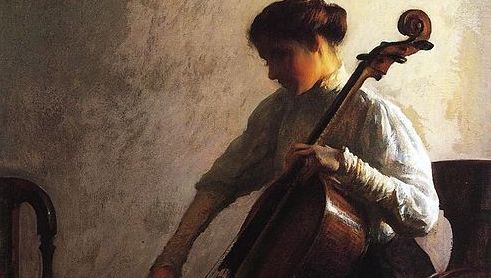
Postures by Devon Balwit

The cellist rests her instrument between
her knees, finds the sway

and draws her bow. Atlas fits his shoulder
to the groove of the Earth, lifting.

The dog circles before settling, lays
his nose daintily across a paw.

The poet teases out spider-silk as long
as she has a body like the trees

that kindle then stand naked
in their bones, unabashed at being seen.


Devon Balwit teaches in Portland, OR. She has six chapbooks and two collections out or forthcoming: How the Blessed Travel (Maverick Duck Press); Forms Most Marvelous (dancing girl press); In Front of the Elements (Grey Borders Books), Where You Were Going Never Was (Grey Borders Books); The Bow Must Bear the Brunt (Red Flag Poetry); We are Procession, Seismograph (Nixes Mate Books), Risk Being/ Complicated (with the Canadian artist Lorette C. Luzajic), and Motes at Play in the Halls of Light (Kelsay Books). Her individual poems can be found or are upcoming in Cordite, The Cincinnati Review, The Carolina Quarterly, Fifth Wednesday, The Ekphrastic Review, Red Earth Review, The Fourth River, The Free State Review, Rattle, Posit, and more.


Detail of The Cellist, 1908, by Joseph DeCamp.

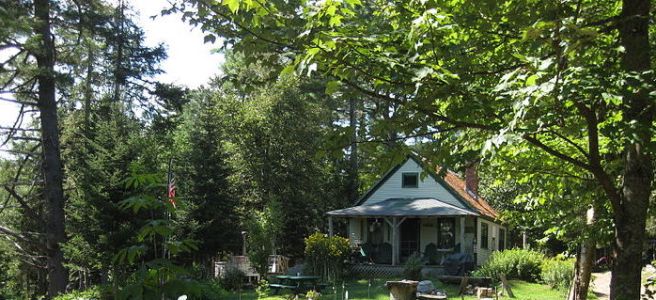
Living in the Woods with Mom, 1970 by Nicole Michaels

You are wearing an un-tucked white blouse over slacks and drinking jug wine.
Something on the stove not a curry – those came later – smells divine

and you are letting me help cut the root vegetables, steadying my hand
on the mascara-black handle of a knife while I stand on a stool.

The stool is painted to look like a mushroom, and I am barefooted
and on tip toe like a visitor from a damp kingdom of ferns and morels.

The day before, you were ironing in front of TV with a poor signal,
first the body, then the sleeves, careful not to singe the buttons.

Your dark hair was pulled up, pin curls made with spit and bobby pins
to hide your ears as if they were pointed and would give you away.

Your eyes were the color of moss in indirect light
and the thick charcoal of the times lined your lids, turning up at the corners.

Not everyone’s mom looked so mysterious doing the housework.
Not every house had a feral daughter, pockets filled with shade flowers

and gem stones. My scabbard caught in the door as I came in to wash up,
my leather armor smelling of fresh battle with dragons.

Only a silver pleat of antenna separated us while you picked up another shirt,
and maybe a little mist as you pressed down.


Nicole Michaels is a Marin County, CA native who makes her home in frontier Wyoming. She is a working poet with a degree in English from Stanford University where she studied under the late Diane Middlebrook and chose an emphasis in feminist studies. She spent some time in the American South as a journalist for small papers.


Photograph The Winter House at Forest Lodge by Beverkd.

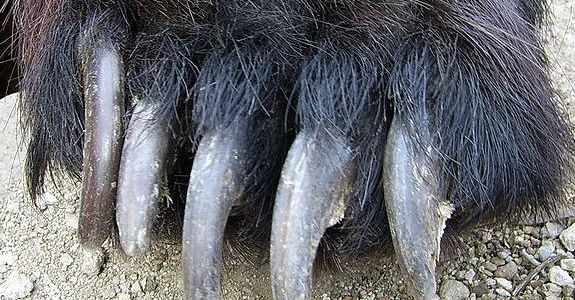
#MeToo: Still Life with Road Kill by Tina Barry

Spooled across the dirt road, the bear,
dead. A melodious spent planet.
I smelled its hold-your-breath,
kick-to-the-gut of life
stopped short. Whirring atop
its flattened skull’s tire-track
tattoo, an unlucky wreath of flies.

I stood near the bear, hand
on chest. Not in some form
of prayer, but to press back
what had lain still.

I had a boyfriend who was struck by a car.
His death arrived like a gift.
I had wanted him to die.
His rage gobbled color,
blotted sound.

I thought of him afterward
with a kind of shorthand:
Our legs beaded with lake water
His aversion to birds,
then beans. How good food
tasted when he wasn’t there
to share it.

The bear was left on the road to rot.
It seemed undignified, the menace
reduced to a malingering mass.
Now I see the wisdom
in allowing its slow surrender.
Why bury what will never stay dead?


First published in Red Sky: Poetry on the Global epidemic of Violence Against Women, (Sable Books, 2016).


Tina Barry’s work has appeared in The American Poetry Journal, The Best Short Fictions 2016, The Peacock Journal, b(OINK), Nasty Women Poets: An Unapologetic Anthology of Subversive Verse (2017), among other journals and anthologies. She has two Pushcart Prize and several Best of the Net nominations.


Photograph by Shizhao.

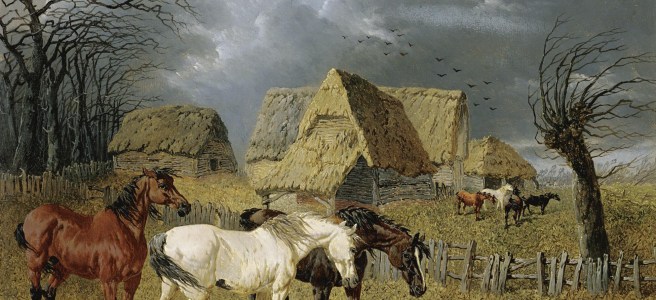
By the Chicken Coop Dust by Tracy Mitchell

A Response to Thunderstorm Coming by Tom Hennen

By the chicken coop dust
I feel it too.
My ankles become electric.

Frogs and crickets
cut fringes on the bottom of the night.

Clouds ripple
above the yard light
as though they are blankets
on a clothes line
strung
between nearing stars.


Tracy Mitchell is a newly retired native Minnesotan, recently relocated to the splendor of Colorado. His free verse writing is largely inspired by the vagaries of this frail and transitory life. Fair game subject matter includes nature, ourselves, and each other. His best work has been imagined by the campfire in a clearing somewhere near sleep. He is a contributing member of Poetry Society of Colorado, MyWritersCircle, Writers Among Us, Poetry Circle, and PigPen Poetry Forum. His work has appeared in Lake Region Review, and the poetry anthology As the Kettle Wolf-Whistled.


Painting detail of The Coming Storm by John Frederick Herring.

A Field of Prayer by Michael H. Brownstein

This is the word of my mistaking:
Hike with me through this field of prayer,
through mudflats and iron foot,
the eulogy deep and dried passion fruit,
the salt of columbine, a terrain of frenzy,
lacewing and the yellow mollies of spring,
milk and milk thistle, a porcelain of words.

Hike with me past the girth of oak,
the prayer tree of Cambodia, the blue iris,
purple passion, the field of glories
behind the back forty no one touches.
Share with me wild onion, mint,
dandelion leaves and acorn meat,
the edible leaves of the Acacia.

The storm will pass. The forest will replenish.
Rivers will not run dry. Nor will they shrink.
Hike with me five years from now. Share
my bounty anytime. The eulogy premature,
prayer alive in flower and grass, blossom
and honey bee, a porcelain of words.
and a strength in who we really are.


Michael H. Brownstein has been widely published throughout the small and literary presses. His work has appeared in The Café Review, American Letters and Commentary, Skidrow Penthouse, Xavier Review, Hotel Amerika, Free Lunch, Meridian Anthology of Contemporary Poetry, The Pacific Review, Poetrysuperhighway.com and others. In addition, he has nine poetry chapbooks including A Period of Trees (Snark Press, 2004) and Firestorm: A Rendering of Torah (Camel Saloon Press, 2012), The Possibility of Sky and Hell: From My Suicide Book (White Knuckle Press, 2013). He is the editor of First Poems from Viet Nam (2011).


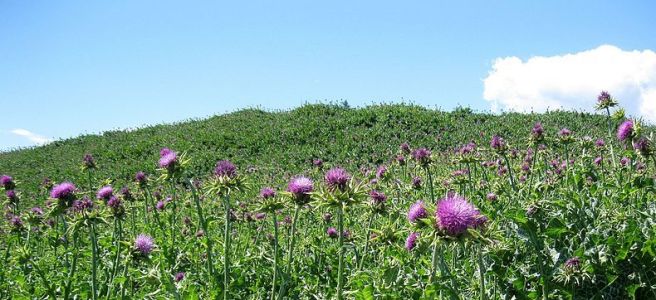
Photograph, Field of Thistle, by John Newcomb.

Red Velvet by Ankita Anand

My first view of the red velvet gilt-edged diary
Was of its opening page, of a declaration in my newly-wed aunt’s hand
On my uncle’s behalf
Saying he will never hit her again
Signed by my uncle, with love.

In the bottommost shelf of her almirah
I saw the book again today
When her teenaged daughter was rummaging for a favourite top.

Skipping several blank pages after the first one
I saw my aunt’s grocery lists
And miniscule digits secured in ovals
That showed how much she had managed to save.


First published in Muse India.


Ankita Anand’s writing has travelled through India, Pakistan, Singapore, Ireland, South Africa, Canada, the US and the UK. She also facilitates writing workshops. An archive of her publications can be found here: anandankita.blogspot.in


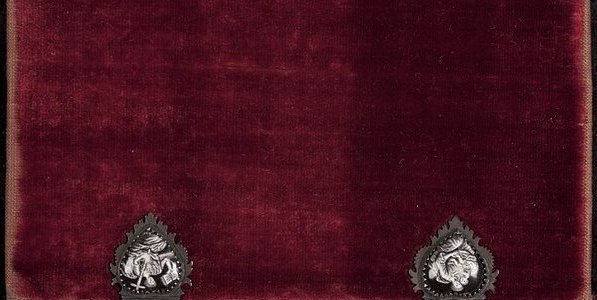
Photo a detail of the Book of Hours by the Master of Zweder van Culemborg, 18th Century.

when your mother convinces you to take in your homeless younger sister by Alexis Rhone Fancher

She will date your boyfriend.
She’ll do it better than you ever did.
She’ll have nothing but time.
He’ll start showing up when you leave,
train her to make him the perfect BLT,
(crusts off, avocado on the side),
encourage his cheating heart,
suck his dick so good he’ll think
he’s died and gone to Jesus.

Your sister will borrow your clothes,
and look better in them than you ever did.
Someone will see her with your boyfriend
at the Grove, agonize for days
before deciding not to tell you.
Meanwhile he’ll buy her that fedora you
admired in Nordstrom’s window, the last one
in your size.

When you complain, your mother
will tell you it’s about time you learned to share.

While you’re at work, your sister will tend your garden,
weed the daisies, coax your gardenias into bloom.
No matter how many times you remind her,
she will one day forget to lock the gate;
your cat and your lawn chairs will disappear.

Your mother will say it serves you right.

Your sister will move into your boyfriend’s
big house in Laurel Canyon. He will ignore her,
and she will make a half-hearted suicide attempt;
you’ll rescue her once again.

Your mother will wash her hands of the pair of you,
then get cancer and die.

Smell the white gardenias in the yard.
Cherish their heady perfume. Float them in a crystal bowl.
Forgive your sister as she has forgiven you.


First published in RAGAZINE, 2015


Alexis Rhone Fancher is published in Best American Poetry 2016, Plume, Rattle, Diode, Rust & Moth, Nashville Review, Verse Daily, and elsewhere. She is the author of How I Lost My Virginity To Michael Cohen and other heart stab poems, (2014), State of Grace: The Joshua Elegies, (2015), and Enter Here (2017). A multiple Pushcart Prize and Best of the Net nominee, Alexis is poetry editor of Cultural Weekly.
http://www.alexisrhonefancher.com


Detail of Rembrandt, The Sisters, Eleanore and Rosalba Peale.

defeat of purpose by Jess Kangas

listen close,
because we’re
three minutes
away from the
messiah coming
and my name
is on her boot
and you’re going to
want to know why.

it all started
harmlessly,
and then fire rippled
my teenage face
like an electric surge
of candy
proportions.

if this doesn’t make sense,
it’s not going to,
and I apologize for
twisting words into foul play
and smoking up a storm on
your mother’s piano last week.

but ten days ago,
i came across a box,
blue, leather, unusual
with diamonds on the corners.
it puzzled me and inside
were all your thoughts-
every one of them.

i know where you went that Monday-
and why you don’t like me
wearing buttoned shirts,
and how you laughed at your father’s
death not knowing what it meant.

listen, I’ve only got
about thirty-two seconds left
and I know you’re going to try
to lather me in calm bubbles
and sweep me up, so I’ll
hold still the night,
but these actions
are too devoted.

no, you and i
will part and perhaps
you’ll live in high peaks
of pearl colored satisfaction
while
i delve into the horrors
of my charred body
cracking over street corners,
mixing with the tar like
how you and i used to
dance.


Jess Kangas is a strawberry siren poet located in Buffalo, NY. Her poetry is rich in sound, structure and secrets.


Photograph by Nessa Land.

Clothes Make the (Wo)Man by Devon Balwit

“It was a hat for the great and lonely” —Hein Donner

Where is my page to arm me for the day,
fastening greaves and hauberk? Where
my factotum? Must I do everything myself?

I lean towards the mirror, draw on a mustache,
powder my sideburns to be taken seriously.
A wig adds gravitas. I oil both smirk and frown.

One never knows what face will be called for.
There was a time when I had only one, when
I stood in my nakedness before hoodlums.

I learned, swallowing teeth and coppery blood,
smearing snot and tears on coat sleeves.
Now, I dress as though I’ve already won.

No one dares tell me otherwise. And if
they snicker behind my back, no matter.
My suit is thick, my shoulders well-padded.


Devon Balwit teaches in Portland, OR. She has six chapbooks and two collections out or forthcoming: How the Blessed Travel (Maverick Duck Press); Forms Most Marvelous (dancing girl press); In Front of the Elements (Grey Borders Books), Where You Were Going Never Was (Grey Borders Books); The Bow Must Bear the Brunt (Red Flag Poetry); We are Procession, Seismograph (Nixes Mate Books), Risk Being/ Complicated (with the Canadian artist Lorette C. Luzajic), and Motes at Play in the Halls of Light (Kelsay Books). Her individual poems can be found or are upcoming in Cordite, The Cincinnati Review, The Carolina Quarterly, Fifth Wednesday, The Ekphrastic Review, Red Earth Review, The Fourth River, The Free State Review, Rattle, Posit, and more.

Grotesque by Amy Lowell

Why do the lilies goggle their tongues at me
When I pluck them;
And writhe, and twist,
And strangle themselves against my fingers,
So that I can hardly weave the garland
For your hair?
Why do they shriek your name
And spit at me
When I would cluster them?
Must I kill them
To make them lie still,
And send you a wreath of lolling corpses
To turn putrid and soft
On your forehead
While you dance?


(Amy Lowell, 1874 – 1925)

Nostalgic Hate by Sergio A. Ortiz

My ears listen to you lovingly
until the very end of love.

At the finish my hatreds harken,
my mind figures it’s a weapon

made of paper and tattoo ink.
I’d journey to East Asia and do us

love-making in origami.
Listen to the paper fold finely.

Imagine my ears there,
where the only thing that’s heard

is me disassembling, each time,
every time, at the end of tenderness.

Where hate is nostalgic
finalization of affection.


Sergio A. Ortiz (Featured Poet, August, 2017) is a two-time Pushcart nominee, a six-time Best of the Web nominee, and 2016/17 Best of the Net nominee. His poems have appeared or are forthcoming in Valparaiso Poetry Review, Loch Raven Review, Drunk Monkeys, Algebra Of Owls, Free State Review, and The Paragon Journal. His chapbook, An Animal Resembling Desire, will be published by Finishing Line Press. He is currently working on his first full-length collection of poems, Elephant Graveyard.


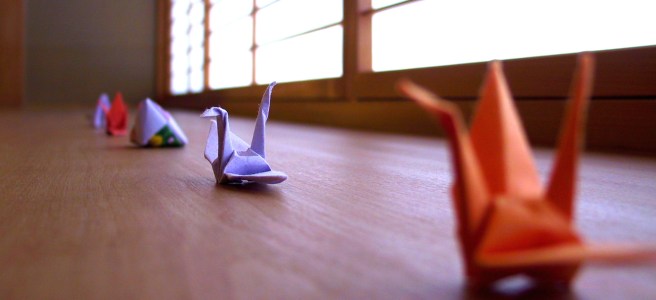
Origami Spring folded and photographed by Jason 7825. 

Tender Buttons [A Light in the Moon] by Gertrude Stein

A light in the moon the only light is on Sunday. What was the sensible decision. The sensible decision was that notwithstanding many declarations and more music, not even notwithstanding the choice and a torch and a collection, notwithstanding the celebrating hat and a vacation and even more noise than cutting, notwithstanding Europe and Asia and being overbearing, not even notwithstanding an elephant and a strict occasion, not even withstanding more cultivation and some seasoning, not even with drowning and with the ocean being encircling, not even with more likeness and any cloud, not even with terrific sacrifice of pedestrianism and a special resolution, not even more likely to be pleasing. The care with which the rain is wrong and the green is wrong and the white is wrong, the care with which there is a chair and plenty of breathing. The care with which there is incredible justice and likeness, all this makes a magnificent asparagus, and also a fountain.


From Tender Buttons (1914) by Gertrude Stein, 1874 – 1946.


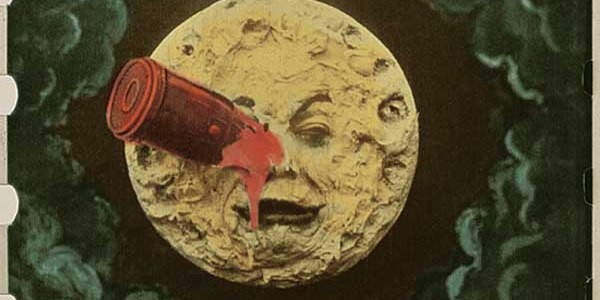
Trip to the Moon, Georges Melies. 

#MeToo: “You are my home.” by Hinnah Mian

When I asked you to show the key
you showed me a crowbar and said
I would have let you in anyway,
what’s the difference?

Through the keyhole, you called for God,
a deity, a prayer, you were met with
silence.

Where were you touched? They asked
me to point to parts of my body
still left bruised.

I pointed to the bedroom, called it a prayer room.
Here hands explored, preyed on all crevices
of a body. The bathroom, here knees
met cold tile floors. Here in the kitchen
we started fires and danced in the smog.

They asked if I was okay,
if it still hurt. I told them not to bother
looking for illness inside of me—

just a boy who made himself
at home and never found
his way out.


Hinnah Mian is a Pakistani-American Muslim poet who studies at Kenyon College. Her work has been previously published in the Blue Minaret and HIKA.


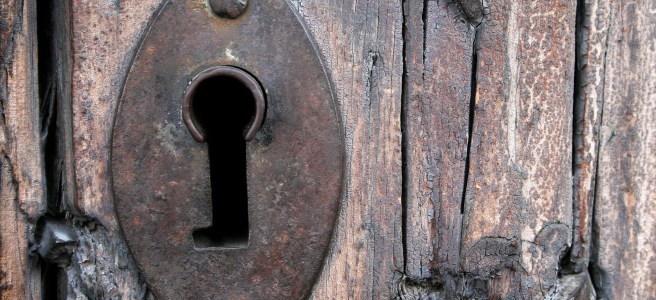
Photograph by Tomas Castelazo.

#MeToo: Pine by Tina Barry

Air freshener dangling
from a cabby’s window.
A freshly mopped floor.
The surprise of Christmas trees
in a November farmer’s market
where a woman waved a branch,
proud of its healthy aroma
and I fled.

I thought of going back
if only because she’d said, Miss?
with such concern.

Because she was kind,
I didn’t return to explain,
Your trees smell like a man
who locked me in his car,
or burden her with details:

The warped cross of black
moles on his cheek.

Burnt evergreen of
stale cologne.

His weight, the crush
of an overturned tree.

Chilly fingers in my coat pockets,
I began:

Heart
Mouth
Hands
Breath
Heart

Until the smells became street smells.
The noise street noises.
Until my tongue tasted like nothing
but my tongue.


First published in Veils, Halos & Shackles: International Poetry on the Oppression and Empowerment of Women, (Kasva Press, 2016).

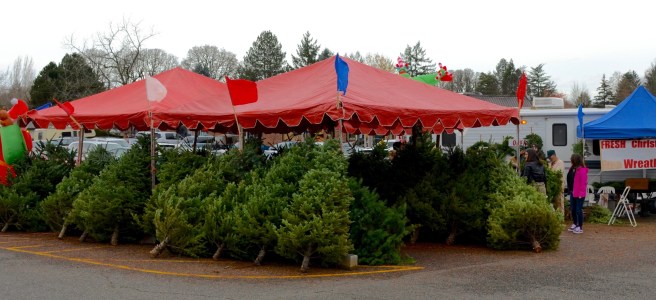
Christmas_tree_for_sale


Tina Barry’s work has appeared in The American Poetry Journal, The Best Short Fictions 2016, The Peacock Journal, b(OINK), Nasty Women Poets: An Unapologetic Anthology of Subversive Verse (2017), among other journals and anthologies. She has two Pushcart Prize and several Best of the Net nominations.


Tree lot photograph by Steve Morgan. Trees in netting by Project Manhattan. 

Teach Your Dog to Tango by Nicole Michaels

Use a different glass every time
as you drain, alone, a bottle of wine,
and leave each vessel on the counter unwashed.
It will look like you threw a party.

Exit an empty house listening to music.
The spines of cellos will stand up in your absence,
a saxophone has stretched out on the couch.
A swaying gown has challenged a curtain to a duel.
No telling what you’ll come home to.

Shop a thrift store for T-shirts that lay
claim to many adventures:
Marathons, fundraisers, exotic vacations.
Causes and out of the way bars.
Wear them all and lie when asked.

Test drive cars you can’t afford and tell the salesman
one of your boyfriends will stop by to close the deal.
Tell him to be discreet:
You are not sure which one it will be,
and you don’t want a scene.
Leave him guessing. Leave your card.
Watch him press his nose against the car window like a puppy.

You are unforgettable.

Go around in too much perfume and too much rouge
from the testers at department stores. Buy nothing.
Wear a long dark coat and dark glasses and walk
with a purpose; people will mistake you
for a celebrity they can’t quite place.

Be your own hope chest. Buy yourself a promise ring.

Whatever you do,
forget the brave face.
Cry all you like – you are done
throwing things
and tears are just the ghosts
of all you dry-eyed broke against the walls –
there’s a river in you –

but remember to also dance barefoot on the carpet
and slide in your socks on tile floors.
Teach your dog to tango as the water rises.

57373cefccb46eed21fd89bd5e17e9a7--just-dance-dance-dance-dance


Nicole Michaels is a Marin County, CA native who makes her home in frontier Wyoming. She is a working poet with a degree in English from Stanford University where she studied under the late Diane Middlebrook and chose an emphasis in feminist studies. She spent some time in the American South as a journalist for small papers.


New Year’s Eve by Ellaraine Lockie

The year is all packed
Refusing to be left behind
A black baggage of grief
burned by betrayal in love’s incinerator
And by beloved bodies dehydrated
as they processed to fine particles

My inability to focus
scatters like ashes over stacks
of partially-sorted photographs
Piles of unfinished poems
maneuvering their midlife crises
And multiple party invitations
Each promising to
bring in the best new year

Confetti falls from one
like gaiety imposed by a pushy hostess
Another drones Auld Lang Syne
in digital incessance as I open the invite
Bottles of booze litter the last two
Conjuring loss of inhibition
and sloppy kisses from strangers

Picking the best of the bad
proves to be as challenging
as choosing proper party apparel
And my fifth and final change
forces me in front of Times Square
Countdown clarity as plain
as the pajamas I wear

that when the year clocks into next
I’ll unpack the bereavement baggage
Accept sorrow’s timetable
And snack on some more popcorn
or pretzels or peanuts
Or maybe nachos or Cheetos
or chocolate covered mints


Ellaraine Lockie is widely published and awarded as a poet, nonfiction book author and essayist. Tripping with the Top Down is her thirteenth chapbook. Earlier collections have won Poetry Forum’s Chapbook Contest Prize, San Gabriel Valley Poetry Festival Chapbook Competition, Encircle Publications Chapbook Contest, Best Individual Poetry Collection Award from Purple Patch magazine in England Competition, and the Aurorean’s Chapbook Choice Award. Ellaraine teaches writing workshops and serves as Poetry Editor for the lifestyles magazine, Lilipoh.


Detail of photograph by Frances Benjamin Johnston, Self Portrait as “New Woman,” 1896.

Hemp, Haiku & Social Lies by Tracy Mitchell

He toured Kansas, then Greenwich
where he lived as a postulant, later
described as the happiest time of
his life. With a face resembling
Vonnegut, or a plump pumpkin
going flat, he aged quickly along
with American innocence, if ever
there was such a thing. The hippies
thought him a god-like blend of
hemp, haiku and hitchhiking, a
view he never admitted to liking.
Authorities long considered him
a poet in times of war, a lector
at the City Lights Bookstore,
and of that they could not abide.
He went to the camps, went to
shore, and finally went to ground.
His daughter, Mary, changed her
name to Mariana. His third wife
left him for a poet. No record remains
of the man having lived or died, but
for his words, and now this,
and only after tea and peyote.
A pipe plays slow and long. Low
thunder sloshes from the Rockies to
Brooklyn, Chicago to The City, where
streets on the hill tilt toward the sea.


(First published in Poetry Circle.)


Tracy Mitchell is a newly retired native Minnesotan, recently relocated to the splendor of Colorado. His free verse writing is largely inspired by the vagaries of this frail and transitory life. Fair game subject matter includes nature, ourselves, and each other. His best work has been imagined by the campfire in a clearing somewhere near sleep. He is a contributing member of Poetry Society of Colorado, MyWritersCircle, Writers Among Us, Poetry Circle, and PigPen Poetry Forum. His work has appeared in Lake Region Review, and the poetry anthology As the Kettle Wolf-Whistled.


Photograph of Kenneth Rexroth reading, source Foundsf.

Compassion Moves the World by Michael H. Brownstein

After the sculpture Compassion Moves a World,  by Julie Rotblatt-Amrany

In the days that followed
The blue ink of sea broiled over

A child, a vulture, a lack of seed.
Everything spreading outward.

Wind whined into place and rained.
Sun spread its thick arms and stayed.

One person can make a world.
A strong wind can swim in acid and wake.

Water in turmoil thickening.
Hold on with all of your might.

The earth has not broken open yet.
The legs of the strong are stronger

Than the waves of the cloak of life.
We will come to cross this path,

We will make it across this continent,
We will find the child, the vulture, the seed.

We will change the shape of water.

compassion-moves-a-world full length

Michael H. Brownstein has been widely published throughout the small and literary presses. His work has appeared in The Café Review, American Letters and Commentary, Skidrow Penthouse, Xavier Review, Hotel Amerika, Free Lunch, Meridian Anthology of Contemporary Poetry, The Pacific Review, Poetrysuperhighway.com and others. In addition, he has nine poetry chapbooks including A Period of Trees (Snark Press, 2004) and Firestorm: A Rendering of Torah (Camel Saloon Press, 2012), The Possibility of Sky and Hell: From My Suicide Book (White Knuckle Press, 2013). He is the editor of First Poems from Viet Nam (2011).

#MeToo: Sister Poem #5 -Double Date: The Quarterback, The Fullback, & The High Cost of Dinner by Alexis Rhone Fancher

When the date ends, your sister will
kiss the fullback goodnight on tip toe
under the porch light, her soft curls a halo
illuminating her naivety.

You, on the other hand,
will stare at your bare feet.
Not shy: Sullied. Seething.

Your sister will thank the fullback for dinner
at Tony’s on the Pier,
the copious cocktails and signature chocolate mousse.
She’ll tell him she had a wonderful time.
That she hopes she’ll see him again.

You will say none of these things.
You will mind your manners.
You will try not to think how the quarterback
just forced himself into your mouth.

You will bite your tongue and smile,
pretend his baller body
hasn’t just slammed into yours,
that he didn’t wipe his penis on your sheets
when he was done,

that while he was assaulting you,
you didn’t wonder if the fullback was out there,
raping your sister. If he, too, was brutal.

In fact, your sister and the fullback only
watched tv, making out, but just a little.

You had no way to know this.

You lie there and take it for your sister.
You think about her delicate spine,
believing if you play it wrong,
he might snap her like a sparrow.

They eye the closed door of your bedroom.
They share a knowing smile.
They know nothing.


First Published in Tinderbox Poetry Journal, 2017


Alexis Rhone Fancher is published in Best American Poetry 2016, Plume, Rattle, Diode,
Rust & Moth, Nashville Review, Verse Daily, and elsewhere. She is the author of How I Lost My Virginity To Michael Cohen and other heart stab poems, (2014), State of Grace: The Joshua Elegies, (2015), and Enter Here (2017). A multiple Pushcart Prize and Best of the Net nominee, Alexis is poetry editor of Cultural Weekly.
http://www.alexisrhonefancher.com

breeding by Jess Kangas

sobriety breeds insomnia
breeds my sunday
night-at my home, it’s mother’s
day-I bought the succulent near the horse farm, the card
in walgreens, I posted on facebook with 3
hearts-our secret.
remains. it comes from the mother-
yours was a lion actress, she took men in
her mouth on acid while
you ate tv dinners nearby, I remember
her in the mall-every step a broken step- her mother
GG. seventy years old bail bondsman in Florida-
the prisoners loved her- she had dinners
with everyone, you mentioned the drugs, guns, the transgender
woman, that guy Nicky had a knife.
and your father’s mother- they called her red,
she lied about her birthday, her clothes neatly
pressed- no one ever spoke
of her son that passed-
they lived
on the upper
west side- fine china, two maids-
one nanny. when the stocks
crashed- he blanked himself-
we never speak of what
lies dormant
in my womb.


Jess Kangas is a strawberry siren poet located in Buffalo, NY. Her poetry is rich in sound, structure and secrets.


Photograph by Steve Snodgrass.

#MeToo: The doer and the done upon by Ankita Anand

I sprawled on the floor, was asked to sit properly,
beginning of shame in my being.

A boy I didn’t know whispered foulness in my ears
on the playground. I made sure my loose shirts
kept my chest as flat as it felt
in those seconds of frozen air.

Middle-aged bicycleman airkissed me,
I pedaled hard. At thirteen I learnt the roads
do not carry my weight
but weigh me down.

How many things must be rotten in our Denmark?

In Taekwondo class I stretched my legs
on both sides till they hurt, till much after the hurt.
Two girls, their feet against mine, silently promising me
I won’t relent. That winter, the flame
of pride in my thighs kept me warm.

I named parts of my body
(that asked why I never spoke to them)
to tell wide-eyed men of the exact violations they committed.
I discovered my tongue and language could be allies if they spent
enough time together.

Curious, I returned the gaze foisted upon me,
took my time to take in this bundle of nerves turned to jelly.
My eyes were street dogs who could fight on half-empty
stomachs, every day pulled into games others played, refusing
to be tamed.

My body says it wishes to unlearn the fear of what could be done
to it, to show me everything it can do.


A version of this work was first published in Tuck Magazine.


Ankita Anand’s writing has travelled through India, Pakistan, Singapore, Ireland, South Africa, Canada, the US and the UK. She also facilitates writing workshops. An archive of her publications can be found here: anandankita.blogspot.in


Photograph by Saad Akhtar. 

Four Poems for Christmas Sharing

Pressed Pansies by Victoria Crawford

A mother’s gift to make for Christmas day
in the book, Pressed Flowers, from a thrift store.
A Eureka! stretching a teacher’s pay.

My pansies were blooming in bright array.
Cardboard and string press pansies galore,
a mother’s gift to make for Christmas day.

I made backing and frame from an old tray,
gilded for flower picture Mom would adore
a Eureka! savings for teacher’s pay.

Pressed pansies, picture framed, artful bouquet,
glossy glitter made it cleverly shine more
for mother’s gift handmade for Christmas day.

December, the present and I on our way
hit potholes before we reached Mom’s front door
and that Eureka! moment for teacher’s pay?

Bumps, glue, and gravity ruined the display:
ruined pansies and glitter weren’t much, for
a mother’s gift made for Christmas day
or Eureka! stretching a teacher’s pay.


Winter by Martin Willitts, Jr.

silence and cold expectations
speak thinly
translating
with deep pain
into new fallen snow
through the determined
darkness
among blue hazed trees

wind moves slowly
wearing snowshoes


Andy Williams by Kenneth Pobo

Aunt Gwen plays his albums while
pushing a splintery mop
over crabby kitchen tiles. Andy
sings that he hears the music
from across the way. Gwen thinks
maybe she hears it too—only oak
leaves against a screen. She wishes

that just once Tree would have taken her
to see him at the Moon River Theater
in Branson. Last Christmas
he promised, but his job got busy
and Delia Anne came home broke.

As Gwen pours gray water down the sink,
Andy sings “Moon River”–
We’re after the same rainbow’s end,
the album turning in endless circles, Gwen

stopping suddenly when a tuxedo’d man
leaps out from worn grooves
to offer her one red rose.


The Captive Fire by Wren Tuatha

She tosses the yarn
and the kittens roll with it,
hitting the wall at the
propane heater,
its grill a cage for
the captive fire within.

She lets out a smile
but it swings back to her,
on a pendulum,
like a good smile,
contained in quiet play.

In the span of a sigh
the kittens will leave, cats,
echoes of the children
who fell, men and women,
from her breast.
She would give a breast
to be needed
that way again.

She snatches the yarn
and the kittens
settle for her shoelace
as she finishes the fringe
on her fourth grandson’s afghan.
Muted shades of
red, orange and yellow.


Victoria Crawford. From Monterey, California, Victoria is a poet passionate about connecting nature and the human experience in words to share with readers. She has been published in Peacock Journal, the Ibis Head Review, Wildflowers Muse, the Lyric Review, Eastlit, Penwood Review, and other magazines, as well as having upcoming work in Canary and Pacific Poetry.

Martin Willitts, Jr. is a retired Librarian. He is the winner of the 2014 Dylan Thomas International Poetry Award and Rattle Ekphrastic Challenge, June, 2015, Editor’s Choice. He has over twenty chapbooks including the winner of the Turtle Island Quarterly Editor’s Choice Award, The Wire Fence Holding Back the World (Flowstone Press, 2017), plus eleven full-length collections including Dylan Thomas and the Writing Shed (FutureCycle Press, 2017) and Three Ages of Women (Deerbrook Editions, 2017).

Kenneth Pobo has a new book of poems out from Circling Rivers called Loplop in a Red City. His work has appeared in: The Queer South anthology, Caesura, Colorado Review, Mudfish, and elsewhere.

Wren Tuatha (Califragile Editor). Wren’s poetry has appeared or is upcoming in The Cafe Review, Canary, Peacock Journal, Coachella Review, Arsenic Lobster, Baltimore Review, Pirene’s Fountain, Loch Raven Review, Clover, Lavender Review, Autumn Sky Poetry Daily, Poetry Pacific, and Bangalore Review. She’s also an editor at JUMP, the International Journal of Modern Poetry. Wren and her partner, author/activist C.T. Lawrence Butler, herd skeptical goats on a mountain in California.


Painting: Night on the eve of Ivan Kupala (1892) by Henryk Slemiradzki (1843-1902).

Santa by Jack D. Harvey

Santa

Looking in the eye of Santa
the vista all behind the orb,
curled and
feathery landscape of trees
and snow;

the fault is mine, not his
I see no farther.

In the snowpalace
his red suit waits;
the deer outside
move gently in the cold;
food is no gift.

From the nose of Claus
the rosy delicate color
rises, ripens
to the cheeks;
his pink ears,
open as porches,
give insights to the
insides of chimneys,
children’s’ wishes.
Gifts, in the eye of
Santa, become pledges
that a good king makes;
bounty that makes men
feel the burden
of heaven
and its law.
Give, says the pelican;
love thy brood;
suffer the beak’s
greedy grasp.

So Santa sows;
from the ramparts,
his eyes,
twin suns warming,
oversee the harvest.


Jack D. Harvey has been writing poetry since he was sixteen. He lives in a small town near Albany, N.Y. He is retired from doing whatever he was doing before he retired. Jack D. Harvey’s poetry has appeared in Scrivener, Mind In Motion, The Comstock Review, The Antioch Review, Bay Area Poets’ Coalition, The University of Texas Review and a number of other on-line and in print poetry magazines over the years, many of which are probably kaput by now, given the high mortality rate of poetry magazines.

#MeToo: Armed in Eighth Grade History Class by Ellaraine Lockie

Gary Galvin sits at the desk in front of me
Mr. Schwartz writes dates on the blackboard

Gary reaches a hand back
and shimmies it up my leg

I stand, extend my left arm like an eagle in flight
Hook its talons into Gary’s left cheek

Just as Mr. Schwartz turns around
to see history reversing itself

I am not called into the principal’s office
But into a flock of women with machismo


Ellaraine Lockie is widely published and awarded as a poet, nonfiction book author and essayist. Tripping with the Top Down is her thirteenth chapbook. Earlier collections have won Poetry Forum’s Chapbook Contest Prize, San Gabriel Valley Poetry Festival Chapbook Competition, Encircle Publications Chapbook Contest, Best Individual Poetry Collection Award from Purple Patch magazine in England Competition, and The Aurorean’s Chapbook Choice Award. Ellaraine teaches writing workshops and serves as Poetry Editor for the lifestyles magazine, Lilipoh.

Digigrams: Five Poems by Barbara Henning

Mar 21, 2016

—a fast walk—follow circles—around the park—a big hawk nest—mother gingko—look away—playground and basketball—melancholic clouds—if he gets his way—Hillary says—it will be bully Christmas in the Kremlin—just an excuse—to hawk steaks and wine—one hundred sheep—huddle in a circle—under a blue light—low and breathy—Daymé Arocena sings—you knew before—you knew before—what could have been— Avenue A to 7th Street—stand still—one hand over the other—over your heart—in Brussels—more than thirty pounds—of explosives—over the East River, a  full moon—

Apr 23, 2016

—along the Hudson river—children—on a merry go round—screaming and peddling—swivels and swoops—not quite enough rain—to say rain—CNN will stream—the so-called debate—a new digital device—for a rapid stream of single words—one after the other—a  red ferry glides back and forth—yellow cabs now and then—just past noon, the sun, a woman—in a brown coat strolling along—with notebook—stops, looks—under black sunglasses—jots down something—perhaps a poet—perhaps a journalist—in Arizona—or Michigan or Long Island—at a bully rally—Look dad!—says the little boy—snipers!—our American dream—a walled-in community—with smaller walled-in homes—as the jagged hills and walls—recede into the distance—in Battery Park—a little girl swings—back and forth—scooping up the air—

May 15, 2016

—when Tunick shoots a large group of naked people— no surprise—no news— standing in a kitchen—dreaming—Alter Rd near the Detroit River—naked, holding a kitchen towel over my crotch—the chubby new wife—in an apron—shocked—when oxygen is low—naked mole rats—flip a switch to survive—metabolic—now it’s her apartment—my body parts—I try to explain—cooking—she’s cooking—a one man militia in the bedroom—rushes through the hallway—angry —skedaddle out of there—then again—in the living room—just in time—to stumble down the aisle—he’s holding—something yellow—a flower—in a bombed hospital in Afghanistan—I’m dying—a doctor with one leg torn off—talks into a cell phone—take care of the children—from now on—to the men in the militia—we will call you Donald—

Dec 30, 2016

—“Tuck in youuuur bellieees”—sings the teacher—on Sunday night television—reenact history—the aristocracy and their servants—Bono says—capitalism is better a servant—than master—an abandoned boat—crossing the Mediterranean—crammed full—of migrants—capsized—the bully boasts—of  groping women—so many women care less—watch out—if you critique him, you’ll get sued—do the dishes—take a hot bath—the planet’s  hotter—this year—old racial hatreds—on a floating platform—beside melting glaciers—Mr. Einaudi plays piano—I calm myself—by reading Sebald—in some dreamy place between living and dying—take a walk along the park—scarf, hat, little flats—slow snow melting—on my shoulders—and the cement—young people—smoking—between one bar and another—I was once young, too—walking along this same block—sometimes smoking—on 7th Street—from Avenue A to B—waiting for Michael at the Horseshoe Bar—

Jan 4, 2017

—Queen Elizabeth to her guard—a momentary assassin—that’s quite all right—next time I’ll ring beforehand—so you don’t have to shoot me—in Cucina de Pese—reach into my bag for my cell—shoot—left it home—pick up a flier and write on the back—pen sliding over paper—no news, no texts—January 4, 1960—today is my mother’s death date—a voice at another table—I was 14 and my brother was nine when my mother died—even though we were in prep school—I looked after him—we went to public school—I was the babysitter—tastee bread and campbell bean sandwiches—56 years later—we vote for the bully—I put my face in my hands—contemplate breaking away—to woo voters—a gospel concert in Richmond—sponsored by the Koch brothers—hurray for the oil industry—when they pay—we dance and sing—


Barbara Henning is the author of several collections of poetry, her most recent A Day Like Today (Negative Capability Press 2015). Other recents include A Swift Passage (Quale Press), Cities and Memory (Chax Press) and a collection of object-sonnets, My Autobiography (United Artists). She has published three novels, Thirty Miles to Rosebud, You Me and the Insects and Black Lace, and she is the editor of Looking Up Harryette Mullen and The Collected Prose of Bobbie Louise Hawkins. Born in Detroit, Barbara lives in Brooklyn and teaches for Long Island University, as well as writers.com. http://barbarahenning.com
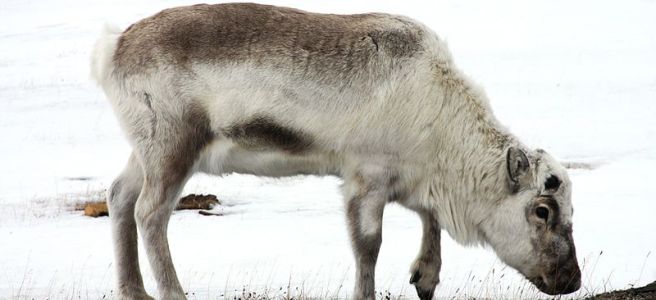
The Great Con by Devon Balwit

The old dog
shuffles stiff,
whiffles

to test
the familiar,
pressing nose

to the meat
of me
before circling

into place
with a whumph
of yielding.

I have fooled
him
and feel bad—

good
in the singular,
but in the aggregate

wiping out
the earth
as he knows it.


Devon Balwit teaches in Portland, OR. She has six chapbooks and two collections out or forthcoming: How the Blessed Travel (Maverick Duck Press); Forms Most Marvelous (dancing girl press); In Front of the Elements (Grey Borders Books), Where You Were Going Never Was (Grey Borders Books); The Bow Must Bear the Brunt (Red Flag Poetry); We are Procession, Seismograph (Nixes Mate Books), Risk Being/ Complicated (with the Canadian artist Lorette C. Luzajic), and Motes at Play in the Halls of Light (Kelsay Books). Her individual poems can be found or are upcoming in Cordite, The Cincinnati Review, The Carolina Quarterly, Fifth Wednesday, The Ekphrastic Review, Red Earth Review, The Fourth River, The Free State Review, Rattle, Posit, and more.
Tender Buttons [A Plate] by Gertrude Stein

A PLATE.

An occasion for a plate, an occasional resource is in buying and how soon does washing enable a selection of the same thing neater. If the party is small a clever song is in order.

Plates and a dinner set of colored china. Pack together a string and enough with it to protect the centre, cause a considerable haste and gather more as it is cooling, collect more trembling and not any even trembling, cause a whole thing to be a church.

A sad size a size that is not sad is blue as every bit of blue is precocious. A kind of green a game in green and nothing flat nothing quite flat and more round, nothing a particular color strangely, nothing breaking the losing of no little piece.

A splendid address a really splendid address is not shown by giving a flower freely, it is not shown by a mark or by wetting.

Cut cut in white, cut in white so lately. Cut more than any other and show it. Show it in the stem and in starting and in evening coming complication.

A lamp is not the only sign of glass. The lamp and the cake are not the only sign of stone. The lamp and the cake and the cover are not the only necessity altogether.

A plan a hearty plan, a compressed disease and no coffee, not even a card or a change to incline each way, a plan that has that excess and that break is the one that shows filling.


(Gertrude Stein, 1874 – 1946. A Plate from Tender Buttons, 1914.)

Darkening, Lightening, Darkening by Trish Saunders

I like the way you sing apocalyptic hymns at sunset.

Maybe I’ll learn that habit. I’ll chant mantras at dusk
the way a Persian soldier drank poison
to ensure his body
couldn’t
be killed by it.

I’ll keep this shoebox, with its hidden pistol
under the bed where you can touch it
for reassurance like a fifth of vodka;
open it when you need it most,

or run into the woods on wakening and
pretend nothing’s wrong.
That never fails–like your hand in my hair
sets it on fire, every time.

There’s a chance too, the day will close quietly,
and the moon will rise over a barn.


Trish Saunders divides her time between Seattle and Honolulu. Her poems are published or forthcoming in Snapping Twig, Gnarled Oak, Busted Dharma, Blast Furnace Press, Off the Coast, Poets and Poetry, and Here/There Poetry.

Solitare by Amy Lowell

When night drifts along the streets of the city,
And sifts down between the uneven roofs,
My mind begins to peek and peer.
It plays at ball in odd, blue Chinese gardens,
And shakes wrought dice-cups in Pagan temples
Amid the broken flutings of white pillars.
It dances with purple and yellow crocuses in its hair,
And its feet shine as they flutter over drenched grasses.
How light and laughing my mind is,
When all the good folk have put out their bedroom candles,
And the city is still.


(Amy Lowell, 1874 – 1925)


Photograph by Pseudopanax.

Soapstone Figure by Nicole Michaels

If her wrists ache, forgive her:
They are freshly chiseled.

If her head rings, maybe it’s the hammer
somebody just laid down.

Others are quick to admire
her newly gaunt shape,

her willowy thighs,
the slope of her nape.

But her waist stings from the rasp,
and it appears she will forever be naked,

no hint of clothing in the scheme,
bare toes clasping a block,

that remnant of her soapy seam.
The sessions are long, and when she’s

left alone under a drape,
she recalls a coppery darkness,

the scrape of shifting plates,
the song of gems, and how she wept with aquifers.

Now her arms seem to be reaching
up for something – she worries

they haven’t finished her face –
wants a good nose –

She believes they will send
birds to perch on her shoulders.

She believes her hands will become bowls.


Nicole Michaels is a Marin County, CA native who makes her home in frontier Wyoming. She is a working poet with a degree in English from Stanford University where she studied under the late Diane Middlebrook and chose an emphasis in feminist studies. She spent some time in the American South as a journalist for small papers.


Nymph with a Scorpion, Lorenzo Bartolini, 1845.

Suzy, the innocent don’t try to escape by Jordan Trethewey

I-75, suburban ‘merica,
not prime geography to relocate
after a Houdini escape
from a circus regime

ask ’87 Cuban nationals
detained in Atlanta state pen
immigration a-no-go

different stripes don’t go unnoticed
or tolerated for long
before police draw weapons ’round here

especially if you disturb
a beloved wiener dog penned outside
with a big Bengali hug


Photograph by CGBGrey.

The Stories We Tell by Holly Day

I feel the wings flutter under my skin as I tell them
about my childhood, about how things were before
I had children of my own. I hint at the type of insect I was
make it more beautiful-I was a butterfly, a damselfly
a fluorescent leaf-hopper, something amazing.

Because they’re my children, I can tell they believe me
that right now, they’re imaging me as
a lime-green lunar moth, wing soft as down
not the chitinous beetle I really was
brown and dull and unimportant,
scuttling from one crack to the next.


Holly Day has taught writing classes at the Loft Literary Center in Minneapolis, Minnesota, since 2000. Her poetry has recently appeared in Tampa Review, SLAB, and Gargoyle, and her published books include Walking Twin Cities, Music Theory for Dummies, and Ugly Girl.


Photograph by Wren Tuatha, Spoutwood Faerie Festival, Glen Rock, PA. 

A Gen Xer and a Millennial Speak of the End of the World by Anthony DiPietro

When you’ve just finished reading apocalypse
novels and your slightly younger boyfriend’s
addicted to climate change
articles and you have faith that what’s
coming, whether zombie virus, H1N1,
solar flare—whatever happens first
doesn’t matter—you’d rather imagine
what kind of wagon you’ll escape on,
you and your love, when that late afternoon
light disturbs some future morning—
but he says phytoplankton have begun
to smother like goldfish, gasping
on kitchen counters and coral reef
will soon be museum relics, nothing else
and he argues whether Bernie
can still win—you interrupt
to list a few artful approaches
you’ve seen in the literature, but then
the razor in his voice when he says
I’ll stop talking, I’ll just listen, between gritted teeth,
firmly as if you’ve raised a fist.
Then you find your lip quivers
with the tension of a dam, and did I mention
you are riding the Red Line when the crying
starts—you both get out at Harvard Square, the acrid
summer garbage smell welcomes you but isn’t
what’s stinging your eyes that now drizzle
like the Cake Ace on Food Network
and he apologizes, Honey, honey,
honey, for the nothing wrong he did,
and by the time you get to Elephant & Castle
you don’t feel like eating—the host
who seats you didn’t want to come to work
tonight, and your weeping
doesn’t help, and everyone in the restaurant
wonders if your date attacked you
or if your parents have cancer—so you go
to the basement, find a urinal, still leaking
from your eyes, and stare at a poster of red
double-decker buses in London, and that should cheer
you up, and you start talking
to yourself in a British accent
because sometimes you don’t have a bloody clue
why the fuck you’re crying.

Anthony DiPietro is a Rhode Island native who worked for 12 years in community-based organizations that addressed issues such as violence, abuse, and income inequality. In 2016, he moved to New York to join Stony Brook University as a candidate for a creative writing MFA and now teaches undergraduate courses. A graduate of Brown University with honors in creative writing, his poems have appeared or are forthcoming in The American Journal of Poetry, Anomaly, Assaracus, The Good Men Project, Helen, Rogue Agent, The Southampton Review, Talking River, and The Woman Inc. His website is AnthonyWriter.com.

Breathable Air by Tracy Mitchell

To buy or sell water
was a preposterous thought
and somehow time accordioned
down its own found spaces like
a lost cutworm. Fuck the cocoon,
what I would give again
for night and space
and dew.


(First published in Poetry Circle.)


Tracy Mitchell is a newly retired native Minnesotan, recently relocated to the splendor of Colorado. His free verse writing is largely inspired by the vagaries of this frail and transitory life. Fair game subject matter includes nature, ourselves, and each other. His best work has been imagined by the campfire in a clearing somewhere near sleep. He is a contributing member of Poetry Society of Colorado, MyWritersCircle, Writers Among Us, Poetry Circle, and PigPen Poetry Forum. His work has appeared in Lake Region Review, and the poetry anthology As the Kettle Wolf-Whistled.


Photograph by ep.Sos.de.

Escape by Elinor Wylie

When foxes eat the last gold grape,
And the last white antelope is killed,
I shall stop fighting and escape
Into a little house I’ll build.

But first I’ll shrink to fairy size,
With a whisper no one understands,
Making blind moons of all your eyes,
And muddy roads of all your hands.

And you may grope for me in vain
In hollows under the mangrove root,
Or where, in apple-scented rain,
The silver wasp-nests hang like fruit.

(Elinor Wylie, 1885-1928.)

White Paper Poetree by Wren Tuatha

The paper this is written on holds
experiences. You never think
to ask. The trees, the centuries,
the violence. Ripping and bleach. Slaves
and workers who don’t know ease.

Flipping ocean waves and seeping petrol.

White and cleansed with poetry
so tidy and ordered the world
could never be raw.

All paper is mute, only crackling in hand,
the way of bowing pulp pines smacked
by atmosphere. The ink lets through
certain stories and some news.
And under our objects, pretty paper,
plastic and cotton, work slaves
we don’t see.


Previously published in Five:2:One Magazine.

Illustration: “The Road to Dividends,” artist unknown. 


Wren Tuatha (Califragile Editor). Wren’s poetry has appeared or is upcoming in The Cafe Review, Canary, Poetry Pacific, Peacock Journal, Coachella Review, Arsenic Lobster, Baltimore Review, Pirene’s Fountain, Loch Raven Review, Clover, Lavender Review, Autumn Sky Poetry Daily, and Bangalore Review. She’s also an editor at PoetryCircle.com. Wren and her partner, author/activist C.T. Lawrence Butler, herd skeptical goats on a mountain in California.

Fragments of a Reproductive Species by Tim J. Brennan

Trails of space trash, bits
of rock ice, maybe

a whisper of God’s voice—
comet debris, grains

of sand. Everyone who loves
has a problem;

life depends
on elegant patterns:

moonshine & cricket bone,
extinction & certain birds

flying in loop migration who stop
to replenish; seasonal nought

in wind aids flight of fancy,
and all kaleidoscopes

depend on pixels.
It may be as easy as rolling

the eyes or pointing.
Freedom of choice

is often in err by the curve
of a dactyl.


Tim J Brennan’s poetry can be found in many nice places including The Bitchin’ Kitch, Green Blade, Talking Stick, The Lake (U.K.), KAXE public radio, UpNorth, and Volume One. Brennan’s one act plays have played across the country including stages in Milwaukee, Colorado Springs, Gulf Shores, Rochester, & White Bear Lake Lake & Spring Valley MN, and most recently in Ypsilanti, MI.


Photograph by Yellowstone National Park.

Three Poems by John Grey

Waiting Room Reading

I’m reading a six month old
Sports Illustrated.
I know the coach
they’re glorifying
is fired by September,
the great running back hope
busts his ankle in the
third game of the season.
My symptoms are
flicking through page after page
looking for the one
low light in some athlete’s life
that they know turns into
a feel good story.
But there’s no cure here.
So I pick up a year old Business Week
whose headline promises
better days ahead.
We all know how that turned out.
I’m trying to be optimistic for the future
by seeing how the past did it.
But days gone by
never do get good at
predicting how it all comes out.
“The doctor will see you now.”
the nurse says.
Well at least he won’t be
seeing me back then.


My Checkup

It’s not the light
promenading down my heart
or my words read sideways

but EKG, X-ray; urine sample,
rubber-fingered rectal exam.
None of the invisible shock

waves of the head but reflex
test, lung-capacity graph,
and blood sucked up into a needle.

No one’s powdering my soul
for prints or running biopsies
on each reminiscence.

They’re telling me I’m
fine for what I am, the latest
way to tell me nothing.


Dear Brain Surgeon

So the brain is cut wide open.
Tell me doc, what do you see in there?
Any clue as to who I am?
Anything in there that doesn’t need
a functioning body to represent me,
that can pulse on forever
like that Energizer bunny?

My head gave way to your scalpel.
Even that pudding-like organ
of neurons and axons and dendrites
is putty in your surgeon’s hands.
But what of the spiritual core?
Is there anything left
when you run out of Latin names?
A soul?
An object so deeply embedded
that even you, with all your skills,
can’t go there?

Of course, you’re not
messing about in my cerebellum
to verify my suitability for the hereafter.
It’s that tumor that has your attention.
A vengeful God doesn’t come into your equation.
But a malignant or benign lump does.

And then hours alter
you’ve put me back together,
given me the all-clear,
I awake to a chorus
of “It’s a miracle!”
My parents, my siblings, my lover –
but not you.
Not someone who really knows me.


John Grey is an Australian poet, US resident. Recently published in Examined Life Journal, Studio One and Columbia Review with work upcoming in Leading Edge, Poetry East and Midwest Quarterly.

Two Months After Hurricane Maria by Sergio A. Ortiz

1.
And the world disagreed with its own blood.
The wind blew away sanity and today
we pull against the riptide.

Time and space, wooden shacks, flew
in an unknown direction and love lied
on the image of a moon tired of unfaithful
lovers.

2.
Night undressed, and all could see
her nakedness. She stopped weeping
and wailing over lost paths to rescue
what was left of her pride, seaports, airspace,
enslaved hearts, and raised fist
without knowing the shackles were so heavy
that even her silence had toppled.

3.
If I were to expand to the point of bursting
into thousands of pieces, if my suffering
should ever reach that level
do not sanction my heart or my body
do not let me escape into nothingness
like an insignificant hot gas.

4.
Toilet paper or disposable towels…
insensitive son of a bitch— do we really need
to kiss your presidential ass?

can we afford another one hundred and nineteen
years of insults, grave diggings,
war deaths and stupidity?


Sergio A. Ortiz (Califragile Feature Poet, September, 2017) is a two-time Pushcart nominee, a six-time Best of the Web nominee, and 2016/17 Best of the Net nominee. His poems have appeared or are forthcoming in Valparaiso Poetry Review, Loch Raven Review, Drunk Monkeys, Algebra Of Owls, Free State Review, and The Paragon Journal. His chapbook, An Animal Resembling Desire, will be published by Finishing Line Press. He is currently working on his first full-length collection of poems, Elephant Graveyard.

#MeToo: My Doll Janie by Lola Ridge

My doll Janie has no waist
and her body is like a tub with feet on it.
Sometimes I beat her
but I always kiss her afterwards.
When I have kissed all the paint off her body
I shall tie a ribbon about it
so she shan’t look shabby.
But it must be blue –
it mustn’t be pink –
pink shows the dirt on her face
that won’t wash off.

I beat Janie
and beat her…
but still she smiled…
so I scratched her between the eyes with a pin.
Now she doesn’t love me any more…
she scowls… and scowls…
though I’ve begged her to forgive me
and poured sugar in the hole at the back of her head.

— excerpt from Sun-Up and Other Poems

(Lola Ridge, 1873-1941.)

Trans* by Mary Meriam

An Ekphrastic poem inspired by Metamorphosis 2, by Thomas Terceira.

Kitty is my monument to selfhood.
Drown me now, sailor.
Fir fir fir fir, o little white blossom, save me.
I told them Love poems have no pronouns in newsprint.
She misses her mother, had a few surgeries.
Now these wings on my back and a mustache.
Now she’s telling me her dreams and nightmares.
Just get off my back, this is my map.
Sleepy, erudite, easy, ooooo, bat legs, foxy.
It shares a language, it speaks for the self
and for more than the self; it speaks for the culture.
No way will I have a birded head or be suppressed,
restricted, criminalized.
“And that night, they were not divided.”
The poem serves as a substitute culture
with towns and cities of selfhood.
Then she starts blooming into a striped wallflower.
No one could look at the brown blind little creature.
Gertrude, what is trust? A haphazard dynamic.
Take this red road to Rahway. You will find the sticks.
The sticks will be bats. Toss them into the sea or hit homers.
The tiny, starving, thirsty, trampled plant is trust.
Trust is a mother holding her infant.
We learn the extent of our comfort in her arms.


First published in Ekphrastic Review.


Mary Meriam is the founder of Lavender Review, cofounder of Headmistress Press, editor of Irresistible Sonnets, and author of The Lillian Trilogy. Her poems have been published by The New York Times, the Poetry Foundation, Oxford University Press, National Public Radio, Penguin Random House, University Press of New England, Seal Press, and many literary journals.

A Lady by Amy Lowell

You are beautiful and faded,
Like an old opera tune
Played upon a harpsichord;
Or like the sun-flooded silks
Of an eighteenth-century boudoir. In your eyes
Smoulder the fallen roses of outlived minutes,
And the perfume of your soul
Is vague and suffusing,
With the pungence of sealed spice-jars.
Your half-tones delight me,
And I grow mad with gazing
At your blent colors.
My vigor is a new-minted penny,
Which I cast at your feet.
Gather it up from the dust
That its sparkle may amuse you.


(Amy Lowell, 1874-1925.)


Photo of Amy Lowell c. 1916 by Bachrach. 

Identification In Belfast By Robert Lowell

(I.R.A. Bombing)

The British Army now carries two rifles,
one with rubber rabbit-pellets for children,
the other’s of course for the Provisionals….
‘When they first showed me the boy, I thought oh good,
it’s not him because he’s blonde
I imagine his hair was singed dark by the bomb.
He had nothing on him to identify him,
except this box of joke trick matches;
he liked to have them on him, even at mass.
The police were unhurried and wonderful,
they let me go on trying to strike a match…
I just wouldn’t stop you cling to anything
I couldn’t believe I couldn’t light one match
only joke matches… Then I knew he was Richard.’


(Robert Lowell 1917-1977.)

Wolf 1061 By David Rodriguez

At about 2.5 ft/sec, a
body in the Loop Current
will disappear posthaste.

Our planet is pitiless,
the nearest goldilocks
14 light years away,

only 4 times the mass
of earth and rocky,
with 18 day orbits.

Perhaps life has existed
near Wolf 1061
the decade we’ve watched,

and bodies warm
in a gulf stream
like Southerners here,

2 weeks to decompose,
8-12 years to finish…
But perhaps not. I can

imagine that world
still unwilling to
loop to death, still pristine.

The chance is as
real and as fun
as the skeletons inside us.


David Rodriguez is a writer and teacher based in New Orleans with an MFA from Florida State University. He has previously been published in the New Orleans Review, The Southeast Review, The Sandy River Review, Hawai’i Review, and Jarfly, among other places.

Two Poems by Marta Shaffer

Carcasses

We are hibernating, but it’s not winter.
We are in the middle of the lake,
but we are not swimming.
We’ve made an island of a canoe.
I brought berries, nuts and plums
and you brought beer, and some poems
that I wrote. Staring out into the woods,
I wonder how many mountain lions are prowling,
scraping their huge paws against bird carcasses
on the ground. They don’t eat dead animals,
you correct me. And they’re nocturnal.
And I point out that we’re not swimming,
but we’re still in the middle of the lake.


First published in the collaborative chapbook, Five by Five. 

 
Imbalance

The pills aren’t for me: they’re for
the man who lives in my stomach,
who is hoisting up my spine with a stick
upon which he is trying to balance
the spinning plate in my head. It wobbles
like a warped record on a player.
The man’s neck hurts from always
looking up at the bottom of the plate.
The pills are to ensure he does not lose his
job.


Marta Shaffer is completing her MA in English at California State University, Chico, where she received first place in the poetry category for the 2015 Intro Journals Project Award. She has worked as a student co-editor/poetry slush pile reader for Watershed Review. She was the winner of the haiku contest judged by Kazim Ali at the Wordspring Writing Conference in 2014. Marta has upcoming work appearing in the fall issue of The Finger, and was also a Chico News & Review finalist in the 2015 Poetry 99 contest. She cannot roll her tongue. She hails from Minnesota.


Photograph of a mountain lion in Grand Teton National Park (not at night) courtesy of the National Park Service. 

Three Poems by Rishitha Shetty

Why we speak

My grandmother’s song
grows in fields, where
joy is trapped
in the clap of tongues,
grief twirls between teeth,
and silence is sculpted with
fractured pause.
She sings of words dressed in ink,
drying in the folds of wrinkled spring.
To save them is to
frame them in speech.

Ripples

come from fists
breaking open skin
of stagnant ponds,
cut banana slices in milk,
light kissing folded pages of poetry,
apologies churned out of
stuttering lips,
and in the heel of wise old women
standing over history,
with wind parting their hair.

God of half hill

God-
of half hill.
The other half for
storm goddess, that wily bitch-
he was a sword wielder,
would find stolen gold
from the ear of corn,
spit in faces
Of bystanders.
She chewed,
mouth open-
stepped on his toe
when he stretched.

God –
Striped of fury-
for fury belonged to the storm,
and him, the half hill.

God-
bathed in silver light-
storm goddess pulls snakes
out of her nostril
skin, lilac of
evening oceans-
untouched by spite.


Rishitha Shetty lives in Bangalore, India. She has been previously published in Spark, The Indian Review, The literary yard and The Quail Bell Magazine. She is a member of Bangalore Writers Workshop.


Photograph by Flowcomm.

A Desperate Season by Devon Balwit

Leaves flare
a loosening
of petioles,

a foot-shuffling
rustle
of rain-sticks.

Squash smirk,
lopsided,
match-hungry.

The days fold
ever smaller—
messages

held beneath
the tongue
and passed

through barbed wire
to the hands
of sympathizers.


Devon Balwit teaches in Portland, OR. She has six chapbooks and two collections out or forthcoming: How the Blessed Travel (Maverick Duck Press); Forms Most Marvelous (dancing girl press); In Front of the Elements (Grey Borders Books), Where You Were Going Never Was (Grey Borders Books); The Bow Must Bear the Brunt (Red Flag Poetry); We are Procession, Seismograph (Nixes Mate Books), Risk Being/ Complicated (with the Canadian artist Lorette C. Luzajic), and Motes at Play in the Halls of Light (Kelsay Books). Her individual poems can be found or are upcoming in Cordite, The Cincinnati Review, The Carolina Quarterly, Fifth Wednesday, The Ekphrastic Review, Red Earth Review, The Fourth River, The Free State Review, Rattle, Posit, and more.


Original photograph by Khlim28. 

Two Poems by Mark J. Mitchell

Pacific Heights

The man saw fog
swallowing the top
of every building
that made up downtown.

He walked up
the long hill
and looked back—
A city in eiderdown.

Feeling a lack
of city, missing buildings,
he closed a tiny door
on the gift-wrapped town.

Somewhere he knows fog
will melt and soft-topped
monuments will show up.
The sky goes from gray to black.

fog two

A Secret Craft

The only time to tune foghorns
is when you can’t see them, when mist
will lick fingers and lashes form
prisms, breaking light. You exist—
a shadow cast by foreign storms—
your ears cold but soft as the fist
that taps this bell up. That one lists
to starboard—twist it hard a-port—
the only way. The tunes foghorns
sing can’t be seen, just felt through mist.


Mark J. Mitchell’s latest novel, The Magic War just appeared from Loose Leaves Publishing. He studied writing at UC Santa Cruz under Raymond Carver and George Hitchcock. His work has appeared in the several anthologies and hundreds of periodicals. Three of his chapbooks— Three Visitors, Lent, 1999, and Artifacts and Relics—and the novel, Knight Prisoner are available through Amazon and Barnes and Noble.. He lives with his wife Joan Juster and makes a living pointing out pretty things in San Francisco.

How to Become an Artist by Anthony DiPietro

a river in chaos. brave existence. sudden
roads. kidneys in chaos. sleep, sleep. a mother—
she is everyone’s mother. when you wake, you remember.

a bridge crumbles of its own will. then
it is no bridge. ask the tumbling river, what
shall I say? sleep. place at the ocean floor

the name you give yourself but never
speak. reserve the right to grasp for it
tomorrow. a child dies at noon. you must sit

with faith. you must sit with a genuine loss
of faith. this is not something you can fake.
become a child with no understanding. death

comes to your door in triumph & soon.
rivers continue to carve. if you let
your enemies freeze then you too must be consumed

with uncertainty. fill your goblet again & drink.
you will sit in a hollow valley. feel your strong
lungs open up. you will feel mud

fill those lungs. if so, tell only lies.
give me something to make me sleep. give me
something to burn the barn, destroy pink flesh.


Anthony DiPietro is a Rhode Island native who worked for 12 years in community-based organizations that addressed issues such as violence, abuse, and income inequality. In 2016, he moved to New York to join Stony Brook University as a candidate for a creative writing MFA and now teaches undergraduate courses. A graduate of Brown University with honors in creative writing, his poems have appeared or are forthcoming in The American Journal of Poetry, Anomaly, Assaracus, The Good Men Project, Helen, Rogue Agent, The Southampton Review, Talking River, and The Woman Inc. His website is AnthonyWriter.com.

Image: Junction of the Yukon and Koyukuk Rivers, Alaska, August, 1941. USGS. 

Attack of the Fanatics by Mary Meriam

Detail of Sappho Leaping into the Sea, by Theodore Chasseriau, 1840.

Breathe, darling, breathe. I cannot
for the life of me patch the ocean.
Ghetto on the fraught sea, blinding.
Did they question the men also?
Or did they only question the women?
The lesbians are policing the lesbians.
Who are you? How do you define yourself?
I list weakly as the interrogators
peer through my telescope backwards.
I am all adrift in the spring fog, trembling.
Port to starboard, keel to mast, mainstay,
my sails a-shiver in the salt-stained waves,
I am unknown to myself, with only a word
my sisters found on Lésvos and gave me.


First published in The Gay & Lesbian Review.


Mary Meriam is the founder of Lavender Review, cofounder of Headmistress Press, editor of Irresistible Sonnets, and author of The Lillian Trilogy. Her poems have been published by The New York Times, the Poetry Foundation, Oxford University Press, National Public Radio, Penguin Random House, University Press of New England, Seal Press, and many literary journals.

Everyday Disciples by Monique Gagnon German

Sometimes you see one in traffic,

a Samaritan in a Mazda parting

the sea of angry commuters

so you can finally get in.

Sometimes it’s a guy in the street

who gets a hundred bucks

and immediately spends it on a feast

for other homeless people around him.

Sometimes it’s a dog who sobs

and leaps with joy

when his owner returns

from hospital or war.

Sometimes they pop up, bobbers

on the murky stream of your day:

a smile in a hallway, a genuine question,

“How are you, really?”

Some disciples hide in words,

in gratitude, in every thank you said

but also in the middle finger

of the pissed off driver behind you now,

the one behind the guy that waved you in.

We can hear them in all the voices

that criticize and approve

every failure and win. The rub: we

are their witnesses. Our job: to recognize them.

How we react is just a stone cast into a pond,

an addend in an ongoing equation in signs.

Maybe our responses are disciples too;

watch them ripple and roll over time, trying

to gain momentum, trying to sculpt our shoreline.


Monique Gagnon German is a graduate of Northeastern and Northern Arizona Universities. She is a wife, mother, a former Copy Editor of Ragazine(www.ragazine.cc), and former Technical Writer for a laser manufacturer in San Diego, CA. Currently, Monique works as a Content Developer and document QA Specialist for a small veteran owned company in TX while continuing to write poetry and stories in CO. Her poems have appeared in over 30 journals/anthologies including Rosebud, California Quarterly, Tampa Review, Off the Coast, and The Wayfarer. Her micro-flash, flash, and short stories have been featured in Kalliope, A Journal of Women’s Literature & Art, The MacGuffin, and Adelaide Literary Review. In October 2017, she was nominated for a Pushcart Prize for poetry so she is actively crossing her fingers as you read this. Website for Monique: http://www.moniquegagnongerman-com.webs.com/


Photograph by Ikiwaner,  Lausen, Gombe Stream National Park

Looking Away at Lambert Airport by Beth Gordon

Female twins, black-haired, arm in arm, like blind newborn
werewolves, identically addicted to meth,
disembark the plane
in St. Louis, walk into our square of terminal, so craven in eye
and mouth that we collectively believe
that when the moon
blocked our planet’s star for 160 seconds, fur began to sprout
between their talons, behind their knees,
spreading like poisonous
mushrooms, only to recede when cicadas stopped singing, when
sparrows fell from trees like petrified
bones, more arachnid
than mammal, they twist their cracked lips into utterings that only
the other twin can decipher,
and then only with
the aid of potions brewed from fresh anteater blood. Unmoved
by visible magic, we return one-by one
to our screens, like sedated
vultures waiting for someone to die in front of us, bubonic plague,
rabies, salmonella, something
riddled with bullets
and primary colors that we can photograph and share with our high
school classmates whose skin we
haven’t touched
in years or our online food-addiction support group as we browse
through 81 recipes for heavenly hash,
while eclipse stragglers
with souvenir tattoos and mildly damaged retinas scream obscenities
at their precocious children
who are using a gift
shop magnifying glass to aim the sun’s holy rays onto unattended
babies to see if they will
burst into ash.


Beth Gordon is a writer who has been landlocked in St. Louis, Missouri for 16 years but dreams of oceans, daily. Her work has recently appeared in Into the Void, Quail Bell,Calamus Journal, By&By, Five:2:One, Barzakh, and others. She can be found on Twitter @bethgordonpoet.

Five Poems by Barbara Henning

Mar 27, 2016

—rows of rear windows—pricey tenements—raindrops on shrubs—drips gliding off the fire escape—“Look!” says a boy on tv—“Real water!”—a dictator waves his hand—never would I—tarnish my own name—a silver necklace over Ganesh’s nose—I rub it shiny—a volcano in Alaska—a cloud of ash—more than seven miles upward—in Kansas—their house now a pile of bricks and ash—this locket—between my mother’s face—and my own toddler smile—his ashes won’t stay put—some on the table—my fingers grainy with a body—like fingernails—on the ground a clutter of acorn shells—the dream—like an albatross—pulling me into the pillow—

Aug 4, 2016

—the sun’s hot—a cool breeze off Lake superior—a path along the shore—peddling behind a woman—on a turquoise upright bike—a polluted sky—does not have—the advantage—of producing these atmospheric colors—a cuticle brittle and dull—every drop of water—hangs from a twig—sunflowers follow—the rising sun—up, over and westward—as I pass the turquoise bike—“I’m going slightly faster than you, dear”—by law—many mothers—are unable to pass on—their citizenship to their children—but for fathers—a different story—when a pass is made—four defenders charge—from the net—trying to block—the oncoming shot—a year later—a committee of American men—will meet to decide—the rights of women—the woman on the turquoise bike laughs—“Thanks,” she says, for letting me know—”

Jan 12, 2017

—damp and unseasonably warm—fast walking—an unscheduled bus—run back and hold my hands in prayer—he reopens!—zoom no traffic—Union Square Station—escalator broken—a woman with baby buggy—standing at the stairs—young man on cell phone—drooping pants—could you help her?—he looks at me—with scorn—then at her—she’s black—ok he takes her stroller down—over shoulder—he snarls at me—the way—throughout time—we have slaughtered each other—each death a negative charge of unbearable loss—through the human community—anger and retaliation—why then–do we believe—in so much possibility?—man begging on Dekalb—I give a dollar—as if—I’m doing something—stop and talk with Lewis—story about 1974—this and that anthology—a student said the NY School was sexist—I say all men are sexist—to some degree—subway to the village—a midrange buzz, distant whistle, relentless throb—

Mar 20, 2017

—even with banks of icy snow—alternate side parking—inside my radio ear— Russian hacking—with tiny hands—and a tiny brain—like the tyrannosaurs—ha ha—the bully had to develop something—an ability to lie and deny—even when myths are dispelled—their effects linger—it’s possible to hack into a phone—or a car—with only sound waves—tiny accelerometers—under the scholar’s trees—open an envelope—rent increase $200.00—google mania—first floor, no fee, rent stabilized—Brooklyn studio—quiet, tree-lined—a commuter—but I like living here—come on, Barbara—says the landlord—when you get older, you should move—we will never give you—a rent stabilized apartment—a commodity—a troublemaker brainiac—Tony Conrad—crooks his finger—come here—I’m gonna wreck your brain—a crack—in the cave—with ulnar nerve repaired—DeGrom’s back on the mound—a 97 miles per hour fastball—

Apr 28, 2017

— on Houston—a garden—with young people—smoking and snapping—an ex-coal worker—can’t breathe—wants his job back—coal ash arsenic mercury lead—in landfills and bodies of water—between Saturn and its innermost ring—the patter of a summer squall—then a drifting tone—in the branches—of a giant elm—the baby and me—fading—into flickering leaves—a Himalyan crevasse—the rock climber falls—he keeps climbing—into the subway station—a young woman—with two little ones in tow—talking on her cell—to hold a fossil—to clutch a fragment—thirty-five years—in this same spot—with Né and Mook—it’s raining today—and the baby is a man now—he drills a hole—in the ceiling—of my new apartment—for a plant—the leaves spilling over the pot—


Editor’s Note: These poems are part of Barbara Henning‘s in-progress series entitled DIGIGRAMS. Her digigrams have been published recently in Recluse, Chill and Rascal; others are forthcoming in the Brooklyn Rail, Downtown Brooklyn, Live Mag! and Local Knowledge. Another five of Henning’s digigrams, curated by Wren, will appear soon in PoetryCircle.


Barbara Henning is the author of several collections of poetry, her most recent A Day Like Today (Negative Capability Press 2015). Other recents include A Swift Passage (Quale Press), Cities and Memory (Chax Press) and a collection of object-sonnets, My Autobiography (United Artists). She has published three novels, Thirty Miles to Rosebud, You Me and the Insects andBlack Lace, and she is the editor of Looking Up Harryette Mullen and The Collected Prose of Bobbie Louise Hawkins. Born in Detroit, Barbara lives in Brooklyn and teaches for Long Island University, as well as writers.com. http://barbarahenning.com


Original photograph by Michah Saperstein.

Zelda by Sneha Subramanian Kanta

“She refused to be bored chiefly because she wasn’t boring.”

― Zelda Fitzgerald

Zelda, unbeknownst sister of Ozymandias
accompany me to where the sun rises
east of Bhagdad, west of Byzantium

let us make our spot for pilgrimage there.
Rub fertile mud on our skin whilst
the approving sun shines –

I, your brown sister, will bring you tales
from the other side of the Mississippi
you tell me about the Americas

you have seen in one country.
To speak of roots and corkscrews,
bottles and potions, we will read

Rumi to find out how much the heart
can hold. Beyond the yellowing
sand dunes, let us recall the last bird

who sang in the middle of a desert.
What shall we plant here, in the middle
of a heatstroke land – cacti, seeds of

wild blueflowers, or do we bury
carols for Christmas?


Sneha Subramanian Kanta is often seen tracing manufacturing of sensibility from the eighteenth century to present day notions of psychology, She pays close attention to concentrated molecules in a jar. Her poetry is forthcoming in Eunoia Review and Across the Margin, and fiction in Indiana Voice Reviewand elsewhere. She is general advisor and poetry editor for her university journal, INK. An awardee of the prestigious GREAT scholarship, she has a second postgraduate degree in literature from England. She is the cofounder of Parentheses Journal, a literary initiative that straddles hybrid identities across coasts and climes.

Things to Tell Your Ghost By Vicki Iorio

I need to tell you I still want to pop that blackhead on your back-
the one you wouldn’t let me squeeze
even after sex ever after.

I shiver when I think of your skin
melting in the crematorium-
did that pimple explode or did it
shrivel like your dick
when you decided I was too ugly to fuck?

I need to tell you that your lawyer won’t let us die,
the legal papers shape shift into you
while waiting to get notarized.

I need to tell you that here, on the beach,
your ghost is a trick of sun glare,
sea birds pick at your eyes every time the tide comes in.

The bartender who is now my boyfriend
sweaters me in whiskey when he sees your name
appear out of nowhere on my arm.

I need you to stay dead.
Skip Halloween.

I need you to stop haunting my love life.
Do we need to discuss this over coffee at Starbucks?

I know you poltergeisted my bathroom mirror-
a shattered mess on the tiled floor,
my feet bleed every morning when I brush my teeth.

I know you unscrewed my light bulbs
and hid them under my pillow.

I need you to know I am no longer afraid of the dark,
you’ve lost your incandescence.


Vicki Iorio is the author of the poetry collection, Poems from the Dirty Couch, Local Gems Press, 2013 and the chapbook, Send me a Letter, dancinggirlpress. You can read Iorio’s work in Hell Strung and Crooked, I Let Go of the Stars, (Great Weather for Media), The Brownstone Poets Anthology, The San Pedro Review, The Mom Egg, Crack the Spine, The Painted Bride Quarterly, The Fem Lit Magazine, Redheaded Stepchild Magazine, The Paper Street Journal, Poetry Bay, Home Planet News,Concise, Cactus Heart, Rattle on line, South Florida Poetry Journal, Five:2:One Magazine, RatsAss Review, New York Times, Poetry Super Highway, Eratio Poetry Journal, In Between Hangovers, Conches, Anti Heroin Chic,  and Misfit.


Photograph by Lidija296.

Sky Chronicles by Monique Gagnon German

I’ve got blues
that surpass navy,
cerulean, sapphire,
cornflower, turquoise,
iridescent, eggshell
and cobalt, baby.
I know loneliness,
the length of days
and nights as they move
through me,
molecule by molecule
cataloguing the sun’s face
while it flirts
with the moon
in broad day
and I examine you
with tips of space,
tendrils upon
your trees,
chimneys,
sidewalks,
freeways,
unable to feel anything
but shapes,
blowing on you
like candles
like dandelion fodder
without wishes
for your sake.
So, don’t look
to me for answers
about the track
the ballgame
your love life
your suffering.
And when you climb
to get above me,
expect me to slap
your face.
I am best,
above your head
out the window,
picturesque
split by clouds
birds, storms,
shuttles and airplanes.
So, keep me there
at that distance
that inspires science
and faith but away
from birthday wishes
demands and property deeds.
You can’t see, can’t reach,
can’t know me,
the keeper
of the smooth
blue notes
that conduct
your weather or fate
as you stroll along
day upon day
beneath the eyes
of giant hurricanes.


Monique Gagnon German is a graduate of Northeastern and Northern Arizona Universities. She is a wife, mother, a former Copy Editor of Ragazine (www.ragazine.cc), and former Technical Writer for a laser manufacturer in San Diego, CA. Currently, Monique works as a Content Developer and document QA Specialist for a small veteran owned company in TX while continuing to write poetry and stories in CO. Her poems have appeared in over 30 journals/anthologies including Rosebud, California Quarterly, Tampa Review, Off the Coast, and The Wayfarer. Her micro-flash, flash, and short stories have been featured in Kalliope, A Journal of Women’s Literature & Art, The MacGuffin, and Adelaide Literary Review. In October 2017, she was nominated for a Pushcart Prize for poetry so she is actively crossing her fingers as you read this. Website for Monique: http://www.moniquegagnongerman-com.webs.com/


Art: Starry Night, Vincent VanGogh

College Park by Margaret Young

Front yards lacked sidewalks and curbs,
backyards flowed together with no boundary
marks but stripes in grass from lawnmowers dads rode,
and looming shrubs to hide under
and sycamore and black walnut
shedding their furry or smelly fruits
so we all ran everywhere except
Miss Howe’s, her Dalmatian
Pepper chained to the garage.

Breakfast was orange juice we squeezed
half-thawed and glistening from cardboard tubes
(add three of water, stir with the longest spoon)
and cereal poured from boxes with toys inside
and once a Jackson Five record right on
the box, we cut out the disk with them
smiling in candy-bright jumpsuits,
played high-voiced songs on the turntable
pulled from its shadowed cabinet,
the smell of Sugar Smacks mixed in.


Margaret Young’s poetry collections are Willow From the Willow (Cleveland State University Poetry Center, 2002) and Almond Town (Bright Hill Press, 2011), plus a chapbook Blight Summer just out from Finishing Line Press. She is translating the work of Sergio Inestrosa (Mexico) and Débora Benacot (Argentina). Young is on the faculty of the Global Center for Advanced Studies and Endicott College in Beverly, Massachusetts.

Those Two Spiders Died Loving Each Other by Anthony DiPietro

The poets go to bed like nuns to their cells: narrow rooms in the boarding school dorm: some, like me, awake, playing with sediment left after workshop: suddenly through the deep-woods facing window: a primal scream: a man’s: then deep shrieks of pain: like an animal’s: poets scatter to the four directions: then return to the middle: I join them: tell them Nathan’s missing: my dorm-mate: he’s gone to stalk the dark before: to feel damp dirt on his feet: to wound wind with a frightened face: he went at sunset while we sat for the reading: we listened: the voice of an eight-year-old girl: her innocence stolen by the neighbor-boy: listened: the song of a countertenor nuzzled in the hollow left by a lover: dead of a vicious disease: that first night, Nathan and I took turns asking each other questions: What was your worst sex: Give me grotesque: nastier than politics: Who on this flailing blue orb are you closest to: he’s thirteen years younger: we spoke of my fear of thirteen: Judas phobia: he draws Tarot cards each morning: today, for me, the Empress: tonight small schools of poets shine flashlights: murmur his name: Nathan creeps in shadow: now emerges to his bed: arms crossed over his chest like a saint in the making: he assures the seminar director he’s found a stay for what caused the scream: I won’t hurt myself again tonight: we agree I’ll keep watch: alone again, Nathan and I declare the light too brutal: Why don’t we remove some bulbs: we climb two chairs: unscrew the platter-like fixture: inside, a spider the size of my thumbnail entombed: only Nathan looks closer to count: sixteen legs, copulation: and he says: Those two spiders died loving each other.


Anthony DiPietro is a Rhode Island native who worked for 12 years in community-based organizations that addressed issues such as violence, abuse, and income inequality. In 2016, he moved to New York to join Stony Brook University as a candidate for a creative writing MFA and now teaches undergraduate courses. A graduate of Brown University with honors in creative writing, his poems have appeared or are forthcoming in The American Journal of Poetry, Anomaly, Assaracus, The Good Men Project, Helen, Rogue Agent, The Southampton Review, Talking River, and The Woman Inc. His website is AnthonyWriter.com.

Image by Comfreak. 

While Jean Doesn’t Write by Wren Tuatha

While Jean doesn’t write, seditious phrases make their escape
to parallel dimensions where mothman aliens hunt and gather them,
eat them silently and then look through at us knowingly.
This phenomenon is entirely Jean’s fault.

While Jean doesn’t write, seventeen wars that we know of continue
like a second day of rain, race relations in America harden
into pre-1970’s pessimism and 2/3 of her neighbors fail to recycle.
Indeed, for every day that Jean doesn’t write,
another Republican actor runs for office.

While Jean doesn’t write, her lifelong friends don’t change.
Her adult children do what they will.


First published in Five:2:One Magazine. 


Wren Tuatha (Califragile Editor). Wren’s poetry has appeared or is upcoming in The Cafe Review, Canary, Poetry Pacific, Peacock Journal, Coachella Review, Arsenic Lobster, Baltimore Review, Pirene’s Fountain, Loch Raven Review, Clover, Lavender Review, Autumn Sky Poetry Daily, and Bangalore Review. She’s also an editor at PoetryCircle.com. Wren and her partner, author/activist C.T. Lawrence Butler, herd skeptical goats on a mountain in California.

Facing West From California’s Shores By Walt Whitman

Facing west, from California’s shores,
Inquiring, tireless, seeking what is yet unfound,
I, a child, very old, over waves, towards the house of maternity, the land of migrations, look afar,
Look off the shores of my Western Sea–the circle almost circled;
For, starting westward from Hindustan, from the vales of Kashmere,
From Asia–from the north–from the God, the sage, and the hero,
From the south–from the flowery peninsulas, and the spice islands;
Long having wander’d since–round the earth having wander’d,
Now I face home again–very pleas’d and joyous;
(But where is what I started for, so long ago?
And why is it yet unfound?)

Three Poems by Catherine McGuire

Catching a Swarm

Despite variations, they all advise:
spray the clump with sugar water
so they can’t fly, then cut or shake
that living burl into your box –
a hive is best, a basket or cardboard box
will do. Get the Queen.
Always the key. You must capture
the heart of the hive, a tiny Persephone
descending to the dark of your desire.
If she’s there, the others – the ones you missed –
will queue up to enter
as the sonneteers flash their butts and wings
in a strange Rockettes-line at the door,
telling the rest of the group:
Come inside. We’re all here.

And experts say don’t worry about stragglers.
Get the clump and move the hive to the proper spot.
They would howl to see me pick up every twitching bee,
from grass or cloth or twig,
sweep or carry each one to the entrance.
No bee left behind.


Persistence

Everything wears at everything else –
breeze rubs pollen, scatters seed; water smooths rock.
The tumbling sands slowly change the coastline.
Even mountains can’t claim eternity.

We carry our edges into the world
and they are rubbed smooth, or raw.

But look! Above my head, a broken, moss-furred twig
balances in holly
the whole summer.


(untitled)

A January fog hangs in the holly –
red berries dot shiny spiked green.
The ice tiaras have slipped down
the limbs, buds unsheathed.
Throughout the sodden garden
calendula, lavender, thyme, kale
huddle in sparse straw. Gophers raid
and favorites vanish – dirt mounds like graves
dot the yard. There is no peace
in the pieces – plans seem audacious,
premature. Seasons unreasonable now –
we have no guide; the past unhelpful.
Where will this new climate lead?
Comfrey and borage, their prickly furred leaves blackened,
will come back as surely as the gophers.
Birds swoop and scavenge as always –
they have no almanac; they do their best.
Below the mulch, slugs curl around their eggs,
the caterpillar army sleeps, unaware
that their ancient targets are stuttering, lulled
by weather as willful as any jihad.
They will wake too late,
or too early; they will hump along strange leaves,
searching for scents and shapes
that define their survival.
And our own.


Catherine McGuire is a writer and artist with a deep concern for our planet’s future. She has three decades of published poetry, four poetry chapbooks and a full-length poetry book, Elegy for the 21st Century (FutureCycle Press). A deindustrial science fiction novel Lifeline was just released by Founders House Publishing. Find her at http://www.cathymcguire.com.


Photograph: Rock Bees, Anamalai Hills, India, by T.R. Shankar Raman. 

Three Poems by Maurice Devitt

Sixteenth of September
after René Magritte

The oak tree marks the mid-point
of my run. There and back.
A collector and dispenser
of breath, branches clustered
like alveoli
against the autumn grey.

The relief of tagging,
turning and not looking back.

I never witness the leaves
parting to reveal a nascent moon,
this mere sliver of a thing,
cradled and fattened with light,
later to be craned
into a meaningless sky.


A View of the Lake

Maybe you came across this poem
in a small journal
you had never read before, encouraged
to pick up a copy by a friend,
whose poem is featured on page 57
and, as you skimmed through the pages
looking for his poem, were struck
by this title, reminded of a place
you used to swim as a child.
Maybe you started to read it,
wondering would it be any good
or would it be one of those modern poems
that don’t seem to make any sense.
I’m so glad I triggered
the memory, though conscious
that no words I would ever write,
could equal that feeling
of you dipping your toes in the water.


Property Bubble

Five years ago I bought this house
and only recently I noticed
that, as the price increased,
the rooms got smaller,
until I found myself stooping
when I stepped through the doorway,
sitting with my knees pressed
up to my chin and watching
television through the kitchen window.
I called a man who knows about
these things, he measured the rooms
with an ever-decreasing tape,
lifted the floorboards to check the pipes,
then declared, You’ve got a leak,
there’s air escaping, nothing
you can’t fix with a basin of soapy water,
just be careful what you tell the neighbours.


Maurice Devitt was runner-up in The Interpreter’s House Poetry Competition in 2017, he was winner of the Trocaire/Poetry Ireland Competition in 2015 and has been placed or shortlisted in many competitions including the Patrick Kavanagh Award, Listowel Collection Competition, Over the Edge New Writer Competition, Cuirt New Writing Award, Cork Literary Review and the Doire Press International Chapbook Competition. He has had poems published in Ireland, England, Scotland, the US, Mexico, Romania, India and Australia, runs the Irish Centre for Poetry Studies site and has a debut collection upcoming in 2018 with Doire Press.


Photograph by Linda Bartlett.

Meeting Tink in a bar in Heaven by Kate Garrett

for Tara

When I sleep, she still exists.

Her face peach-bright
and more than just a pinch of skin.

My friend is a tattooed hologram who hugs
me tight and tells me she’s glad to see me

and how she’s sorry I can’t be a bridesmaid
as her wedding won’t be going ahead.

I won’t tell her when she left he changed his mind.
Most people do, when you go the way she did.

And she says she can’t wait for my wedding,
her corset is laced and her boots are shined.

She’s bringing her favourite lover, a leather-and-tartan
skirted sprite, curved in at the waist and out at the hip;

this one makes her feel more alive than ever.

I’ve been here all this time, she says, as music
blasts through black-light clouds – not a harp in sight –

and tells me how I’d love her new friends
because they are absolute angels.


First published at Clear Poetry.


Kate Garrett is the founding editor of Three Drops from a Cauldron and Picaroon Poetry, and her own work can be found here and there – most recently in Dying Dahlia Review, Riggwelter, Hobo Camp Review, and The Literary Hatchet. Her latest poetry chapbook You’ve never seen a doomsday like it was published by Indigo Dreams Publishing in 2017, and the next, Losing interest in the sound of petrichor, will be published by The Black Light Engine Room Press in early 2018. She grew up in rural southern Ohio, but moved to the UK in 1999, where she still lives in Sheffield with her husband, 4.5 children, and a sleepy cat.

Midcentury Moderns by Margaret Young

Drank so many martinis they forgot
to serve the casserole.
He fell into the oval pool.
She told the children not to look.

He lost his hat, a second stanza.
They found themselves in puzzled love
at last. She woke up in a distant cornfield.
He woke up in the empty pool.

They danced on the low-hanging balcony.
She sang songs from a former country
as he fell asleep beside the dying fire.
They woke to watch the blinking satellite.


Margaret Young’s poetry collections are Willow From the Willow (Cleveland State University Poetry Center, 2002) and Almond Town (Bright Hill Press, 2011), plus a chapbook Blight Summer just out from Finishing Line Press. She is translating the work of Sergio Inestrosa (Mexico) and Débora Benacot (Argentina). Young is on the faculty of the Global Center for Advanced Studies and Endicott College in Beverly, Massachusetts.

#GunViolence: Fish by Paul Lojeski

The man behind the fish counter
weighed out a half-pound of Fluke,
wrapped it, handed it over and said,
Anything else? I wanted to ask him

about the latest shootings but knew
he was strapped to the same machine
I was (flames and sparks shooting
out around his body, halos of gold

and silver stars). That’ll do it. Thanks,
I said. And because we were familiar
to each other, we smiled and nodded.
I put the fish in my green basket and

walked away, feeling the bindings
tighten slightly, heat increasing,
thinking, this is all wrong. Every bit
of it. Then I saw the wave of sparks.


Paul Lojeski was born and raised in Lakewood, Ohio, and he attended Oberlin College. His poetry has appeared online and in print. He lives in Port Jefferson, NY.

The Witch in Hansel and Gretel Speaks by Gayle Kaune

I am the bad one in this story, I know.
But just think: I’m alone in the forest,
maybe I am gimpy with stroke,
or have Alzheimers, a heart condition.

I’m the mother of the step-mother
who sent those kids into the woods to starve.
And what about me, abandoned
in this lean-to shack the color of burnt gingerbread?

I take those rug rats in.
I don’t shove them in my oven.
I feed them candy and milk.
Spies, they are, for my heartless
daughter. She wants me dead.

Medicare ain’t paying for no dementia
ward and there are no beds at Eastern State
Hospital. Yes, I’m diagnosed with a psychosis
NOS, not otherwise specified, but I’m not
going to eat those kids. Cannibalism?
No way, but really, didn’t being a mother
eat me up? The constant worry, earnest
as hunger. The only reward for suckling
them, sore nipples, veiny breasts.

Nobody cares about the old woman
with shriveled ovaries, so they call us witch.
I’ve only taken your cutie-pies hostage,
not that their stepmom, cares,
not that anyone gives a damn.

Child Protective Services
will eventually be called
but it will be too late.
I will have relieved the parents of their little
burdens, then spread their ashes over the moss.

Gather sticks for a large pyre,
Hansel and Gretel, your Grandmama
will soon join you. The crows
can witness how brightly
cast-off things burn.


Gayle Kaune has been published widely in literary magazines including Poet and Critic, Crab Creek Review, Seattle Review, Milkweed Editions, South Florida Poetry Review, and Centennial Review. She has won several Washington Poets Awards, a Ben Hur Lampmann award, and has been nominated for a Pushcart Prize. Her book, Still Life in the Physical World, was published by Blue Begonia Press; her latest, All the Birds Awake, is available from Tebot Bach. She also has two chapbooks: N’Sid-Sen-Star and Concentric Circles, which won the Flume Press Award. Her latest manuscript, Noise From Stars, is looking for a home.

Make Soup, You Said by Wren Tuatha

I’m making a soup
to fill my bowl.
I’m after that carrot of consolation
you dangle.
I would remember
a recipe
uttered
in that season of my childhood
without language.
The three sisters–
corn, beans and squash…
When they hold hands
they can give weight
while they dance and stir,
balanced in a circle chain,
resolved, complete.

If I know the right herbs,
if my flame is humble,
if I stir with the tide,
if I ladle with steadiness,
if I eat with grace,
if I digest with stillness,
I will understand
why you have gone.
I wrote you a letter.
I burnt it,
buried it,
scattered it,
sent it sailing,
nailed it to my bed.
Make soup, you said, nothing is simple.

(First published in Baltimore Review.)


Wren Tuatha (Califragile Editor). Wren’s poetry has appeared or is upcoming in The Cafe Review, Canary, Poetry Pacific, Peacock Journal, Coachella Review, Arsenic Lobster, Baltimore Review, Pirene’s Fountain, Loch Raven Review, Clover, Lavender Review, Autumn Sky Poetry Daily, and Bangalore Review. She’s also an editor at PoetryCircle.com. Wren and her partner, author/activist C.T. Lawrence Butler, herd skeptical goats on a mountain in California.

Not Even the Birds Can Be Trusted by Katelyn Thomas

They wander the Gobi
in search of wings,
step instead into a red snare.
Only the sorrowing stars see
their pain drenched hope.
They stretch out their
hands to see if perhaps
it is that they are
invisible and discover that
the face of Kim Jong-un
is tattooed on their skin.

They watch the news –
more than one channel now –
and ask the birds if
America will blow up
their mother’s cousin, who
wasn’t discovered watching
a Hollywood movie and
is still alive in the maw
of the regime, hoping that
the stars will call to the moon,
“Sister, what is happening here?”


Katelyn Thomas is a poet and photographer who works in the children’s department of her local library. She spends her free time hiking, reading and watching her rambunctious hens cavorting in the sunlight. She has most recently been published in Social Justice Poetry and Haiku Journal.

Wind Song by Aparna Sanyal

In through the mullioned windows and doors,
the wind comes traipsing-
Look, she says
at my skirt of leaves!
A sashay, a susurration,
it has a tutus’ delicacy-
Wraithlike, wrapped in wisps,
inconsequential but binding.
And sometimes
it is a gown of velvet and plush ochre,
autumnal in its flow,
riveting in its gaze.
Sometimes the leaves are Pan.
And I dance and dance to
a flute melody for my ears alone.
I wander mist laden, dew embedded
through halls and galleries,
arches and naves,
finding corners to resonate me
with fitting music
and songs of yore.
At night, waxing, waning moon crescents
twinkle through my firmament.
I am in bowls and galaxies too-
Find me, I am all around you.
Hollownesses make me full,
unbound I ruffle your hair-
I am a lovers’ touch
I am a sighs’ despair.
In through mullioned windows
and doors I roam.
Wed to eternity,
to soil and loam.


An MA from Kings College, London, Aparna is a writer, theatre producer, and award- winning furniture designer. A popular Spoken Word poet, she performs at events across venues in India. Her page poetry has appeared/ is forthcoming in literary journals such as Autumn Sky Poetry Daily, The Visitant, The Same, Leaves of Ink, The Paragon Journal, Duane’s Poetree, A Writer’s Haven Blog, et al. She lives with her 3-year-old son and husband in Pune, India.

Photograph by Wren Tuatha.

Distance Traveled by Michael Chin

We watched Brent Barry at face value. Asking who was this white kid who dunked form the foul line to win the Slam Dunk Contest. We were abstractly aware of his pedigree. That his daddy was an NBA legend, his older brother a respected two-guard, but put that aside in favor what Brent represented. That the way he cruised to the basket, he looked like he could have started from farther back than the free throw line. I said the first guy to dunk from the three-point line would win the Dunk Contest for sure, and Vinnie nodded along, because we didn’t yet have a sense of the limitations of anatomy. We believed in three-point dunking not as wild speculation and fantasy, but as real possibility, maybe even an inevitability of our lifetimes.

And Vinnie, he took Brent Barry’s dunk and applied it to taunts from the boys at school who called him short and called him pudgy. The boys who laughed when he couldn’t catch net when we all ran and leapt, seeing how high we could reach on a basketball hoop.

“I’m going to dunk,” Vinnie said.

I didn’t believe him. No one did. The difference was I wanted it to be true, and thought maybe he could pull it off. We’d grown up on Hulk Hogan body slamming Andre the Giant, Daniel Larusso crane kicking Johnny into next week, Luke Skywalker bullseyeing womprats in his T-16. We learned to believe in the power of hard work and the reality of chosen ones.

In the years to follow, I sat on the steps outside Vinnie’s house while he did calf raises. Calf raises while we debated the finer points of who was the hottest girl in our junior high. Calf raises while I read chapters of To Kill A Mockingbird aloud so we could both know what happened, calf raises while we sipped not Mountain Dew, but Diet Mountain Dew.

Body squats while we watched NBA Inside Stuff and The Knicks play the The Lakers.

Then he stopped.

Vinnie introduced a new philosophy over a bag of sour cream and onion potato chips. “It’s the ability to do something that matters,” he said. He referenced the scientific system he’d set up on his bedroom wall alongside the plastic basketball hoop. A strip of masking tape he’d applied at his highest jump before he started working toward dunking, a foot from the ceiling. Another from the week later, an inch higher. “If I keep going, I’d be dunking by summer. Easy. I just don’t want to.”

There was an impeccable quality to the argument, or perhaps just to the confidence with which he made it, and yet infuriatingly imperfect about the logic. The logic he’d apply to not trying out for the JV, let alone varsity squads in high school. To the colleges he didn’t apply to and the women he didn’t ask for digits from at our college bar.

We didn’t re-watch video of Brent Barry for long, after it was clear he wouldn’t become a superstar, least of all after Vince Carter went three-sixty into a windmill jam, went between his legs, started from behind the backboard. Not sheer distance traveled, but acts of athletic ingenuity. Imagination.

The truth is, Vinnie stopped watching basketball much a couple years later. Got stuck in time on his basketball knowledge, and when we caught a Warriors game one Christmas, was quicker to recognize Steve Kerr, one time point guard, now one the sidelines as coach, rather than Steph Curry, top-five player of his day, budding superstar, world champ and world beater.

We didn’t talk about Brent Barry, but he brought up Vince Carter, frozen in his rookie year, all potential and power. “He may have been the best dunker of all time.”


Michael Chin was born and raised in Utica, New York and his hybrid chapbook, The Leo Burke Finish, is available now from Gimmick Press. He won Bayou Magazine’s Jim Knudsen Editor’s Prize for fiction and has work published or forthcoming in journals including The Normal School, Passages North and Hobart. He works as a contributing editor for Moss. Find him online at miketchin.com or follow him on Twitter @miketchin.

Until You Could Not Tell Them Apart by Devon Balwit

And the wolf leaned over the sleeper,
and the sleeper slept, wrapped

in his breathing. His hide became
her blanket, cushioning where

thigh met thigh and breast, breast.
The sleeper dreamed

of the prick of claws, of the prick
of a prick, and blood

rushed to her cheeks and to where
blood rushes, and she

sighed. The wolf panted, and she,
also. And the wild night

streamed light, the wolf riding it,
buoyed by a wildness

wild as his own. They were both
and singular, wolf and sleeper,

they curled into one another until
you could not tell them apart.


Devon Balwit is a writer/teacher from Portland, OR. She has five chapbooks out in the world. Her poems have appeared in Rattle, The New Verse News, Poets Reading the News, Redbird Weekly Reads, Rise-Up Review, Rat’s Ass Review, The Rising Phoenix Review, Mobius, What Rough Beast, and more.

Nascence by Aparna Sanyal

All limbs right now,
you feel like a tender grasshopper
A daddy long legs,
lime green, supple, raw;
even your leg rubs are squeaks.
And it feels like the garden mocks
your noise, your silences, even
the pauses you take to exhale.
Your breath is timorous with
fraught expectations. Your disappointments have turned the bush
you hide in,
to a nut- brown shade;
with leaves of crimson, that blush
your growing pangs away.
Each day these leaves fall, litter the ground in tear shapes and we,
who bend to sweep,
weep at their fallen grace.
You’re a creature that sleeps the
day away, unless awakened,
and comes out to play with
curly lashed smiles at night.
In the safety of darknesses and corners you’ve
carefully spun, you reveal your shades-
shy librettos and candied tenors,
tender contraltos that melt away like
treacle.
You allow lightning quick glimpses of your soul between gulps and nervous titters,
then hop away to hide
and build
for the coming day.
Such exquisiteness you have, such
tender vividity, it bleaches my soul
with its incandescence.
But you cannot see it.
Not yet.
For that, you have to wait.
Your time is nascent-
It waits with me, eagerly counts down,
to your
eventual unfurling.


An MA from Kings College, London, Aparna Sanyal is a writer, theatre producer, and award- winning furniture designer. A popular Spoken Word poet, she performs at events across venues in India. Her page poetry has appeared/ is forthcoming in literary journals such as Autumn Sky Poetry Daily, The Visitant, The Same, Leaves of Ink, The Paragon Journal, Duane’s Poetree, A Writer’s Haven Blog, et al. She lives with her 3-year-old son and husband in Pune, India.

Afterlife by Gayle Kaune

When I was a child and had ideas
about religion my father called
me smarty pants. He wanted no
interference to his way of thinking.
Maybe he was right.
I felt no empathy for the wan, tubercular,
desert fathers or others whose strings

were pulled by the Vegas mob.
Only ten, I knew there was an
underworld in my hometown
where people never slept
and mothers wore fishnet
stockings, taught their daughters
to mend the tears.

I can discuss these events — moldy
water recirculated in the swamp
coolers of childhood: My first kiss,
with Joe Spoleto, on his parents’ patio,
under flickering bug lights,
the air we breathed, laced with particles
from tests at Yucca Flats.

These memories like dust storms,
some drift away, some still glow:
Father’s photo on the front page
of the Review Journal, his face bruised,
beat up in the desert one night by crooks;
Mother winning a mink stole,
wearing it over a dress that flamed
her cleavage with rhinestones.


Gayle Kaune has been published widely in literary magazines including Poet and Critic, Crab Creek Review, Seattle Review, Milkweed Editions, South Florida Poetry Review, and Centennial Review. She has won several Washington Poets Awards, a Ben Hur Lampmann award, and has been nominated for a Pushcart Prize. Her book, Still Life in the Physical World, was published by Blue Begonia Press; her latest, All the Birds Awake, is available from Tebot Bach. She also has two chapbooks: N’Sid-Sen-Star and Concentric Circles, which won the Flume Press Award. Her latest manuscript, Noise From Stars, is looking for a home.

Oracle’s End by J.P. Dancing Bear

Edvard Munch, At the Roulette Table in Monte Carlo, 1892.

Oracle’s End

Truth, like love, has no winners.

This is why you never see
Casandra at the crap tables
calling out for snake eyes.
The old witches gathered around
the roulette table, their one eye,
bouncing and knocking into one slot
after another, as the wheel slows,
as fate is known.

No, Nostradamus did not catch a ship
to America, never opened a book shop
right off of Main Street. No kids
to legacy. No fortune in untold tales.

And even though there a jail cells,
there’s caldron with bones
that roil and roll from the trick of heroes,
even when the random bullet leaves its war
and finds a collateral skull,

truth, like love, has no losers.


J. P. Dancing Bear (Featured Poet, October, 2017) is co-editor for the Verse Daily and Dream Horse Press. He is the author of fourteen collections of poetry, most recently, Cephalopodic (Glass Lyre Press, 2015), and Love is a Burning Building (FutureCycle Press, 2014). His work has appeared or will shortly in American Literary Review, Crazyhorse, the DIAGRAM and elsewhere.

On the Occupy Savannah by Wren Tuatha

Intestines in trees and the births
of stars. These are my witnessings

on the Occupy savannah. So much brutal
beauty and belly breathing I can’t digest.

It’s a giraffe in traffic,
can’t get out of her own way.

And even with this stuck flow
Wall Street should be very afraid.

A giraffe in traffic is not on the payroll,
not towing your barge, not plugged in.

And a giraffe in traffic has
everyone’s attention.


Wren Tuatha’s poetry has appeared or is upcoming in The Cafe Review, Canary, Peacock Journal, Poetry Pacific, Coachella Review, Arsenic Lobster, Baltimore Review, Pirene’s Fountain, Loch Raven Review, Clover, Lavender Review, Autumn Sky Poetry Daily, and Bangalore Review. She’s the founder and editor of Califragile and also an editor at PoetryCircle. Wren and her partner, author/activist C.T. Lawrence Butler, herd skeptical goats on a mountain in California.

Two Poems by Seth Jani

Aftersong

Somedays the music helps you
Die a little death.
Mortis harmonious, and the stars
Rain extravagances, forming beads
Of light at the house’s edge.
We attend our silences
Until they swell with a second coming.
God or bird, or simply the flesh
Of soundwaves themselves,
We travel the river straight
To the instrument’s center.
The long diminuendo
Cascades into nothing.
Birds ignite the morning trees.

Eclipse

You open your eyes and are no one.
This is the way both life and death occur.
In between, the construction happens:
The jobs and personalities,
The yellow stone you call a god.
But sometimes, you might remember.
The wind blows through you,
The flowers bloom and diminish,
Happiness and suffering
Wax and wane.
You smile nonchalantly
While the night strings
The street in omens.
You don’t need to read the cryptographs,
The images stars paint
On the peeling wall.
It’s ok to just be a witness.
The sea is nearby,
The wharves full of echoing bells.
A stranger passes.
A great, orbiting moth
Covers the moon.


Seth Jani currently resides in Seattle, WA and is the founder of Seven Circle Press . His own work has been published widely in such places as The Chiron Review, Pretty Owl Poetry, El Portal, The Hamilton Stone Review, Hawai`i Pacific Review, VAYAVYA, Gingerbread House, Gravel and Zetetic: A Record of Unusual Inquiry. More about him and his work can be found at sethjani.com.

I Believed in Magic by Michael Chin

When Earvin Johnson announced he was HIV positive, it sounded like a death sentence.

That is, unless you believed in magic.

For though he wore neither the purple nor gold of the Lakers, but rather a plain black suit and tie, white shirt, like he was ready for embalmment, and though he announced a retirement effective immediately, he was still Magic. Still a champion, an MVP, an all-star. Still Showtime.

I believed.

Same story, different year, different world when Claudia told me she’d been seeing another man. That she wasn’t seeking forgiveness. She didn’t knead a dish towel like she had when she told me she couldn’t have kids, didn’t eye the spaces between wood panels on the walls like when she scraped the side of my Civic.

Looked me dead on. Hands holding mine. Nothing up her sleeve. Told me we were done.

I believed.

Believed in the Magic who came out of retirement for one outing, 1992, Orlando. The All-Star Game. One more round with the rest of the best and walked out the king of kings. Twenty-five points, the last three when he drained a buzzer beater from behind the arc. Most Valuable Player one last time.

Claudia told me I could keep the apartment. She’d find another place.

We’d moved to Crescent City out of compromise. After coming out west on her command, after the Bay Area proved too expensive. Crescent City kept us in driving distance for weekend trips, and let us breathe that Redwood air. A place to call home until one of us got a break, until things got better.

Magic played for the Olympic team, too. The original Dream Team with Michael and Larry and Charles. Won again. Another trick.

Claudia Left. Took the pots and pans. All the furniture we’d bought since college. Left me the futon from my senior year apartment with the busted frame, so it only folded out to two-thirds length. A closet full of old basketball jerseys, categorized in alphabetical order, from when I dropped money on such things, ranging from Mahmoud Abdul-Rauf’s Nuggets one to Jason Williams from the Kings. In varying degrees of collecting dust. Of decay. Age old orange crust on the collar of Anfernee Hardaway’s Orlando jersey. Number one.

The Orlando Magic.

I believed.

So I cashed in my vacation time and hit the road solo, east bound for Springfield, Massachusetts. A city I’d never seen, but the place where they say Dr. James Naismith first nailed peach baskets over a gymnasium floor. Where the magic started with teenage boys bouncing soccer balls, a gym class activity that became something.

Presto change.

Magic Johnson played point guard most of his career. But his rookie season, last game of the Finals, Kareem Abdul-Jabbar on the DL, Magic started at center. Caught the ball and faked a shot, only to drive as far as the foul line and soared, his best imitation of Jabbar’s sky hook, hitting nothing but net.

Now it’s my turn to drive.

To believe again.


Michael Chin was born and raised in Utica, New York and his hybrid chapbook, The Leo Burke Finish, is available now from Gimmick Press. He won Bayou Magazine‘s Jim Knudsen Editor’s Prize for fiction and has work published or forthcoming in journals including The Normal School, Passages North and Hobart. He works as a contributing editor for Moss. Find him online at miketchin.com or follow him on Twitter @miketchin.

In Consideration of Things Seen or Only Felt by Devon Balwit

Approaching sirens wail, but I examine
glistening stonefly larva, balled

in an open palm, and a regal moth coif, elaborate
as any contessa’s. I count

the feathers of a barred owl’s wings,
for a moment shielded

by their spread blessing. I know the fate
of this and every other poem

having recently wandered the stacks
of the largest bookstore in my town,

pitying the slim volumes huddling
for warmth, each orphaned darling.

Better to consider the crystalline perfection
of snowflakes delivered

by the same technology that pinpoints
airstrikes but cannot spare

noncombatants, or to lose myself
in the archives of the surrealists,

a preserve for insomniac dreams,
the meticulous obsessions of three a.m.

As covertly as a masturbator, I pour over
Paphiopedilum and Phalaenopsis,

blossoms spread like blood-swollen privates—
all of this, species and souls,

evanescing, as it would even were the State
benevolent, and the earth not wheeling

at 1,550 km/hour, spinning skin into crepe,
bones into spun-sugar filigree.


Devon Balwit is a writer/teacher from Portland, OR. She has five chapbooks out in the world. Her poems have appeared in Rattle, The New Verse News, Poets Reading the News, Redbird Weekly Reads, Rise-Up Review, Rat’s Ass Review, The Rising Phoenix Review, Mobius, What Rough Beast, and more.


Two Poems by Kierstin Bridger

Photo by D’Arcy Norman.

Flight Plan Interrupted

I often guess at names for towering clouds,
walk Wonder and Preconception on separate leashes,

try to picture where the other shoe has dropped
or where it dangles somewhere barely holding on.

Skyscrapers are nothing seen from the window
of our Cessna. Flat planes of gray concrete stuck to the land.

Never mind their stories, their poetic sighs
elevated and numerated from within.

Yet here I am floor 7, room 728 remembering
their silent geometries as I watch the citizens below

in matchbox cars and other combustibles
(addictions and intentions invisible

save for the wink of turn lights and the curl
of smoke slipping out thin window cracks).

From this vantage I can’t see the red satin slipper
we passed a half an hour ago.

The shoe was not without sex appeal
the mystery of abandon— one thin strap,

told tongue-tied tales of a date gone bad—
maybe a pilot, a cad, and some fresh rose

scented with vanilla and musk
dabbed behind her ears.

Too much tequila—too much, too fast—
details more mundane than sublime.

It seems whether aloft or on sidewalks,
Scuff and Speculation are the only dogs I know.


Snapchat/Snapshot

The soft hair of a mule deer
floats inside the open window sill
without notice.

There is no mesh screen, only a boy
entangled in his bedsheets,
a thin phone glows in his hand.

He takes photos of himself
naked torso, profile in shadow.
The ambient stillness of lamplight

is kind to his face
which is broken out but only a little.
He is thinking about the girl

across the country.
It is still early evening for her.
Dishes just cleared from her California table,

olives poured back into the jar, bottles
slick with sweat, glisten near her head.
She has stood so long in light of the icebox—

an old fashioned word
for a new and not so knew time— an hour
has slipped past without making a sound

save for the cool thermal hum.
The boy and the girl
exchange images over and over.

Her face tilted, filter of cartoon:
doe spots, lips parted in half pout
while his eyes grow heavy with sleep.

Outside an animal folds its legs into the sage,
tucks his new velvet prize in moonlight
and beds down for the night.


Kierstin Bridger is a Colorado writer and author of the 2017 Willa Award winning Demimonde (Lithic Press, 2016) and All Ember (Urban Farmhouse Press). Winner of the Mark Fischer Poetry Prize, the 2015 ACC Writer’s Studio Award, an Anne LaBastille Poetry Residency and short-listed for the Manchester Poetry Competition in the UK, Bridger is both editor of Ridgway Alley Poems and Co-Director of Open Bard Poetry Series. She co-hosts Poetry Voice with poet Uche Ogbuji. Find her current work in Prairie Schooner, December, and Painted Bride Quarterly. She earned her MFA at Pacific University. Kierstinbridger.com.

#GunViolence: Columbine by Dana Bloomfield

I experience this through John.
My widower friend enters my office,
back from his coffee break
with breaking news
that fifteen lay dead in a Colorado school.
Hostages, bombs, mountains, columbine.
I let his face tremble
and his voice sway dizzy, heavy wonder.
I am his quiet anchor, How tragic…
Columbine High School.

Yesterday, radio rhetoric argued
that American education doesn’t prepare
children for the global marketplace.
Glazed-over American eyes turn away
from Kosovo’s blue light hum
to tremble, sway dizzy,
learn late what it’s about.
I survive this onslaught.
I have John for a human shield.


Dana Bloomfield is a retired preschool teacher. Her poems have appeared in Baltimore Review, Digges’ Choice, Baltimore Women’s Times, Green Revolution, and the anthology Grease and Tears.

Music Hath Charm by Jack D. Harvey

Sweetbody told me
that in the Republic
of Mars
surgeons operate
not with scalpels
in their mitts but
with musical instruments-
can this be true?
The ragged edges of
make-believe are
strained by that metal.

Who can’t see the
trumpeting surgeon
blowing an abdomen open
with the brass,
or the piccolo twiddling
away the cerebellum?

What fancy irritations
for the bemused patient.

Locked in death,
the corpse is a feast
of sound;
the human recovery
a triumphal procession.

Death allegro,
life andante.
Maybe on Mars
concerts are swashbuckling
events,

redder than the planet itself.


Previously Published in Indiana Review.


Jack D. Harvey has been writing poetry since he was sixteen. He lives in a small town near Albany, N.Y. He is retired from doing whatever he was doing before he retired. Jack D. Harvey’s poetry has appeared in Scrivener, Mind In Motion, The Comstock Review, The Antioch Review, Bay Area Poets’ Coalition, The University of Texas Review and a number of other on-line and in print poetry magazines over the years, many of which are probably kaput by now, given the high mortality rate of poetry magazines.

Two Poems by Victoria Crawford

Angel Autumn

Oranges, scarlets and golds
burst across the Southland,
mobs of Fall color,
to match my mother’s calendar
as the year and pages grow thin.

SoCal unique autumn benefits,
nightly news touted catalog,
for the encircling mountains
of Ciudad de los Angeles:
clearance for spring of
fragrant manzanita, oily chaparral,
wildlife has more open space,
hi-temp seed germination.
Jerky cameras display flamed brilliance
climbing against the stars,
up the Angeles Crest.
Pine and oak torches dance on hilltops.

Angelino child, I stand in my front yard
and wonder about California seasons.
The radio told us it was
carelessness or intentional,
or an Act of Nature like auto
insurance called it
when our car hit a deer.
I watch the oranges, scarlets, and golds
on the horizon and stick out my tongue
to taste drifting ashes.


Cypress Years

A kid scrabbles up gray boulders,
forsaking mother’s sedate path.
Plaque is read, for my inattention,
detailing two centuries of life
for Pebble Beach’s Lone Cypress.

Among towered stones, she dwells
in the house of adversity
between typhoon winds and melon
sunsets crimped on the horizon.
I grip her coarse bark, smelling
the sour of decayed aspirin.
Chains upright like crutches hold her
in place— fun for my swinging,
until mother warns me off
to tide pools below Madame’s feet.

My own children rock scramble,
probing tide pool short lives:
sea urchin, star fish, and sculpin.
Park bench suits grandma and me.
We admire the tenacity
of Lone Cypress from forty feet
fenced to secure safety from
tourist feet and arson.
Scorched, a twisted arthritic
fist stabs at heaven,
immobile and eloquent,
Cypress persists. We change

and I push my mother up
a wheelchair accessible trail
to an inaccessible tree
a last 17 Mile Drive tour.
Soon mother’s dust will waft
to the unseen Western Isles.
How many greats of grandchildren
will see this vibrant tree?


From Monterey, California, Victoria Crawford is a poet passionate about connecting nature and the human experience in words to share with readers. She has been published in Peacock Journal, the Ibis Head Review, Wildflowers Muse, the Lyric Review,
Eastlit, and other magazines, as well as having upcoming work in Canary and Pacific Poetry.

The Truth of the Matter (Revealed in My FB Feed) by Devon Balwit

The dog has a parrot
perched

on his nose.
He watches

with a single eye,
concerned

by the beak
so close

to ocular jelly.
The dog is trying

to be a sport,
the parrot

only itself,
coy, mugging

for an unseen
master. My own devil

perches the same,
God

looking on.
Perhaps, his stay

will be as brief
as a photo op,

perhaps, a lifetime;
perhaps he will take

an eye. His talons
prick

my bridge.
I look askance.


Devon Balwit is a writer/teacher from Portland, OR. She has five chapbooks out in the world. Her poems have appeared in Rattle, The New Verse News, Poets Reading the News, Redbird Weekly Reads, Rise-Up Review, Rat’s Ass Review, The Rising Phoenix Review, Mobius, What Rough Beast, and more.

Of Arc by Kierstin Bridger

Stepping across the threshold
I take a long, smoky pull
from the August dark,
try to memorize dirt and water
all that holds me on this blue orb
every boy I met at midnight
every car I pushed down the road
revved like thunder
leaned into bend and turn
to escape the rearview
bridges snapping
rope and board
peripheral flickers of constellation
bigger than the small grip of control
it took to shut out the lights
lock the door,
secure the privacy settings.

In this brittle haze of nostalgia
I remember another mad man is in charge
but this time I have a child asleep
while I secret this drag.
Listen,
my curated walls are enflamed
my zip code could be nuked
just like that it could be gone.
I have to take off my specks—
what you do before a fight–
My opponent will blur
the way they did for Artemisia
and for Joan.

This is how to stand like a knight
only a slim blade against the dragon
of this time.
Hold my light
I’ll whisper into the legacy of stars
to the wind and crescent moon
handover my glowing ash and lick of flame.
Every uprising takes a curve of trajectory
and a practice run.
Every revolution starts with one woman
turning inward, holding court with herself.


Kierstin Bridger is a Colorado writer and author of the 2017 Willa Award winning Demimonde (Lithic Press, 2016) and All Ember (Urban Farmhouse Press). Winner of the Mark Fischer Poetry Prize, the 2015 ACC Writer’s Studio Award, an Anne LaBastille Poetry Residency and short-listed for the Manchester Poetry Competition in the UK, Bridger is both editor of Ridgway Alley Poems and Co-Director of Open Bard Poetry Series. She co-hosts Poetry Voice with poet Uche Ogbuji. Find her current work in Prairie Schooner, December, and Painted Bride Quarterly. She earned her MFA at Pacific University. Kierstinbridger.com.

Photograph by JiNKY Lin

Herons by Martin Willitts, Jr.

herons take off
like white sheets after making love
stirring ancient machinery
making a haunting sound
delivering reams of light

I find abandoned nests
like drawers
empty of silverware


Martin Willitts, Jr. is a retired Librarian. He is the winner of the 2014 Dylan Thomas International Poetry Award and Rattle Ekphrastic Challenge, June, 2015, Editor’s Choice. He has over 20 chapbooks including the winner of the Turtle Island Quarterly Editor’s Choice Award, The Wire Fence Holding Back the World (Flowstone Press, 2017), plus 11 full-length collections including Dylan Thomas and the Writing Shed (FutureCycle Press, 2017) and Three Ages of Women (Deerbrook Editions, 2017).

The Oracle of Warranties by J.P. Dancing Bear

The Oracle of Warranties
“Duh! Winning!” — Charlie Sheen

Everyone will tell you to take responsibility

for your actions

and your inactions

but I’ve seen what happens

the punishments and sentences

who does the right thing?

In baseball the saying goes: “if you’re not cheating

you’re not trying hard enough.”

Why don’t we live like utility players?

Why not cut-up and dishonor the contracts

of society?

Like here there are a lot of killers,

we have a lot of killer—

we are like a nation of killers.

You think we’re so innocent?

They came to me with illegal information

—who wouldn’t use this?

What am I a Boy Scout?

No. I hire boy scouts to make me look good.

I told you everything

you ever wanted to hear—

sold it to you buyer beware.

So don’t come back now

crying about the fake warranty.

I could see all of you coming!

I closed up shop,

I moved beyond the border wall

to state with no extradition

and the loveliest nesting dolls

—you might care to look me up—

we could make a deal!

I know people

who know people.


J. P. Dancing Bear (Featured Poet, October, 2017) is co-editor for the Verse Daily and Dream Horse Press. He is the author of fourteen collections of poetry, most recently, Cephalopodic (Glass Lyre Press, 2015), and Love is a Burning Building (FutureCycle Press, 2014). His work has appeared or will shortly in American Literary Review, Crazyhorse, the DIAGRAM and elsewhere.

Testimony by Rae Cobbs

Georgia O’Keeffe, Black Lava Bridge, Hana Coast No. 1.

When did I first see it? In a pool of black, bobbing children
collected in the only swimming pool, desert town, summer,
where the heat hit like an explosion when you opened the door.

What did you do? We left.

When did I first feel it? At 2:30, crammed with other students
at the entrance to the buses. Someone threw a cherry bomb
directly at a crowd. One girl before me howled in pain, her leg
a raw exposure of her vulnerability.

What did you do? I ran to her and held her tight.

What evidence did you have of wide injustice? Every black student that I met
was starched and scrubbed so that their mother’s hands were worn on their faces. Each one
excelled as though only ultimate success was good enough.

I taught. I read. I listened. And I loved.

What mistakes have you made that contributed to the problem? I accepted
the attention that came cheaply, satisfied to be a white girl causing it.

What changed your mind, and your ways? It may have been the teacher that I loved
who took me close into his mind but never violated my trust.

What was the essence of that experience? I learned that one need we all share
is to love and respect ourselves. I learned that you can read this in a person’s eyes.

How did this change you, individually? After error, there can be redemption. I saw
power in the act of recognition.

How did this affect you? An unwanted pregnancy became my reason for being.

What were your main obstacles? My parents feared that we would not be accepted.

What did you decide in response? My son was beautiful; it was the world’s problem to accept.

How have your concerns played out in your personal life? I have watched people grow, sometimes after much distress. All of my children live in a varied and indivisible world.

What can you do, now? Testify and love.


Rae Cobbs is a Californian made into a Kentucky keeper. She has been writing and teaching since she came to Louisville, Kentucky, over half her life ago. Through poetry, she keeps in touch with the physical world, the desert, which she misses, and her own life. Her poems carry the weight of the personal, social, and political changes that are being wrought. She lives in Louisville, Kentucky, with her partner and a house full of four-leggeds. She has twice been a recipient of a grant from The Foundation for Women.

Three Poems by James Croal Jackson

Mud

or is it clay or is it ghosts I remember
muddy footprints you walking in from
rain white plate of cookies in sweat-palms
mud on floor you said sweet, sweet, sweet,
sweet children all those black nights the salty
wind knocking its way in through shut
windows the dead flowers in vases
received sunlight their daily bread
give us ours the ramshackle trinity of unclean
dishes filthy hands and the sticky fridge door
which wouldn’t open not for you
and certainly not for us


Horoscope – July 16, 2017

So, so many projects to complete
before the deadline, Taurus!

How is your pressure? Blood?
Tire? Determination will drive you

to your office parking lot, and there,
in circles, you’ll run out of gas.


Models

You cut my face
from a magazine,
pulled tanner grass
in L.A.– how you
lose your sense
of color with nothing
but blue sky and sun
and sidewalk cigarette
stains, everyone dead
in their own way.


James Croal Jackson is the author of The Frayed Edge of Memory (Writing Knights Press, 2017). His poetry has appeared or is forthcoming in FLAPPERHOUSE, Yes Poetry, Serving House Journal, and elsewhere. He edits The Mantle. Find him in Columbus, Ohio or at jimjakk.com.

A Thank You Note by Catie Marie Martin

Dear – ,

Thank you so much for the sparkling wine glasses,
what beautiful additions to our cabinet they will make!
Thank you for the darling yellow apron, which curtails
my waistline, which kisses my kneecaps in the kitchen.

Thank you for the cantaloupe, the rounded rhododendron
of fruits. Thank you for unclaimed baggage, for forgotten
bank accounts, for the whittled souvenir badger that peers
over my dashboard. I appreciate the first draft of indigo,

the open bar, the fog machine that aggravated my asthma,
the opportunity to wear red cowboy boots. Thank you for
“Sweet Child of Mine.” Please thank your mother for “Jolene.”
I adore the barking black sky, the crestfallen bundle of balloons.

I can’t wait to attempt the Mississippi recipes, the watercress
cucumber salad, the virgin petticoat punch. Thank you for
the shrillness of the morning, the jar of salt that fosters
superstition, the cautionary tale of breaking bows at a bridal shower.

I hope you know how much the empty bottles mean to me,
the crystal shards of adolescent remembrance and common
enemies; the chalky railroad stones, the radish blossoms.
I appreciate your to-and-fro, your plus-one, the arithmetic

of a waltz, your readiness to share crossword puzzles
in Gorges State Park from the backseat. See you soon –
tell the holes in your coat pocket I said hello, and give my love
to the paper mache volcano, in spite of its refusal to erupt.

Sincerely –

 
Originally from Birmingham, Alabama, Catie Marie Martin is currently a student at Brooklyn Law School in Brooklyn, New York. She received her BA in English from Mississippi State University, where she worked as the poetry editor for the school’s literary magazine, The Streetcar, as well as the managing editor for the student newspaper, The Reflector. Catie Marie’s poetry has previously been published in The Streetcar and in the University of Illinois’s Ninth Letter.


Photo by Dirk Ingo Franke.

The Really Bad Stuff by Howie Good

The whole night it was slam, bang, boom. It bubbled up from the doors, seeped in from the windows. You just looked around and saw things were totally gone. It’s like a tornado went in and swept everything up. I was shocked. I didn’t think it would happen. They told us to keep inside, to be ready for anything. It’s had me spooked for years. Now we’re also worried about our houses blowing up. You know how they say you hear the train noise? I heard it.

*

I’m really having a hard time understanding today right now. Dave put a shotgun to his chest so we could study his brain. I didn’t like him staring at me. He often talked to himself. Now we’re kind of like: How do we know if he was telling the truth or not? I’m not a big fan of dialogue. What I fill it with will only be known when it comes spilling out. People are left wondering if it’s going to be a disaster. There will be others out there who will make connections we haven’t seen. To be honest, we just cook bacon and eggs. But sometimes you need bacon and eggs.

*

I’ve seen the really bad stuff on television. But actually experience it? No. Never. I’m not used to this. What might make sense in one place might not in another. Oh my God. Oh my God. Oh my God. Everything is thrown everywhere. We don’t have anything to stop it. I just feel so sad and empty. At one point I couldn’t see for about five minutes. You press a button, an alarm goes off. A lot of laughter, crying, yelling, tears. They’re laughing at us, every one of us. I don’t care what they do as long as fire doesn’t start coming out the windows.

*

There’s a lot of screaming and praying to Jesus. I guess I’m confused about why this scene. I come and I go and I come and I go. It all depends on the path. I don’t know where I am. I don’t know where we’re going to sleep tonight. I just know it’s totally different from before, when you could get killed for a pair of sneakers. Some people are trembling. I’m composing, if not music, sounds like waves on the beach or perhaps wind in the forest. Do you realize how dangerous that is? I dream of standing ovations.

*

It’s important to test during the day whether or not you’re dreaming. I had a dream and then I turned on the lights and discovered that I had blood all over me. I don’t ever want to forget the shock of that discovery. We’re recreating it with historical obsession and mesmerizing detail. The school there is full of dead bodies. First thing Monday morning, I want to find out why. Anything can happen: I take more medicine than I should; there’s a bloody knife on the bed; they burn the man to the ground.


Howie Good, a journalism professor at SUNY New Paltz, is the author of The Loser’s Guide to Street Fighting, winner of the 2017 Lorien Prize for Poetry from Thoughtcrime Press. He co-edits White Knuckle Press with Dale Wisely.


Photo by Tony Webster. Minneapolis Police Department squad cars stand by as City crews demolish and discard demonstrators’ belongings early in the morning on December 3, 2015, following 18 days of protests and occupation, with calls for Justice for Jamar Clark, shot by a Minneapolis Police Officer on November 15, 2015.–Wikimedia Commons

Palest Peach, the Sky Meets Day by Rae Cobbs

Georgia O’Keeffe, Sunset, Long Island.

You don’t know how it survived the journey,
but you slice it into cornflakes, knowing
you’ll taste summer bounding into fall.
The yellow polar bear against the arctic white
is like the light that accents your dark hair,
now streaked with gray. I remember
being dazzled by the colors dancing all
around your head. I have looked into
lacunas of your eyes, seeking power
that you know is emptiness I fill,
standing under stars, my memory.
Nothing will reflect until I sit down
at the table, see light from the door
tag both your eyes, wet with glory.

In the privacy of thought, what colors
come, sweeping slowly? Does the edge
of darkness seep with rainbows rimmed
for birth? Joan Baez sings, recorded
thirty years ago. I listen, rapt, while she
climbs heaven with her voice,
a rasping turbulence that arches home.
She practiced, so her guitar keeps time
like a river, always catching up,
surpassing expectations. I lay me down
in the curve of cardinal feather, slivered gray.
I succumb to sorrow, though it feels like joy.


Rae Cobbs is a Californian made into a Kentucky keeper. She has been writing and teaching since she came to Louisville, Kentucky, over half her life ago. Through poetry, she keeps in touch with the physical world, the desert, which she misses, and her own life. Her poems carry the weight of the personal, social, and political changes that are being wrought. She lives in Louisville, Kentucky, with her partner and a house full of four-leggeds. She has twice been a recipient of a grant from The Foundation for Women.

Natural Light by Anna Kander

The desire to be seen
transforms me.

Slide a mirror to me
under the door,
here in this dark room,
and I will find a way
to flash semaphores.

Previously published in Gnarled Oak.


Anna Kander is a writer in the Midwest. Her work has appeared in journals including Snapdragon, I Am Not a Silent Poet, and Social Justice.

Oracle of Confederate Statues by J.P. Dancing Bear

Oracle of Confederate Statues

1.
To see the future the eye must burn
must experience its mass in two places
must cross dimensions

must love the flame

No one chooses to see
but not see

no one looks fondly upon the future

2.
What’s the use in such knowledge

we have a firm grasp
on myths like old blankets
we wrap ourselves in comfort

let’s not read inscriptions
not tonight by the fires
you’ve carelessly lit

here are the great surrenderers
mounted and pointing stoically
into a battle centuries gone

here once were cannons
and you may still hear the echoes
of the thread-bare and torn dead

and where it should have ended
it did not

These monuments
buried in Ozymandian sand
inscriptions worn
the tired faces warn
men from their hatreds

leave them earthed
and forgotten

now that the world is a better place

3.
you come to me not to see
that which is to come

but here you are
waxing nostalgic over the past

not even your own
but people who died
so long ago their very definition
of human (all humans) should be so different

from your own

4.
Now you fight to continue
to ignore the future
of sand slipping through

whispering truth
does not require your belief
to exist

still, I must open my eyes to this future

whenever yours are closed


J. P. Dancing Bear is co-editor for the Verse Daily and Dream Horse Press. He is the author of fourteen collections of poetry, most recently, Cephalopodic (Glass Lyre Press, 2015), and Love is a Burning Building (FutureCycle Press, 2014). His work has appeared or will shortly in American Literary Review, Crazyhorse, the DIAGRAM and elsewhere.


From the Editor: Welcome to Califragile‘s Featured Poet for October, J.P. Dancing Bear! Watch for poems from his Oracle series on Mondays and visit Verse Daily!

Three Poems by Judy Shepps Battle

Almost Abandoned At Six Years Old

Orange tiger lily grows tall in
cut-down milk container
black soil smells sweet

I planted it
I water it
I love it

but Mom left it
somewhere in Mount Vernon
when we moved to Brooklyn

She also left Noisy
my floppy-eared
cocker spaniel who

loves Kennel Ration
and long walks on
sidewalk grass

She would have left me
but I made sure to
hold her hand.


Previously published in The Tishman Review.


Not Guilty

Marilyn O and her Catholic
friends chase me home

yell Dirty Jew!
throw rocks

taught by moms + dads
priests + nuns that

I killed Christ

that four-year-old me
murdered their God

How likely is that?


Previously published in Anti-Heroin Chic.


Lingering
for Joan

she hovers in the nether space
somewhere between life and death
undecided whether to yield or fight

she hovers oblivious to North Star
her only two lovers gone
one to God, the other to New Jersey

she can’t leave
she can’t stay
her body still functions with ventilator

DNR* instruction rescinded when
death came close and breathed icicles
and she remembered how much

she hates the cold
and why she chose Florida sunshine
and weekly visits with the manatees

capturing Kodak moments as they
body surf, barrel roll, and
eat freshwater vegetation.

I too hover in the nether space
waiting for a phone call
from her or about her.


Previously published in Foliate Oak Literary Magazine.


Judy Shepps Battle has been writing essays and poems long before retiring from being psychotherapist and sociology professor. She is a New Jersey resident, addictions specialist, consultant and freelance writer.

Sketch by Rae Cobbs

Georgia O’Keeffe, Hands and Horse Skull.


Sometimes I sit with one sock on,
not ready for whatever’s next. Last night
I stayed up until day turned over into dawn,
taking the hourly pulse of a troubled world.

Kids are starting school today. We are not
prepared. The history lesson’s incomplete,
new civics books disguise the colors blended
into white. For art, the students need their lives.

Miss Meadows gave us time, stubs of last
year’s pencils, the thin, unbleached Manila,
the hour’s quiet freedom. I drew my left hand,
discovering the bones and shadows I still know,

and married art. These hands have winnowed
lines through raw potatoes, imitating light,
discovering the leap of salt, the laugh
of pepper, kiss of garlic after water.

My mother’s hands, her ring, are with me.
When she died, I felt the cool indifference,
looked into her gold-flecked eyes, stained green
with all the shadows that revealed their fires.

She doesn’t feel me brush her hair aside, hear
silk whisper to itself. She lifts her voice,
the wave of loosened horsehair from the bow.
The piano vibrates with her laughter.

Her hands became the cool of peace. How
can she be silent? She keeps the key
of what it means to venture and to die. Everything
before me, all I am, is still blessing her goodbye.


Rae Cobbs is a Californian made into a Kentucky keeper. She has been writing and teaching since she came to Louisville, Kentucky, over half her life ago. Through poetry, she keeps in touch with the physical world, the desert, which she misses, and her own life. Her poems carry the weight of the personal, social, and political changes that are being wrought. She lives in Louisville, Kentucky, with her partner and a house full of four-leggeds. She has twice been a recipient of a grant from The Foundation for Women.

Step Right Up, by Catie Marie Martin

Step Right Up,

We’ve got the best deals in town! I noticed you eyeing
our white wicker chairs; they’ll rock you back

to your mama’s front porch, to stray cats and Mississippi
gleam. You from out of town? Need a smaller souvenir?

What’s your favorite shape? Pulsing bulbs, aching half-moons –
we’ve got your trinkets, your anecdotes, your weapons of choice.

I can get you the hurricane at a discount, 80 mph winds
at 80 percent off! They’ll knock you straight to the ground.
Whatcha tryna destroy? You want flatland? Nuclear fission?

You want to take out Ward Street?
It’ll take that L-shaped bastard straight to hell.

Also! –

We’ve got a packet of New Hampshire quarters, in case
you’ve gotta make quick change. Right here’s a third date
oak tree, a cheeky apology, a wink, an unpaid parking ticket.

You want a tissue? No? Then I’ll take it the sight of redbuds
has never made you cry before. Jars of honey
never made your nostrils tingle? Just wait til the scent

of motel carpet fades,
til you caress nylon underwater,
til a tender minnow grazes your fingertips,
til your church’s organ mildews.

Then you’ll need a morphine drip. Then you’ll need the gospel.
Wait til your palms lose their slender, your collarbone its crevice.

Just wait til you wake, breathless, ashy against the morning.
Wait til you see another’s back against the kitchen window. Wait til

you catch the drift, feel the thrash of a bellyflop, notice
the drooping crape myrtle bleed onto hot asphalt –

then you’ll be begging me for an earthquake.


Originally from Birmingham, Alabama, Catie Marie Martin is currently a student at Brooklyn Law School in Brooklyn, New York. She received her BA in English from Mississippi State University, where she worked as the poetry editor for the school’s literary magazine,The Streetcar, as well as the managing editor for the student newspaper, The Reflector. Catie Marie’s poetry has previously been published in The Streetcar and in the University of Illinois’s Ninth Letter.

Two Poems by Jeff Burt

North Facing

Sometimes when I look at the low winter light
on the ridge of the mountains
it seems both could splinter,
light split into shining tines
like a well-used rake,
mountains riven
into multitudes of valleys
with their own dividing creeks
like wood driven by an axe down the grain,
the way trees of men shattered by war
become kindling by the wayside
of human traffic, broken, spokes
on a discarded wheel

Whips

At the beach persistent boys
like whips snap
each time they move,
tick like windy branches
annoyed by night,
then stand stagnant,
not accumulating algae
as much as becoming it,
bright and rank,
teeth exposed by lips
opened by jaws
set forward
like bulldozer maws
ready to rip
the soft tissues of earth,
t-shirts inked, bannered,
camouflaged, their links of mail,
as if a logo or statement
could keep the bite of the dog
from their thin underbellies.
Once, I wore them too.


Jeff Burt lives in California with his wife amid the redwoods and two-lane roads wide enough for one car. He works in mental health. He has work in The Watershed Review, The Nervous Breakdown, Spry, Atticus Review, and The Monarch Review. He was the featured 2015 summer issue poet of Clerestory, and won the 2017 Cold Mountain Review Narrative Poetry Prize.

Taken by the Wind by Howie Good

There was an explosion so loud that it shook our insides. When police arrived, we heard them yelling, “Hands up” before more shots rang out. They think they’re better than us. They say we’re created different from them. They even brag about cutting up bodies and throwing them in the river. We shut the lights and sneaked out. The stop sign on the corner was missing. People were fighting in the streets for what was left. The wind sounded terrible. There wasn’t one tree still standing. You asked, “Oh why can’t they get that baby out of the ground?” After all we’d been through, that seemed irrelevant. The next day I’m sitting on the park bench with my dog and I see my mother in the window of the plane waving. We have a strange way of repeating history. I say “holy fuck” about 1,400 times a day.


Howie Good, a journalism professor at SUNY New Paltz, is the author of The Loser’s Guide to Street Fighting, winner of the 2017 Lorien Prize for Poetry from Thoughtcrime Press. He co-edits White Knuckle Press with Dale Wisely.


Photo by The All-Nite Images.

Walking Home by Lynne Viti

Driving, we see nothing, eyes always on the road,
We’re on the lookout for red lights, cars that veer into our lane.
We miss: Cigarette butts mounded near a sewer cover,
houses needing paint or new shingles, fronted by
drought-proof gardens of cosmos and black-eyed Susan,
coneflowers, sedum, wood asters a yard tall.
A turquoise flip-flop upside down in the gutter,
lambs’ quarters that spring from cracks on the overpass.
A wooden table and chairs in a sunken sideyard,
a snow thrower against the chain link fence,
brown crabgrass plumes packed with seeds.
Cars on the highway flying by under a new bridge of
bright white concrete, high chainlink fence to warn off suicides.
Abandoned gas station masked by ailanthus, blackthorn, scrub oak.
Behind them, a twenty-foot boat looms, shrink-wrapped in white plastic.
Old auto repair shop, windows broken, black paint faded to grey,
grass pushing up through concrete. Uninvited plants—
nothing stops them. Behind the wheel, we miss all this.


Lynne Viti teaches in the Writing Program at Wellesley College. Her first chapbook, Baltimore Girls, was published by Finishing Line Press in 2017. Her second chapbook, The Glamorganshire Bible, will be released in early 2018. Her writing has appeared most recently in I Come From the World, The Thing Itself, Stillwater Review, Bear Review, In-Flight Magazine, Tin Lunchbox, Lost Sparrow, and South Florida Poetry Journal. She was awarded Honorable Mentions in the 2015 Allen Ginsberg Poetry Competition and the 2017 Concrete Wolf Louis Chapbook competition, and was named a finalist in the 2016 Grey Borders Wanted Works Poetry Chapbook Contest. She blogs at stillinschool.wordpress.com.

What, by Trish Hopkinson

After Sharon Olds’ Poem, When

This is what is going to happen—
the lone woman will stop the
rattle, the death breath from the chimney hearth,
when she opens the damper, then turns the urn’s mouth out
with her wrists, cascading the grayed decay,
from there, the ashes flurry up and out, into the
orange remnants of autumn skyline,
she will watch from the window, as they dissipate
against the end of day, the seeping dark,
the moon’s edge, sharp as dying,
its frowning tip tilted toward Saturn.
She will dust the hearth with feathers,
turn away from the sad moon, its slivered glow
and the dust that was once her lover—
she will love no longer.

–originally published in Nuclear Impact: Broken Atoms in Our Hands, Shabda Press.


Trish Hopkinson has always loved words—in fact, her mother tells everyone she was born with a pen in her hand. A Pushcart nominated poet, she has been published in several anthologies and journals, including Stirring, Pretty Owl Poetry, and Chagrin River Review; and her third chapbook Footnote was published by Lithic Press in 2017. Hopkinson is co-founder of a regional poetry group, Rock Canyon Poets, and Editor-in-Chief of the group’s annual poetry anthology entitled Orogeny. She is a product director by profession and resides in Utah with her handsome husband and their two outstanding children. You can follow Hopkinson on her blog where she shares information on how to write, publish, and participate in the greater poetry community at https://trishhopkinson.com/.


Editor’s Note: Trish Hopkinson is Califragile‘s Featured Poet for September! Click on her name in the rectangle at the bottom of this post to find all of her Califragile poems!

“Trish Hopkinson may describe herself as a ‘selfish poet,’ but her site is an indispensable community hub for poetry lovers, with news and event listings, writing resources, and much more (including her own poems, of course).”–WordPress Discover

For poetry and writing resources, no fee submission calls, editor interviews, and essays on craft, you can follow Trish Hopkinson’s blog via email or your favorite social media here: https://SelfishPoet.com.

Before I Was a Girl by Jessica Barksdale

Before I Was a Girl

I was a streak of light,
a hurricane
of every single thought
moving a thousand miles an hour.
I was yes
never no.
My father
not my mother,
a car, a jet, a bird.
I was a pair of pants
a sturdy shoe,
a thick rope
a plank of smooth wood
leather gloves, a saddle,
a hammer, a trowel
the sun, a beach, an entire town.
I was morning noon night,
flinging through the grassy
world, beaming, hearty, whole,
crowned by a halo of dragonflies
and dirt, my own true self.


Jessica Barksdale’s fourteenth novel, The Burning Hour, was published by Urban Farmhouse Press in April 2016. A Pushcart Prize and Best-of-the-Net nominee, her short stories, poems, and essays have appeared in or are forthcoming in the Waccamaw Journal, Salt Hill Journal, Little Patuxent Review, and So to Speak. She is a Professor of English at Diablo Valley College in Pleasant Hill, California and teaches novel writing online for UCLA Extension. She holds an MA in English Literature from San Francisco State University and an MFA from the Rainier Writers Workshop at Pacific Lutheran University.

Broken Doll by Kim Whysall-Hammond

I broke the doll almost on purpose
Trying to fit her into the toy tank

Determined to play my way
My own game not theirs

Broken dolls littered the playroom
Symbols of a girl who wasn’t

Broken dolls litter the promenade
Broken bodies strew the road

He broke them all on purpose
Because they do not play his game


Kim Whysall-Hammond trained as an astronomer and now works in IT (specifically data networking). She finds beauty and wonder in what others consider strange places. Although she’s been writing poetry since girlhood, she’s only recently started submitting. Her work is published in Ink, Sweat and Tears, Your One Phone Call, In Between Hangovers, Amaryllis, and Peacock Journal. She also shares poems at
https://thecheesesellerswife.wordpress.com/ [1] in a rather free fashion for an Englishwoman.

To the Mothers at Buffalo Creek by Catie Marie Martin

On February 26, 1972, Pittston Coal Company’s coal slurry impoundment dam broke after several days of steady rain, unleashing approximately 132,000,000 gallons of black waste water. With a crest of 30 feet, the water flooded the homes of over 4,000 people and killed 125 members of the surrounding West Virginia mining community.

What does it feel like when it rains? Do you clench
your teeth, drown out the pitter-patter with the screech
of the teakettle? What does it feel like to catch your face
in a sidewalk puddle, as the gasoline swirls about your reflection
and turns your cheeks to a kaleidoscope? Are you afraid
it will swallow you up?

Surely the day will come when you no longer shy
from grocery carts, from rotisserie chicken,
from bicycles. Surely knotted necklaces will cease
to remind you of fallopian tubes. Surely tulips,
bending from their jars, will cease to remind you of the
gravitational tug of your knees to the ground.

I know the measures you have taken.
I know you cleaned your ears with sponges
after the flood pulled down your walls
like pants.

I know Russian dolls in perfect rows mock you,
with their hollow chests that are so easily filled
by one another.

So, I have to ask:
If your day will come, you,
whose bones and branches all at once
broke in two, whose backyard oak trees
turned to sand as the earth devolved and crunched
against itself, as the river browbeat your home to rubber –

Then surely I, who tapers away from windows like a curtain,
I, to whom the entire world smells like a Carolina motel
and sounds like a mistuned clarinet –
Surely I will one day dry like mildew
and unfold like cardboard. Surely I will unfurl
like ribbon and settle like stone.


Originally from Birmingham, Alabama, Catie Marie Martin is currently a student at Brooklyn Law School in Brooklyn, New York. She received her BA in English from Mississippi State University, where she worked as the poetry editor for the school’s literary magazine,The Streetcar, as well as the managing editor for the student newspaper, The Reflector. Catie Marie’s poetry has previously been published in The Streetcar and in the University of Illinois’s Ninth Letter.

American River at Twilight by Jeff Burt

From the crushed granite foothills of the Sierras
I hear the call of Steinbeck in the river,
the struggles of laborers in the field
three hundred miles away,
the reservoirs flush with winter melt
peace-full yet not waters that will stay put,
never the still waters that Psalms has called,
the rush to reach roadside eucalyptus
shedding ribbons of bark in the winter
winding along Highway 101,
cascading to the curse of rocks pulled
from the outcropping by Jeffers to build his house.
I hear mariachi bands, sweeping water
like strums of vihuelas, the triumphal brass
of the common man in the deep splash
of water eroding the rocks of property.
In the river I see a flash of gold, my eyes search
the dry pan of the Sacramento Valley,
then, like water, head for the coast.


Jeff Burt lives in California with his wife amid the redwoods and two-lane roads wide enough for one car. He works in mental health. He has work in The Watershed Review, The Nervous Breakdown, Spry, Atticus Review, and The Monarch Review. He was the featured 2015 summer issue poet of Clerestory, and won the 2017 Cold Mountain Review Narrative Poetry Prize.

Chartreuse by Stephanie L. Harper

Artwork: Chartreuse, by Stephanie L. Harper


Sour-apple-flavored candy

The team color of your alma mater’s rival

A jacket that never gets misplaced

The labial-nasal fricative of choice
for cicadas & fire-flies on a summer’s night

The vaguely perturbing chortle
of that quintessentially hip grandma
who reclaimed her youth through Yoga

The tinkle of that crystal bell
you long ago purchased in Prague for a song

An herbal cold remedy’s fizz

Key-lime pie’s tang

The fizz & the tang of a Midori Sour on the rocks
& the fuzzy socks
that you wouldn’t be caught dead in

The vinyl stool you still covet in your mother’s kitchen
& the satiny ribbon you once got for honorable mention

In other words:
the dessert menu’s less lethal option
for the lactose intolerant on a date


Stephanie L. Harper grew up in California, attended college in Iowa and Germany, completed graduate studies and gave birth to her first child in Wisconsin, and lives with her husband and children in Oregon. Her poems have appeared in Slippery Elm Literary Journal, Rattle Magazine, Ground Fresh Thursday Press, Figroot Press, and elsewhere.

Three Poems by Ali Jones

Oracle Bones
It always begins with a dance,
one that goes on and on for hours,

with old women shouting and stamping
their weight. You have to dance

out of your body and cast your bones
into the blaze before the story

can be told. Open the door to the fire,
coil yourself tight to the embers,

part the shadows and peer
through the world’s fabric.

Awake, swift in the blood,
make a tent for the moon

and a drum, pitch it beyond
the everyday, at a cross roads,

where people play knuckle bones
and no one can reach around the edges.

Oracles are only every ordinary,
the magic is in the eye that seeks,

an everyday spelling of piles of stones,
stacks of beans, the unravelled yarn

in a bag, deep within, where the heart
of a dream fire never burns out.

Howl
Low head, a gleam of teeth,
she could not avoid the gaze
of green fire and mountains,
the pack with singing voices
calling to one another
through the silvered trees.

Stretch out your hand,
the moon is waiting
like a tight skinned drum,
the cold white light,
flashes of stars, needling
through like shards of glass.

Together they cruised
dirt road and old tracks,
in blue afternoons, searching
for something almost found
again and again.

The fretwork fingers of thorns,
the copper fire of the river bed,
the sun bleared deer, eyes
remembering panic, the faint traces
of shit and loam.

Never be late for your meeting
with the pack, beyond the trees,
in a place with no name, between
parallel lines of momentum,
from laughter to skin and bone.

Pack is all, shadows, formed
in slant light, that linger
in the blue hour, a fear
in your fabric, worn like blood
and fur. It is what we dream about
behind our names, when we fear
losing everything in the forest,
when gods step through shadows
to meet us, in the blackness
of the everyday, a pinprick away,
like something wild, tethered.

Flood
The water has taken back the land,
broken things and floated them away,

as if it were following a plan, plastic bucket
bicycle, red mouthed toy, whirling beneath

the shock headed trees and shattered rooves.
Under it, things rise to the surface,

weaving through roses and lilac,
water snails, minnows and sticklebacks

wake at night and dream their way up.
Old things dislodge to bone puzzles,

skin tremors away in the clouding dark,
and water smiles in the empty faces

of the submerged.

Ali Jones is a teacher and mother of three. Her work has appeared in Fire, Poetry Rivals, Strange Poetry, Ink Sweat and Tears, Snakeskin Poetry, Atrium, Mother’s Milk Books, Breastfeeding Matters, Breastfeeding Today and Green Parent magazine. She has also written for The Guardian. Her pamphlets Heartwood and Omega are forthcoming with Indigo Dreams Press in 2018.

Denial by Trish Hopkinson

The surface of silent sorrow
where eyelids fold, half-rimmed
and wrapped sober over

Hiroshima and Dresden.
Colored by denial and closely
guarded, loss has haunted us.

Three generations unforgivable
and past knowing. An ancient
self-portrait from a different dimension

fell from the lemon tree in nameless grief.
The firestorm of emasculation heated
the force of life, horrifying, enormous,

flat, and arranged. The unmanned walls
of flame, unblinking in death-dealing—
a stalemate in exhaustion reflects

the inferno truth. The extraneous layer
more alive than not. Its body tenses, blurred
in abandon, grasping the essential,

and transforming space. It whispers
of progeny—a sea of corpses,
a field of bodies. In transgression,

the atmosphere speaks
her name again
and again.

–a found poem from A Chorus of Stones by Susan Griffin, chapter 1, pgs. 3-17.

–originally published by The Fem.


Trish Hopkinson has always loved words—in fact, her mother tells everyone she was born with a pen in her hand. A Pushcart nominated poet, she has been published in several anthologies and journals, including Stirring, Pretty Owl Poetry, and Chagrin River Review; and her third chapbook Footnote was published by Lithic Press in 2017. Hopkinson is co-founder of a regional poetry group, Rock Canyon Poets, and Editor-in-Chief of the group’s annual poetry anthology entitled Orogeny. She is a product director by profession and resides in Utah with her handsome husband and their two outstanding children. You can follow Hopkinson on her blog where she shares information on how to write, publish, and participate in the greater poetry community at https://trishhopkinson.com/.


Editor’s Note: Trish Hopkinson is Califragile‘s Featured Poet for September! Visit again next Monday for more of her work! Click on her name in the rectangle at the bottom of this post for a list of all her Califragile poems.

“Trish Hopkinson may describe herself as a ‘selfish poet,’ but her site is an indispensable community hub for poetry lovers, with news and event listings, writing resources, and much more (including her own poems, of course).”–WordPress Discover

For poetry and writing resources, no fee submission calls, editor interviews, and essays on craft, you can follow Trish Hopkinson’s blog via email or your favorite social media here: https://SelfishPoet.com.


Two Poems by Theric Jepson

Doline

The realtor failed to mention the spiritual sinkhole beneath our home before we signed here and here and there and once more on this one to trade one third of our income these next thirty years for a home surrounded by the dying and the absent. Someday we’ll no longer be the youngest couple on this street and the land shall flow with milk and honey and, more to the point, wifi, letting evil find easier passage through our lives rather than taking up residence a thousand feet from our front door, signaling the lost and the angry of our wired world that here is the hell from which thy demons came.

El Niño

And there arose false messiahs shewing
forth great signs and wonders insomuch
that they deceived even the very elect….

Matthew 24:24

March 2016

A pair of atmospheric rivers merging on the Bay
brought cries of allelujah to our parched lips.
Our Savior was a showy savior, blowing rain
across the Bay Bridge—for our Lord was in the wind
(better the wind than an earthquake!)
making the same patterns any god makes
when he pounds mud with his fist. He dashed water
into the bridge’s towers making surfable waves
rebound, blowing our Mazda5 to the edge of its lane.

Dams are spilling by morning,
but the Central Valley floor
has sunk a hundred feet since Chinatown,
and California is not a balloon.

We can’t repay to a shuttered bank
no matter the nostalgia
for our flirty teller’s perfume.

(Her name was Betty
and her hair was manzanita.)

Theric Jepson’s poetry has appeared in a number of publications, most of which have never claimed regret for their decision. His chapbook After Chadwick was released in 2015. If you wish to visit him online, alas, thmazing.com is currently crippled by corrupted code, but googling thmazing and seeing what comes up is probably more fun anyway.

Two Poems by Lynne Viti

Skin and Bones

Signs of age mount in a crescendo—
colonies of skin tags behind the knees,
rough to the touch, subdued by Vaseline,
Centime-sized liver spots, identical to my mother’s
when she reached this age, forty years ago, Watergate days.
The nasolabial folds are more pronounced, engraved.
Small puffs have risen up under the eyes.
The fingers stiffened, two swollen at the midjoint
No point in dwelling on it—better to swallow naproxyn
two at a time, smear on arnica or diclofenac,
keep spinal fluid moving with cat and cow pose,
never stop—except to sleep, dream of youth’s body,
strong hands on the piano, on bicycle gears, or
fingers meeting palm in a tight, clenched fist.


Near Christmas at Newbury Court

From the fourth floor, through French doors’ dusty blinds
you can see black trees etched against fading blue-gray sky,
sky punctuated by a strip of pink near the horizon.
Then night sweeps in, not like summer
when the sun takes its time, hugging the world’s edge,
leaking its last light onto the bay.
On the sofa the old woman snores, jolts awake
says it must be time for supper. I help her to her walker,
I’m her balance because hers is gone.
I shuffle with her to the elevator,
shuffle with her down the windowless hall.
The smell of bland food hangs in the air.


Lynne Viti teaches in the Writing Program at Wellesley College. Her first chapbook, Baltimore Girls, was published by Finishing Line Press in 2017. Her second chapbook, The Glamorganshire Bible, will be released in early 2018. Her writing has appeared most recently in I Come From the World, The Thing Itself, Stillwater Review, Bear Review, In-Flight Magazine, Tin Lunchbox, Lost Sparrow, and South Florida Poetry Journal. She was awarded Honorable Mentions in the 2015 Allen Ginsberg Poetry Competition and the 2017 Concrete Wolf Louis Chapbook competition, and was named a finalist in the 2016 Grey Borders Wanted Works Poetry Chapbook Contest. She blogs at stillinschool.wordpress.com.

Drip Drip Drip by William Doreski

This morning the plumbing sighs
that impatient sigh that suggests
how the world’s water supply
has tired of servicing humans.
The hot water faucet dripping
in the bathtub angers you
with a waste of the resources
on which our retirement relies.

I’m too gnarled to turn a wrench
the way a wrench wants to turn.
Too rusty to handle small parts
like plastic washers and O-rings.
Too intemperate to sweat-solder
the copper piping we reclaimed
from the landfill. Blue jays creak
in the yard. Their harsh noises
sound far more fatal than plumbing,
but they aren’t serious enough
to follow up on their threats.

You’re tired of smutting curses
over every naked surface
and taking the shine off objects
that were new in our lifetimes.
You dislike the washer, dryer,
refrigerator, toaster, and range
but have tired of saying so.
Only the microwave oven
escapes your sultry expression.

But you hone your most poignant
silence to scrape the plumbing clean
of the foulest words. Maybe thus
unburdened, the faucet will heal
and we’ll save the plumber’s fee.
Then the water of the world,
pumped from our modest well,
will restrain itself from unholy
baptisms of the psychic void.


William Doreski’s work has appeared in various e and print journals and in several collections, most recently The Suburbs of Atlantis (AA Press, 2013).

Editor’s Note: Click on this poet’s name in the rectangle at the bottom of this post to see more of his Califragle work!

Three Poems by Lana Bella

Entropy

Snow falls from
the pale green eyes
of the pines,
but what can it see
through the frenzy
of loose innards
and blunt clippings
of entropy?

only in silence
do we give audience
to the roughhouse
that shifts our breaths
and bones into wake,
like a sequined light
who becomes alert
only to the dim terrain
through the weaving
of leopard geckos and
snow fireflies.


(Previously published in The Galway Review.)


Calico Water

Paradise lies at the skirt of calico. Like wisps of cloud
spanning across a flat sky. Drifting into small brooks
and riverbeds, riding miles on the halos of plume, wear-
ing the skin of summer crops. I watch teardrops from
the heavens break over blue masonry walls. Almost at
once a fluid motif free fall to its reservoir, in sequence
of colored glass and tropical rinsed green. Shapes turn
into a template of lakes, flowing away and back from a
whisper of the dying wind. And colors upon loose petals
press a coat of rose dye as pink fish eggs, with tips rise
and dip at the tears of water. Swarms of dots, perching
there where the ankle of lights flirt in the dream-let
pilgrimage. Life moves languidly, pale grey about the
brick rocks and moss sprouting weeds. A fluid map of
childhood games drawing the score of new breaths. This
dream of water, under the bevel of glass, tinsel acrobats
cut with jewels, curl their limbs on the bottom stones.
Brain to matter, matter to earth, earth to water, all glow
from colors of rhizomes spilling and spinning through
millions of silver lights. Waiting to die and be born.


(Previously published in Elsewhere.)


Obsidian

since night itself has become a kind
of blindness,
you drink as fast and as much as you can
in order to keep
from leaping off the highway platform—
lurching back,
your consciousness wrestled you forward,
and this seesawing was more unsettled than the one before,
and the one before that—
but then you would forget as you always did,
because the effort of dissolving while cleaving to
the edge of the bar stool with another drink felt
lacking and sad,
so you washed your blood down in spirits ever-presence,
again and again
like a lunatic,
wet, damned and grinning—
nothing for better, nothing for worse,
yet somehow,
you still cannot empty enough this remains of human shame
that grew heavy and crude like obsidian


(Previously published with Poetry Salzburg Review.)


A three-time Pushcart Prize, Best of the Net & Bettering American Poetry nominee, Lana Bella is an author of three chapbooks, Under My Dark (Crisis Chronicles Press, 2016), Adagio (Finishing Line Press, 2016), and Dear Suki: Letters (Platypus 2412 Mini Chapbook Series, 2016). She has had poetry and fiction featured with over 400 journals, Acentos Review, Comstock Review, Expound, Ilanot Review, Notre Dame Review, Rogue Agent, Word/For Word, among others, and work to appear in Aeolian Harp Anthology, Volume 3. Lana resides in the US and the coastal town of Nha Trang, Vietnam, where she is a mom of two far-too-clever-frolicsome imps.

Two Poems by Paul Belz

Point Reyes Remains

Imagine limousines slicing through Pacific winds.
What if putting greens sprawled on coastal scrub?

This never occurred. No cul de sacs now.
Thirty pelicans rise, dip, bounce over waves,
turn and wheel above sandstone cliffs.
No Mercedes-Benz, just brown and gray quail
shaking tassels, herding young into coyote bush,
away from fox. Praise us a little, why don’t you?

Some dreamt of asphalt here. Split levels,
Chandeliers, saunas, dry bars,
picture windows facing the sea. They lost.

No wine bars or chateaubriand
with weekend jazz. Just osprey
flashing white from their wings, sticks in beaks
for nests in Douglas firs. Sometimes we got foresight!

No hair salons, just great egrets, tall white birds
strolling through marshes, beaks poised for frogs.
No cars – just sparrows singing in pines.
No cigar shops, only wildflowers and elk.
Houses don’t thrive here. Whales rise,
spray the sea, flash tails and flukes to the fog,
dive deeper than light can reach for a feast.
Sing our praises just this once.

The Lizard Catcher

Ten years old, she named the lizard Jim,
held him gently by his neck,
that blue belly she caught without my permission.
He twisted his head, nipped her with tiny teeth.
“Stop, Jim!” she giggled, and shared him with the class.
“Let him go!” I told the uncontrolled girl
of deep voice, shoulder length hair,
demim shorts, paintless nails. She grinned.
All the kids longed to touch his scales,
this bit of bumpy wildness in their friend’s hand.
“Set him free!” Contented by his rough touch,
she placed him on an oak’s root. Her friends sighed.
Reptile scampered over crunching leaves, dusty soil,
to darkness and safety in a log’s crack.
“Bye, Jim,” she whispered. “I’ll join you there.”


Paul Belz is an environmental educator and writer, currently based in Chico, California. He teaches natural history for preschool and elementary students, their parents, and teachers. Paul has published articles in Terrain Magazine, the East Bay Monthly, Childcare Exchange Magazine, the website Boots’n’All, and the blogs Wild Oakland and Green Adventures Travel. He’s co-editing a book on bioregional education with Judy Goldhaft of San Francisco’s Planet Drum Foundation. His poetry appears in a number of publications, including Canary, Living in the Land of the Dead (an anthology on homelessness by San Francisco’s Faithful Fools Ministry), Poetalk Quarterly, Just Like Cabbage, Only Different, The Poeming Pigeon, Blueline, the anthology What’s Nature Got to Do With Me? and others. His other joys include hiking and camping, world travel, vegetarian cooking, and long walks around San Francisco and his hometown, Pittsburgh, Pennsylvania.

Three Poems by Thomas Zimmerman

Deep Montana

We’ve stepped into a pool of silence. Deep
Montana. Haze from distant fires. High
up there, above the tree line: speck of white.
A mountain goat? A patch of snow? Won’t know
unless it moves. We’ve eaten huckleberries,
thimbleberries, heard we could survive
on old man’s beard in dire times. We’ve seen
a black bear flipping stones along the shore
of Waterton. Bald eagle. Osprey. Bighorn
rams have butted heads before our eyes
at Logan Pass, the sound a muted gunshot.
Later, ewes and kids, fifteen or twenty,
trotted past us at Two Medicine.
As if we needed proof that we were healed.

Sprout

Don’t miss your life while it gets lived. Sounds trite,
but my insight is clear as beer these days.
Career’s become at times like digging ditches.
Lots of grind, as if a sorcerer
had turned my witch into a hoop and left
me chopping wood, my dreams reduced to ravishing
his daughter. Yes, that play’s too tired. Instead,
let’s try black coffee and a sturdy symphony,
say Beethoven’s Pastoral. And crack
the window. Breeze is cool, the spruces taller
than the house and whispering of things
we don’t have language for. The cones like turds
or sausages upon the mulch. A matter
of perspective. Let’s say to even bad seeds: “Sprout!”

Naïve and Sentimental Sonnet #4

Our half-remodeled house looks like a Roman
ruin. Shostakovich Seven’s on
the stereo. Porch columns lopped off at
the waist. The bones exposed. A wartime symphony.

But then comes reconstruction. Memory’s
like this. I’m drinking huckleberry-flavored
coffee, razing sensory perceptions
quickly—quickly building pasts that I,

that we, can cope with. Spruce trees in the backyard
keep their green all year. Last week, a former
student, now a colleague, told me that

I hadn’t changed: “This life is genre exercise,
and death is just a failure of
imagination.” Wish I’d said this. Wait, I did.


Thomas Zimmerman teaches English, directs the Writing Center, and edits The Big Windows Review at Washtenaw Community College, in Ann Arbor, Michigan, USA. His poems have appeared recently in Blood & Bourbon, Brickplight, and Visceral Uterus. Tom’s website: https://thomaszimmerman.wordpress.com/

The Next State by Trish Hopkinson

“To remember Hiroshima is to abhor nuclear war. To remember Hiroshima is to commit oneself to peace.” –Pope John Paul II on his visit to Hiroshima, Feb. 25, 1981

Every moment becomes
the past in an instant.
Our hands ache with despair,

the inability for reparation.
The unimaginable loss of thousands
imprinted into a copper etching.

The wax melted onto the surface
of subsistence. Curls of copper
burr into engraved cities

and the crosshatching of civilizations.
The ink of history seethes
into grooves, awaiting impression.

This is the first state.

Every moment becomes
the past in an instant.
One divergent force, an impression

so high-pressure, the plate
can no longer produce
a distinct replica—

the hollows disfigured, the edges
distressed. It takes years of work
to repeat the process, to resurface.

This is the second state.

We are stationed here in copper,
in dark ruts and muddy ink.
We are the products pressed

onto paper, products of all
that came before us, products
of passion and of pain,

products of art and wisdom
and learning and of the other,
the not-knowing,

and the witnessing of all
this through individual experience.
The impression is lasting.

This is the next state.

–originally published in The Day After by Art Access & Utah Campaign to Abolish Nuclear Weapons.


Trish Hopkinson has always loved words—in fact, her mother tells everyone she was born with a pen in her hand. A Pushcart nominated poet, she has been published in several anthologies and journals, including Stirring, Pretty Owl Poetry, and Chagrin River Review; and her third chapbook Footnote was published by Lithic Press in 2017. Hopkinson is co-founder of a regional poetry group, Rock Canyon Poets, and Editor-in-Chief of the group’s annual poetry anthology entitled Orogeny. She is a product director by profession and resides in Utah with her handsome husband and their two outstanding children. You can follow Hopkinson on her blog where she shares information on how to write, publish, and participate in the greater poetry community at https://trishhopkinson.com/.


Editor’s Note: Trish Hopkinson is Califragile‘s Featured Poet for September! Visit again on the next two Mondays for more of her work!

“Trish Hopkinson may describe herself as a ‘selfish poet,’ but her site is an indispensable community hub for poetry lovers, with news and event listings, writing resources, and much more (including her own poems, of course).”–WordPress Discover

For poetry and writing resources, no fee submission calls, editor interviews, and essays on craft, you can follow Trish Hopkinson’s blog via email or your favorite social media here: https://SelfishPoet.com.


The Last Blue Pigeon by William Doreski

The last blue pigeon has died,
leaving a hole in the sky.
Once the air darkened with bruise,
stifled by wingbeat. Now the cries

of filthy children suffocate
the distance from here to the sea.
You want to pose on the shore
with blue pigeons circling above—

their song a solo high note
that carries a friendly threat.
You want to rake the guano
from rocks above the tideline

and sell it to perfumeries
advertising in Vogue and Elle.
Blue pigeons were big business
in our childhood when the rivers

stank of acid and dyes from mills
churning out cottons and woolens
we wore to school, church and dinner
with our parents’ creepy friends.

The last specimen died of lust
naked air couldn’t fulfill.
It fell from the sky like a bomb
and exploded in depths of science

the intellect hadn’t yet plumbed.
The hole in the sky looks large enough
to stick our heads through to see
daylight stars brimming with pride.

Maybe if you stood on my shoulders
you could reach that hole and look
into both the past and future
where the latest colors evolve.


William Doreski’s work has appeared in various e and print journals and in several collections, most recently The Suburbs of Atlantis (AA Press, 2013).

Editor’s Note: Watch for more of William’s work this week!

Storm by H.D.

For our Floridian friends and family.

You crash over the trees,
you crack the live branch—
the branch is white,
the green crushed,
each leaf is rent like split wood.

You burden the trees
with black drops,
you swirl and crash—
you have broken off a weighted leaf
in the wind,
it is hurled out,
whirls up and sinks,
a green stone.


(H.D., 1886 – 1961)

Thin Fabric and an Empty Bowl by Dana Bloomfield

For Dan

I come to your country
in exile,
thin fabric and an empty bowl.
You come to my woods
in resignation,
bare trees and leaves into compost.
You wrap me against the leaving breezes
in long johns,
your old coat and trail hugging shoes.

Your uncle, my father,
is gone/crazy/homeless/missing/dead.
There’s no train of numbers on his forearm,
no Southern rope around his neck,
no chalk outline, no ransom call or suicide note.
But his place is just as vacant,
his absence incurable.

I hold out my bowl,
Oliver Twist.
Word soup: You look just like him.
We trade photographs
like baseball cards.
Into my bowl: The Missing Years.
When I offer my bowl to the waiting faces
my gratitude
spills out upon your feet.


(Previously published in Digges’ Choice and Baltimore Women’s Times.)


Dana Bloomfield is a retired preschool teacher. Her poems have appeared in Baltimore Review, Digges’ Choice, Baltimore Women’s Times, Green Revolution, and the anthology Grease and Tears.


Dan Atkins was a seminarian, social worker, polio survivor, and father of three daughters. He lived the last nineteen years of his life homeless, missing to his family. He died of a heart attack on the streets of the Mission District, L.A., at the age of fifty-three. His family learned of his passing nine years later.

Folding Chair by Wren Tuatha

I told you then I would take it out back
and kill it with a knife. But I couldn’t do it.
You stumbled upon my love today as then.

It’s a folding chair, forgotten in the woods,
rusting beside living oaks and rotting, jutting stumps,
unsuitable seats. Your mind tries to pick up its stories
from the air around. A picnicker, a hunter, absent minded
yogi. But stories are noise, excuses. Mute air transmits
this year’s bird noise, same as the moment before
and the moment after this chair was left here.

You realize the years, four legs grounded through
snow mounding and hurricanes, the inflating
and shriveling of mushrooms. Fox and mouse,
mouse and beetle, squirrel and squirrel.
Food and urges and panic. I remember loving you.
There was noise.

Mute, awake air, used to being taken in and released,
doesn’t suffer seasons or fools, doesn’t root for predator
or prey, doesn’t pray that you find your own heart
among curly, restless ferns. I still do.


(First published in The Cafe Review)


Wren Tuatha’s poetry has appeared or is upcoming in Avatar Review, Canary, Peacock Journal, Coachella Review, Arsenic Lobster, Baltimore Review, Pirene’s Fountain, Loch Raven Review, Clover, Lavender Review, Autumn Sky Poetry Daily, Poetry Circle, and Bangalore Review. She never found out how that folding chair got there.

Two Poems by Kelly Shepherd

Songs Around the Prickly Pear

Dry grasslands sing you
bleached-tree hilltops sing you
scrub flatlands sing you
yellow marmot trails sing you
acres between ponderosa pines sing you

Parched gravel creekbeds mourn
by singing you

You exchange melodies
with porcupine, and wild rose, and urchin

You are fire, you gather in crackling circles
to sing around yourself
then break up to sing alone
the traveling songs of hoof and tail,
hiking boot and trail

For a human being to learn your lyrics
they must first eat of your flesh
and the one who would taste you
must first be tasted by you –
there is a ritual that must be adhered to –
prickly pear harmonizes best with bloody fingers

You sing only sharp notes, your voice is spines,
ancient green and reptile dry
you are the spiky back of a crusty fish
that has given up on ever finding water again
its bones sing you

Of the Grotto

The self seeps red
back down the thread
to the beginning of the spiral

to the knapped point
where human realized itself
out of animal

and we scraped on stones
until they spoke
intricate lines, bounded shapes,

music of hoof and hump
and antler, but it wasn’t enough.
Precise to the tendon

we imagined animals,
and ourselves coming out
or going back in.

Even with Ariadne’s thread
the poet does not emerge
unscathed from the labyrinth.

The blood on your horns
might not be your own,
but the blood in your fur will be.


Kelly Shepherd has worked as a kindergarten teacher in South Korea, and a construction worker in northern Alberta, Canada. His first full-length poetry collection, Shift, was published by Thistledown Press in 2016 and longlisted for the Edmonton Public Library’s People’s Choice Award in 2017. Insomnia Bird, a second full-length collection, is forthcoming from Thistledown Press in 2018. He has written six poetry chapbooks, most recently A Hidden Bench (the Alfred Gustav Press, Vancouver, 2017). Kelly has a Creative Writing MFA from UBC Okanagan, and an MA in Religious Studies from the University of Alberta, with a thesis on sacred geography. Originally from Smithers, British Columbia, Kelly lives and teaches in Edmonton, Alberta. He is also the poetry editor for the environmental philosophy journal The Trumpeter.

Rogue Elephant by A.R. Ammons

The reason to be autonomous is to stand there,
a cleared instrument, ready to act, to search

the moral realm and actual conditions for what
needs to be done and to do it: fine, the

best, if it works out, but if, like a gun, it
comes in handy to the wrong choice, why then

you see the danger in the effective: better
then an autonomy that stands and looks about,

negotiating nothing, the supreme indifferences:
is anything to be gained where as much is lost:

and if for every action there is an equal and
opposite reaction has the loss been researched

equally with the gain: you can see how the
milling actions of millions could come to a

buzzard-like glide as from a coincidental,
warm bottom of water stuck between chilled

peaks: it is not so easy to say, OK, go on
out and act: who, doing what, to what or

whom: just a minute: should the bunker be
bombed (if it stores gas): should all the

rattlers die just because they rattle: if I
hear the young gentleman vomiter roaring down

the hall in the men’s room, should I go and
inquire of him, reducing him to my care: no

wonder the great sayers (who say nothing) sit
about in inaccessible states of mind: no

wonder still wisdom and catatonia appear to
exchange places occasionally: but if anything

were easy, our easy choices soon would carry
away our ignorance with the world-better

let the mixed-up mix and let the surface shine
with all the possibilities, each in itself.


(A.R. Ammons, 1926-2001)

Why We Need John Lennon by Paul Belz

Years earlier, I hated the Beatles.
All girls I longed to kiss screamed,
The Lads smoked (I was a good boy),
they played loud, and that hair!
Daring me, you dragged me to “A Hard Day’s Night.”
Defiant goofiness hooked me for life. Years later,

we listened to John again and again –
“As soon as you’re born, they make you feel small…”
our mantra. We shared Ruffles
with sour cream onion dip and Cokes.
“Yeah, after the Air Force, I’ll be done with the Draft,”
you matter- of- factly said, your eyes softly screaming.
Safe with a student deferment, I found no words,
life- long friend.

We’d chased Nazis and Commies
out of town with cap guns and toy tanks,
guzzled buttered popcorn and watched King Kong
smash Godzilla again and again.
After all the summer nights we spent on a porch
wrapped in soft sleeping bags, lullabied
by crickets and woken by work bound high heels,
after all the marshmallows we burnt to a gourmet ash,
and the nights we blammed rock’n’roll
on amplified ukes and bongo drums
driving my poor mother mad, after the make out parties
you described to shy me, I hid in pacifist dreams and had no words.
“…they hate you if you’re clever and they despise a fool…”
Reach him, John, I wished, opening more Cokes.

One New Years, I bought your Air Force weed.
We sat, stoned, motionless, and scared in a slow car
full of old pals while some cop followed us
three miles and shrugged us off. “…’til you’re so fuckin’ crazy
you can’t follow their rules.” That was our last time.

You wrote my mother from Vietnam
and survived. I had no words when the Air Force
released you to that canoe trip
where white water threw you helmetless
to boulders. I was helpless again,
but our brother John caught you,
helped you dance and howl.


Paul Belz is an environmental educator and writer, currently based in Chico, California. He teaches natural history for preschool and elementary students, their parents, and teachers. Paul has published articles in Terrain Magazine, the East Bay Monthly, Childcare Exchange Magazine, the website Boots’n’All and the blogs Wild Oakland and Green Adventures Travel. He’s co-editing a book on bioregional education with Judy Goldhaft of San Francisco’s Planet Drum Foundation. His poetry appears in a number of publications, including Canary, Living In the Land of the Dead (an anthology on homelessness by San Francisco’s Faithful Fools Ministry), Poetalk Quarterly, Just Like Cabbage, Only Different, The Poeming Pigeon, Blueline, the anthology What’s Nature Got to Do With Me? and others. His other joys include hiking and camping, world travel, vegetarian cooking, and long walks around San Francisco and his hometown, Pittsburgh, Pennsylvania.


Editor’s Note: Watch Califragile in the next week for some of Paul Belz’ nature poetry.

The Usual Conspiracy Theory by William Doreski

Diesel rigs snoring uphill
four miles off sound near enough
to run us over. Crickets sawing
leg to leg play alto chorus

to the trucks’ basso profundo.
Summer always ends like this—
slabs of music simmering.
You’re reading another book

on Robert Kennedy, while tenth
or twelfth time I’m attempting
to finish The Maximus Poems.
Something teary in the distance,

maybe a scrap of tropical storm.
Something opens into a dark
we know we’ll never satisfy.
You touch the lowest level of sky

to determine if the paint has dried.
Afraid of all that depth I place
one hand on the worm-warm soil
of my favorite garden plot.

We look awkward enough to laugh,
but the crickets douse our humor
and the roar of the trucks seems
closer, personal enough

to absorb our favorite sins.
I’d better return to reading
about the history of Cape Ann,
the agony of facing the sea

every day, the depth compelling,
almost as cruel as the bullet
Bobby Kennedy’s assassin
lodged in our collective brain.


William Doreski’s work has appeared in various e and print journals and in several collections, most recently The Suburbs of Atlantis (AA Press, 2013).

Editor’s Note: Watch for more of William’s work this week!

Two Poems by Kenneth Pobo

King Spacker

Half drunk, he talks
to his friend DABO,
Dave August Braller,

that he’d like to be king.
Henry VIII could get rid of
wives when they outlived

their usefulness. As king
in Micah, he’d ban everyone,
walk into stores, no clerks—

take whatever he wants
for free. Soon he’d rule
the state, America,

the world until death performs
that single revolutionary act
and dethrones him.

Bonfire

Ida’s mom sewed coats
of rules. After she died,
Ida bequeathed them
to her daughter Amy
who piled them in her front yard,
poured gasoline, lit a match.

Amy remembers her grandmom
as a book of a thousand pages,
mildewing on a shelf,
untouched.


Kenneth Pobo has a new book of poems out from Circling Rivers called Loplop in a Red City. His work has appeared in: The Queer South anthology, Caesura, Colorado Review, Mudfish, and elsewhere.

Three Poems by Muriel Stuart

Lady Hamilton

Men wondered why I loved you, and none guessed
How sweet your slow, divine stupidity,
Your look of earth, your sense of drowsy rest,
So rich, so strange, so all unlike my sea.
After the temper of my sails, my lean
Tall masts, you were the lure of harbour hours, –
A sleepy landscape warm and very green,
Where browsing creatures stare above still flowers.
These salt hands holding sweetness, the leader led,
A slave, too happy and too crazed to rule,
Sea land-locked, brine and honey in one bed,
And England’s man your servant and your fool!
My banqueting eyes foreswore my waiting ships;
I was a silly landsman at your lips.


In The Orchard

“I thought you loved me.” “No, it was only fun.”
“When we stood there, closer than all?” “Well, the harvest moon
“Was shining and queer in your hair, and it turned my head.”
“That made you?” “Yes.” “Just the moon and the light it made
“Under the tree?” “Well, your mouth, too.” “Yes, my mouth?”
“And the quiet there that sang like the drum in the booth.
“You shouldn’t have danced like that.” “Like what?” “So close,
“With your head turned up, and the flower in your hair, a rose
“That smelt all warm.” “I loved you. I thought you knew
“I wouldn’t have danced like that with any but you.”
“I didn’t know. I thought you knew it was fun.”
“I thought it was love you meant.” “Well, it’s done.” “Yes, it’s done.
“I’ve seen boys stone a blackbird, and watched them drown
“A kitten … it clawed at the reeds, and they pushed it down
“Into the pool while it screamed. Is that fun, too?”
“Well, boys are like that … Your brothers…” “Yes, I know.
“But you, so lovely and strong! Not you! Not you!”
“They don’t understand it’s cruel. It’s only a game.”
“And are girls fun, too?” “No, still in a way it’s the same.
“It’s queer and lovely to have a girl…” “Go on.”
“It makes you mad for a bit to feel she’s your own,
“And you laugh and kiss her, and maybe you give her a ring,
“But it’s only in fun.” “But I gave you everything.”
“Well, you shouldn’t have done it. You know what a fellow thinks
“When a girl does that.” “Yes, he talks of her over his drinks
“And calls her a – ” “Stop that now. I thought you knew.”
“But it wasn’t with anyone else. It was only you.”
“How did I know? I thought you wanted it too.
“I thought you were like the rest. Well, what’s to be done?”
“To be done?” “Is it all right?” “Yes.” “Sure?” “Yes, but why?”
“I don’t know. I thought you were going to cry.
“You said you had something to tell me.” “Yes, I know.
“It wasn’t anything really … I think I’ll go.”
“Yes, it’s late. There’s thunder about, a drop of rain
“Fell on my hand in the dark. I’ll see you again
“At the dance next week. You’re sure that everything’s right?”
“Yes.” “Well, I’ll be going.” “Kiss me…” “Good night.” … “Good night.”


The Seed Shop

Here in a quiet and dusty room they lie,
Faded as crumbled stone or shifting sand,
Forlorn as ashes, shrivelled, scentless, dry –
Meadows and gardens running through my hand.

Dead that shall quicken at the call of Spring,
Sleepers to stir beneath June’s magic kiss,
Though birds pass over, unremembering,
And no bee seek here roses that were his.

In this brown husk a dale of hawthorn dreams
A cedar in this narrow cell is thrust
That will drink deeply of a century’s streams,
These lilies shall make summer on my dust.

Here in their safe and simple house of death,
Sealed in their shells a million roses leap;
Here I can blow a garden with my breath,
And in my hand a forest lies asleep.

(Muriel Stuart, 1885-1967)

I Dive by Sergio A. Ortiz

I dive

into those tiny pitfalls that set us up for life,
traps as small as the cages to hunt sparrows.
Some days, on specific days, Mondays and Fridays,
when opening my balcony, I look and see
with all my senses, hear with all my senses,
smell with all the senses. I am a stubborn fiddle
in evidence, a delusional excuse
and life flips on me like a card game.
It makes me fall in love with new lips,
hurries and makes me as essential
as driving credentials, a: here is my hand,
my millions of hands.
My skin quivers with infinite pity.
Humankind kills, dies, lies, steals, gives up
with its back to Beethoven’s Ninth
in the voracious desire for permanence.
Confuses freedom with movement.
Sleeps armed against other men
and against the little man inhabiting
the clearest corners of my chest
despite that music, despite the sun
that rises. Despite the fierce, clean, morning Ode
to Joy denying the spoils of yesterday’s dinner.
Life today presents itself in a costume
and I know it’s a trap. But I give in,
get drunk, and accept any kind of a truce.
I’m a spiral, a seesaw, a chorus, because when
I open the balcony door, when I look, see,
listen, and smell with all my senses, and know
life has taken a deck of cards from its sleeve.
And all I can do is beg in my favor.


Sergio A. Ortiz is a poet, a two-time Pushcart nominee, a four-time Best of the Web nominee, and 2016 Best of the Net nominee. His poems have appeared or are forthcoming in Valparaiso Poetry Review, Loch Raven Review, Drunk Monkeys, Algebra of Owls, Free State Review, and The Paragon Journal.


Editor’s Note: Sergio A. Ortiz is our featured writer for August. Click on his tag (his name at the bottom of his poems) to find all his Califragile work as it is published! Watch Califragile‘s Facebook page for announcements of his upcoming book of poems.

The Hatchery by M. Stone

Trout crowd together in narrow containers
with wire mesh covers, their scales glinting like motor oil
on the surface of a mud puddle.

For a quarter you can buy pellet food
and watch suckling mouths emerge from the water.

When the fish are sufficiently fattened,
the state releases them into lakes and rivers
where they will endure the hook’s bite,

the haul into stunning daylight. Some will be tossed back,
only to fall for the ruse again and again, recalling
the human shadow, the benevolent hand.


M. Stone is a bookworm, birdwatcher, and stargazer who writes poetry while living in the foothills of the Blue Ridge Mountains. Her poems have appeared or are forthcoming in San Pedro River Review, SOFTBLOW, Calamus Journal, and numerous other print and online journals. She can be reached at writermstone.wordpress.com.

Jeremy’s First by John Grey

It’s his first time with a hooker.
Luckily, she makes the arrangement easy for him,
fills in his stutter’s gaps.

And there is none of this
quickie-behind-the-Mexican-café business.
She takes him back to her apartment.
He gets to see where his money’s going.

It’s a cozy place.
Not seedy at all.
Somewhere a real person might live.
On a dresser is a photograph
of what must be her family.
As she undresses,
he tries to figure out
which of the three little girls
grew up to be the woman in the room with him.

“If that bothers you,” I can turn it around,
she says.
For a moment, it is her life
he so wants to see turned around.

But then he begins to unbutton his shirt.
After all, he is paying for this.


John Grey is an Australian poet, US resident. Recently published in The Tau, Studio One and Columbia Review with work upcoming in Naugatuck River Review, Examined Life Journal and Midwest Quarterly.  

Letter #51 by Sergio A. Ortiz

Today there’s a self-drawn sketch
of rice on my forehead, a tiny sorrow.
This mourning is the unhappy reward
of what we never talk about.

Today I tire of birds,
I cut off my wings. A tiger
devours my legs,
an old disgruntled tiger.

He drinks my blood,
disappears like smoke
resembling the roar
of an insomniac ocean.

Today I walk into the surf
with my pockets full of rocks.


Sergio A. Ortiz is a poet, a two-time Pushcart nominee, a four-time Best of the Web nominee, and 2016 Best of the Net nominee. His poems have appeared or are forthcoming in Valparaiso Poetry Review, Loch Raven Review, Drunk Monkeys, Algebra of Owls, Free State Review, and The Paragon Journal.


Editor’s Note: Sergio A. Ortiz is our featured writer for August. Click on his tag (his name at the bottom of his poems) to find all his Califragile work as it is published! Watch Califragile‘s Facebook page for announcements of his upcoming book of poems.

Dolphin by Robert Lowell

My Dolphin, you only guide me by surprise,
a captive as Racine, the man of craft,
drawn through his maze of iron composition
by the incomparable wandering voice of Phèdre.
When I was troubled in mind, you made for my body
caught in its hangman’s-knot of sinking lines,
the glassy bowing and scraping of my will….
I have sat and listened to too many
words of the collaborating muse,
and plotted perhaps too freely with my life,
not avoiding injury to others,
not avoiding injury to myself
to ask compassion… this book, half fiction,
an eelnet made by man for the eel fighting
my eyes have seen what my hand did.


(Robert Lowell, 1917-1977)

Slaughtered Stalks by Dana Bloomfield

Corn ghosts linger
over slaughtered stalks
in Elmer’s field, where

thirteen deer, songless, bound
out of the neutral zone
of the land trust.

In foliage-free turns
of the wheel, no antlers
betray prize kill

as it jetés on a bullet line
toward muted woods
and crouching fluorescent terrorists.

You know to deflect
from my car. If I were
my neighbor, you’d go home

a dozen.

Dana Bloomfield is a retired preschool teacher. Her poems have appeared in Baltimore Review, Digges’ Choice, Baltimore Women’s Times, Green Revolution, and the anthology Grease and Tears.

3 Haiku by Timothy Pond

Focus

World watches Harvey.
Trump arrives, claims camera:
“What a great turnout!”

Charlottesville

In Greenland time burns,
peat smoke seen by satellite.
In Charlottesville, tikis.

The Silo

The silo holds firm
what is placed inside curved walls,
food or destruction.

 
Timothy Pond loves the Staten Island Ferry because it’s orange and a free way to escape Manhattan. She is named after the grass.

Restless by Sergio A. Ortiz

Youth carries with it the demanding, relentless need to relate everything to love. Martin, I sat on the doorsteps of your house. I saw flowers with leaves like swords. They looked like soldiers. You were a soldier. You marched into my life. I came to say, I love you but you were not here, so I wrote it down on a notepad. Martin, I stopped writing to let my arms hang uselessly over my body.

I always sat down and waited, even as a child I bided my time. All women wait for a future life, their images forged in solitude. We see bridesmaids walking towards us, a promise, a man, a pomegranate that opens and displays its red, shiny grains, a pomegranate like a thousand mouths. Oh, my love, we are all so full of inner portraits, so full of unappreciated landscapes.


Sergio A. Ortiz is a poet, a two-time Pushcart nominee, a four-time Best of the Web nominee, and 2016 Best of the Net nominee. His poems have appeared or are forthcoming in Valparaiso Poetry Review, Loch Raven Review, Drunk Monkeys, Algebra of Owls, Free State Review, and The Paragon Journal.


Editor’s Note: Sergio A. Ortiz is our featured writer for August. Click on his tag (his name at the bottom of his poems) to find all his Califragile work as it is published! Watch Califragile‘s Facebook page for announcements of his upcoming book of poems.

April in Myth by Wren Tuatha

April is old like water, prehistoric, recycled. Womb
and bladder. To my Third World parched skin,
she’s America, running the tap.And now, in a foreign
hot tub, she mothers me, as if she has it to spare.
Water and muscles, air and my salty grief.

April has bloomed before, on schedule, sometimes
an early surprise. She has chased and she’s been cupped
to the lips, been drunk in, and done someone’s share
of drinking. Me, too, always in August.

On April’s flesh, tears and kisses evaporate,
leaving shine. On mine, brine, crusty, leaving in cakes
like the ice shelf. I watch it go, with foreboding
that natural disasters will result.

But water and her children won’t be possessed.
In time, she does the possessing, pooling foolish souls
like shrimp, pulling us through hurricanes and extinction
and silence from space.

Mammoths, raccoons, wrens and Americans.

Like water, April is old, knows how to crest and trough,
be a beating organ of the beast, a good germ on the living
planet. Some herons are like pterodactyls pulled by hunger
too far from shore. There are fools and there are fish.
Drink, says April. Extinction breeds myth.
And oh, what a magnetic myth we make.

(Previously published in Antiphon Poetry Magazine.)

Wren Tuatha’s poetry has appeared or is upcoming in The Cafe Review, Canary, Peacock Journal, Coachella Review, Arsenic Lobster, Baltimore Review, Pirene’s Fountain, Loch Raven Review, Clover, Lavender Review, Autumn Sky Poetry Daily, Poetry Circle, and Bangalore Review. She still has no hot tub of her own.

The Fish by Marianne Moore

wade
through black jade.
Of the crow-blue mussel-shells, one keeps
adjusting the ash-heaps;
opening and shutting itself like

an
injured fan.
The barnacles which encrust the side
of the wave, cannot hide
there for the submerged shafts of the

sun,
split like spun
glass, move themselves with spotlight swiftness
into the crevices—
in and out, illuminating

the
turquoise sea
of bodies. The water drives a wedge
of iron through the iron edge
of the cliff; whereupon the stars,

pink
rice-grains, ink-
bespattered jelly fish, crabs like green
lilies, and submarine
toadstools, slide each on the other.

All
external
marks of abuse are present on this
defiant edifice—
all the physical features of

ac-
cident—lack
of cornice, dynamite grooves, burns, and
hatchet strokes, these things stand
out on it; the chasm-side is

dead.
Repeated
evidence has proved that it can live
on what can not revive
its youth. The sea grows old in it.


(Marianne Moore, 1887-1972)

Sea Iris by H.D.

I

Weed, moss-weed,
root tangled in sand,
sea-iris, brittle flower,
one petal like a shell
is broken,
and you print a shadow
like a thin twig.
Fortunate one,
scented and stinging,
rigid myrrh-bud,
camphor-flower,
sweet and salt—you are wind
in our nostrils.

II

Do the murex-fishers
drench you as they pass?
Do your roots drag up colour
from the sand?
Have they slipped gold under you—
rivets of gold?
Band of iris-flowers
above the waves,
you are painted blue,
painted like a fresh prow
stained among the salt weeds.

(H.D., 1886-1961)

On My Way to Disbelief by Sergio A. Ortiz

There are times when everyone
remembers the living as if they were dead,

the way time disappears
from noisy places.

I want my life to fade from the globe,
be inspired by the silent rotations

where all things are hushed
and not even God survives.


Sergio A. Ortiz is a poet, a two-time Pushcart nominee, a four-time Best of the Web nominee, and 2016 Best of the Net nominee. His poems have appeared or are forthcoming in Valparaiso Poetry Review, Loch Raven Review, Drunk Monkeys, Algebra Of Owls, Free State Review, and The Paragon Journal. 


Editor’s Note: Sergio A. Ortiz is our featured writer for August. Click on his tag (his name at the bottom of his poems) to find all his Califragile work as it is published! Watch Califragile‘s Facebook page for announcements of his upcoming book of poems.

The Flood by Robert Frost

Blood has been harder to dam back than water.
Just when we think we have it impounded safe
Behind new barrier walls (and let it chafe!),
It breaks away in some new kind of slaughter.
We choose to say it is let loose by the devil;
But power of blood itself releases blood.
It goes by might of being such a flood
Held high at so unnatural a level.
It will have outlet, brave and not so brave.
weapons of war and implements of peace
Are but the points at which it finds release.
And now it is once more the tidal wave
That when it has swept by leaves summits stained.

Oh, blood will out. It cannot be contained.

(Robert Frost, 1874-1963)