Blued by Kushal Poddar

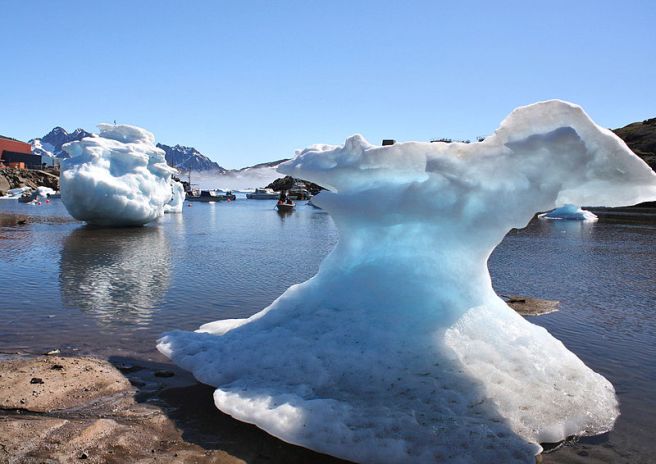
1200px-Netherlands-Ouddorp-blue-wall

The blue walls remember
making love, made
with a cab waiting below,
and the crow who caws
whenever two strangers thus mate
on this bed misses this show
because the fishermen
return from the blue ocean, and
on their brine, wet wood
lie silver still half alive.
The freshness of a goodbye tingles strangely.
On a live wire run two blind mice.
The blue remembers not
when this town was built
or with what amount of love and necessity.
Blue doesn’t know what blue is.


Kushal Poddar has authored The Circus Came To My Island, A Place For Your Ghost Animals, Understanding The Neighborhood, Scratches Within, Kleptomaniac’s Book of Unoriginal Poems, Eternity Restoration Project- Selected and New Poems, and now Herding My Thoughts To The Slaughterhouse-A Prequel (Alien Buddha Press).


Photograph by Johan. 

Your Voice Surprised Me by Linda Wimberly

Pierre-Auguste_Renoir_-_Girl_Reading_-_Google_Art_Project

Rising out of parched pages,
it soared
above the drowsy nod of drone.

Of course I couldn’t see you,
but I could hang every word
on a narrow line, suspend them
above the dusty floor
and watch while they danced
on staccato beats.

Or I could take the words
down a minor scale
and listen as your voice descended
into a midnight kind of blue.

Your voice surprised me.
As I listened,
it wasn’t hard
to follow you
into a darkened room
and close the door.


First published in Kalliope – a journal of women’s literature & art.


Linda Wimberly is a writer, artist and musician from Marietta, GA. A former Vermont Studio Center resident in writing, her poetry has appeared in The Raw Art Review, Lunch Ticket, Stone River Sky: An Anthology of Georgia Poems and others; and a short story appeared in Cricket. She is a self-taught, abstract artist who works in acrylic, oil and mixed media and her images have appeared in or been cover art for Critical Pass Review and Inscape Magazine. Her image “Woman on the Move” won the 2019 Art Contest for So to Speak: feminist journal of language and art. (lindawimberly.com)


Original painting by Pierre-Auguste Renoir. 


The Emigrant Mother By William Wordsworth

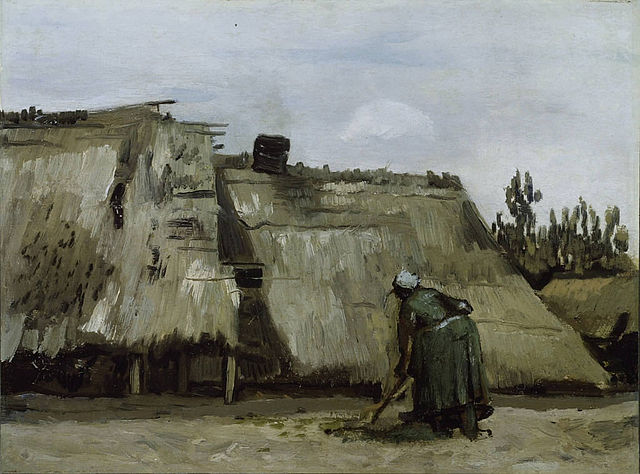
640px-Vincent_van_Gogh_-_A_peasant_woman_digging_in_front_of_her_cottage

Once in a lonely hamlet I sojourned
In which a Lady driven from France did dwell;
The big and lesser griefs with which she mourned,
In friendship she to me would often tell.
This Lady, dwelling upon British ground,
Where she was childless, daily would repair
To a poor neighbouring cottage; as I found,
For sake of a young Child whose home was there.

Once having seen her clasp with fond embrace
This Child, I chanted to myself a lay,
Endeavouring, in our English tongue, to trace
Such things as she unto the Babe might say:
And thus, from what I heard and knew, or guessed,
My song the workings of her heart expressed.

I

“Dear Babe, thou daughter of another,
One moment let me be thy mother!
An infant’s face and looks are thine,
And sure a mother’s heart is mine:
Thy own dear mother’s far away,
At labour in the harvest field:
Thy little sister is at play;
What warmth, what comfort would it yield
To my poor heart, if thou wouldst be
One little hour a child to me!

II

“Across the waters I am come,
And I have left a babe at home:
A long, long way of land and sea!
Come to me, I’m no enemy:
I am the same who at thy side
Sate yesterday, and made a nest
For thee, sweet Baby! thou hast tried,
Thou know’st the pillow of my breast;
Good, good art thou: alas! to me
Far more than I can be to thee.

III

“Here, little Darling, dost thou lie;
An infant thou, a mother I!
Mine wilt thou be, thou hast no fears;
Mine art thou, spite of these my tears.
Alas! before I left the spot,
My baby and its dwelling-place;
The nurse said to me, ‘Tears should not
Be shed upon an infant’s face,
It was unlucky’ no, no, no;
No truth is in them who say so!

IV

“My own dear Little-one will sigh,
Sweet Babe! and they will let him die.
‘He pines,’ they’ll say, ‘it is his doom,
And you may see his hour is come.’
Oh! had he but thy cheerful smiles,
Limbs stout as thine, and lips as gay,
Thy looks, thy cunning, and thy wiles,
And countenance like a summer’s day,
They would have hopes of him; and then
I should behold his face again!

V

“‘Tis gone, like dreams that we forget;
There was a smile or two, yet, yet
I can remember them, I see
The smiles, worth all the world to me.
Dear Baby! I must lay thee down;
Thou troublest me with strange alarms;
Smiles hast thou, bright ones of thy own;
I cannot keep thee in my arms;
For they confound me; where, where is
That last, that sweetest smile of his?

VI

“Oh! how I love thee! we will stay
Together here this one half day.
My sister’s child, who bears my name,
From France to sheltering England came;
She with her mother crossed the sea;
The babe and mother near me dwell:
Yet does my yearning heart to thee
Turn rather, though I love her well:
Rest, little Stranger, rest thee here!
Never was any child more dear!

VII

“I cannot help it; ill intent
I’ve none, my pretty Innocent!
I weep, I know they do thee wrong,
These tears, and my poor idle tongue.
Oh, what a kiss was that! my cheek
How cold it is! but thou art good;
Thine eyes are on me, they would speak,
I think, to help me if they could.
Blessings upon that soft, warm face,
My heart again is in its place!

VIII

“While thou art mine, my little Love,
This cannot be a sorrowful grove;
Contentment, hope, and mother’s glee,
I seem to find them all in thee:
Here’s grass to play with, here are flowers;
I’ll call thee by my darling’s name;
Thou hast, I think, a look of ours,
Thy features seem to me the same;
His little sister thou shalt be;
And, when once more my home I see,
I’ll tell him many tales of Thee.”


William Wordsworth, 1770-1850.


Painting, A peasant woman digging in front of her cottage, Vincent Van Gogh.

Golden State Boy, 1925 by Marilyn Westfall

792px-Worker_standing_on_a_ladder_leaned_against_one_of_the_dozen_or_so_trees_in_an_olive_orchard,_El_Toro,_California,_ca.1900_(CHS-1352)

In retrospect, the first photograph
taken of him, eighteen months old, dressed
in black woolens—leggings, sweater, hat—
posed upon a miniature chair

alone, exposed that he was trained to
listen. Eyes focused. Obedient.
Unsmiling. His feet, laced into boots,
dangled over acorns and oak leaves,

the pattern woven through the carpet
in the sparsely furnished parlor where
his shadow smudged the wall behind him
that winter day, the valley fog thick,

the farmhouse trickling with cold moisture.
Eldest child, he’d labor in orchards,
dig water trenches, treat rot and blight,
plant, prune, and harvest English walnuts,

inherit the family business
but envy his brother who broke bonds
to pilot skies like a peregrine.
His hands would blister, build calluses;

his fair face burn, brown like hulls, sprout with
moles and lesions. His portrait was saved
on linen cardstock, one lock attached
of his shorn corn silk hair, blond relic.


Marilyn Westfall lives in Lubbock and Alpine Texas, and has roots in Ohio and California. Most recently, her poems are published in San Pedro River Review; Weaving the Terrain (Dos Gatos Press); Enchantment of the Ordinary (Mutabilis Press); and are forthcoming in Evening Street Review.

Van Gogh Paints Without The Moon’s Permission by Anna Ruiz

640px-Willows_at_Sunset_1888_Vincent_van_Gogh

Suddenly the sky breaks open with poems.
Magnolia trees laden with Spanish moss
spread rumors.

Rays of sunlight leave lines I had forgotten
were mine. I am deep in the mystery
like a blossoming chestnut tree.

I am too young to be ancient. Spreading
words and black lace like a war widow,
too tired to go home.


Anna Ruiz: I am not a third person though this is my third incarnation as a poet. However, there have been 26,683 incarnations of Anna. They’re all connected to my living breath–the one I have accepted as mine.


Painting, Willows at Sunset, by Vincent Van Gogh. 
Three Poems by Dan Leach

dcpqm8i-b35e1090-4f24-4d0a-a8cc-2cbd870381b8

Teacher

For Achille Mbembe

Death drove down to Clemson in a Cadillac the color of cotton. She found me down
in the stacks. Pressed her clean bones into my back and whispered, What do you think
you’re you doing here? I returned to my book and muttered, Learning how to read.
Death found this hilarious. She said, This is neither the time nor the place for that.
Teach me, then, I said. To which Death said nothing. To which she took my hand in hers

and led me to her car. We drove down to the stadium and she said, Repeat after me.
Gee-oh-teen. I repeated. We drove past the classrooms and she said, Sound it out.
Gruh-gruh-grave. Yuh-yuh-yard. I sounded. We parked outside the Fort Hill Mansion.
She said, Try this one on your own. I said, History. Death sucked her teeth. Try again,
she said. House? I said. Death freed her hand and drove away, the night air rushing

cold and black through the windows, her disappointment on me like a song. I’m sorry,
I said, when she dropped me back at the library. She said, Enjoy your reading.
Wait, I said. Give me one more try. So she nodded to the book in my hand. That,
she asked. What’s the word for that? I had to look before speaking. Then I said, Killer.
This got a smile out of Death. She told me to get back in. Now you’re talking.

The Envelope

For Raymond Williams

It is a difficult thing to talk about. It might make you stutter, then stop,
then start again, before stuttering some more. It might make you feel

like a drunk falling headfirst into darkness while clutching for a wall.

It might make you feel a little like the jazz trumpeter standing alone
before a crowded room with no plan except leaning towards a sliver

of sound and smoke, except breathing and receiving what forms await.

You might get nervous or scared or both. It should be this way.

I remember losing my way in the woods of a mountain without a name,
losing myself to a dark so thick and dominant I raised my hand to my face

and could not see my skin. I remember waiting skinless for the sun.

I was scared. Still I think it should be this way.

It should be a difficult and dizzying thing: this clutching and receiving,
this walking together through the darkness, your hand in mine, waiting

for whatever light emerges to cut through the woods our new way.

such distance, such light

For Fred Moten

Here am I: surrounded
by strong walls
and good views
and much noise
resembling hope.
Here am I: enclosed.

And you out there:
beyond and beneath,
already and not yet,
can you tell me
what it is
you hear?

You out there,
surrounded & surrounding,
do you see me
as I see you?

& how do I sound
from such distance?
& how do I look
in such light?

Just between you and me
how does this situation end?

Dan Leach has published poems and stories in The Greensboro Review, The New Madrid Review, and storySouth. He is currently an MFA candidate at Warren Wilson.


Art by Jenn Zed.

In 1998, you could practice your French in France by Natalie Campisi

lossy-page1-404px-WAITING_FOR_THE_BUS-ON_NICOLLET_MALL_-_NARA_-_551448.tif

In 1998, you could practice French in France. The new and old words were still distanced by water and paper and games of telephone.

It was the year of the Euro. The year of Kosovo. The year of Sampras and the Yankees.

The bus wobbled on steel-belted cartoon wheels toward Montpellier from Paris. Not Marseilles where they steal your money at knifepoint. We had little money and no credit cards and no gold to sell in a pinch.

In 1998, you relied on maps and eyes and lips and eyes.

In 1998, old lives couldn’t be accessed through an app and unrequited loves could remain in amber, forever lithe and limitless, forever ​Lotte​ — not living in Haddonfield with four kids and a mortgage.

<<Je voudrais ​deux billets, s’il vous plaît?>>

With paper maps and paper money, we packed on the packed bus with skinny people who mumbled grunts and slip n’ slide words, a potion of sweet and mildew. The wheel was too big for the driver’s hands. The mirror too small to see.

The faded baby blue bus was peeling-paint old.
The windows were trimmed in white and had curved corners.

A man pressed against me. I sent this postcard of the man pressing against me to my older self, and I received it — perhaps in the middle of the night — and realized he had assaulted me. He had pressed his body against mine on purpose. It wasn’t just a packed train. Assault is a big word when time gets between action. Too big. But, memory remains. I hated it.

I send a postcard back to my 22-year old self: “Push him away. Disez: ​Arrêtez! Arrêtez!

But, no. It’s in amber now. The bus keeps moving.


Natalie Campisi is a journalist and fiction writer currently residing in Los Angeles. She has been nominated for the Pushcart Prize in fiction and her work has appeared in The Chicago Tribune, Auburn Literary Journal, and Writer Magazine. She was recently awarded a writing scholarship to the Chautauqua Institution in New York. Currently, Natalie‘s producing, directing and performing in a fully improvised play based on the work of Wes Anderson, which is running at ImproTheatre in Los Angeles.


Original photograph by Donald Emmerich.


Editors Wanted: Califragile Is Growing!

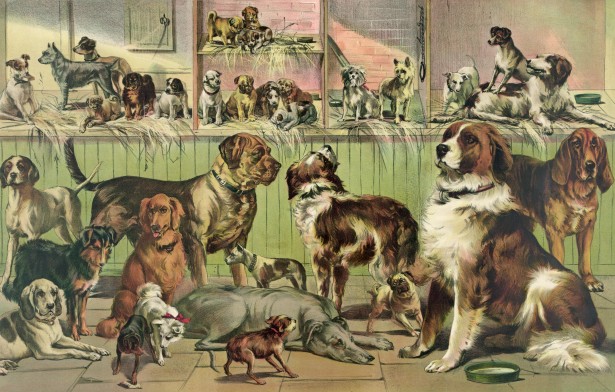
vintage-kennel-club-dogs

We’re ready to take Califragile to the next level, improving our website with video and other interactive features, as well as expanding to include not just free verse poetry, but slam, hybrid, fiction, flash fiction, creative nonfiction and other forms. We will also bring our Arts-into-Action events to Chico and communities around the region.

We’re looking for editors, IT specialists, and fundraisers. All are volunteer positions. We’re especially interested in welcoming people of color, LGBTQ+, disabled and immigrant writer/editors. What do you want to contribute? To begin the conversation, send Wren Tuatha a letter of interest at califragilepoetry@gmail.com. Include the following, and anything else you’d like us to know:

• Previous editorial experience (not required)

• Genres you write in and publication highlights; Teaching experience, if applicable (not required)

• Your location and willingness/availability to travel to Butte County (not required but very helpful)

• Your first thoughts for new ways Califragile can be a relevant voice for climate change and social justice through the arts

Deadline for letters of interest: January 31, 2020

We look forward to hearing from you!


Wren Tuatha and Califragile staff

Shimmer by Wren Tuatha

07EC9109-F5A0-458C-93A7-53B7A0F44201.jpg

Shimmer Sharon Shimmer.
Such sunsmile  on the water.
I, the shore,
I go  to cup her in my hands
and Shimmer She,
she ripples away.


First published in Thistle and Brilliant, Finishing Line Press.


Califragile founding editor Wren Tuatha’s poetry has appeared in The Cafe Review, Canary, Peacock Journal, Coachella Review, Baltimore Review, Pirene’s Fountain, Loch Raven Review, Clover, Lavender Review and others. She’s pursuing her MFA at Goddard College. Her chapbooks, Thistle and Brilliant and the forthcoming Skeptical Goats, are from Finishing Line Press. Wren and her partner, author/activist C.T. Butler, herd rescue goats in the Camp Fire burn zone of California.


Original photograph by Nicolas M. Perrault.

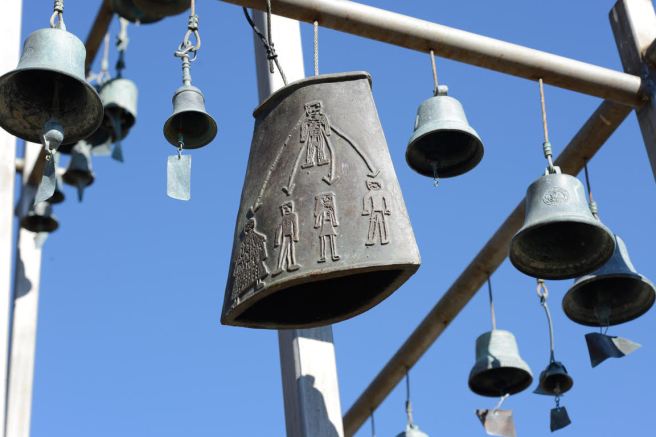
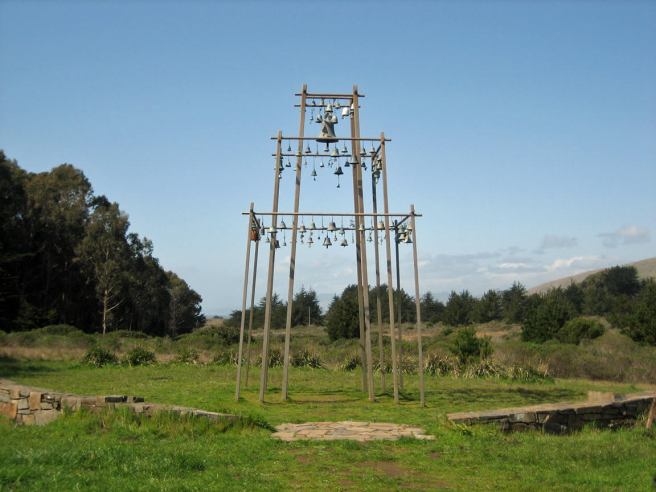
Bell Tower on a Grassy Knoll by Joe Cottonwood

unnamed

Frankly, an ugly structure of steel
like a square-legged spider
with the purest of heart,
a tower of one hundred forty bells.
Ocean air rises, falls, breaks like waves
ringing chimes above Bodega Bay.

Nicholas Green from this small town
at age seven was killed in far-off Italy
by highway robbers. His parents
donated his organs, new life for seven souls.
From Italy in gratitude, in sorrow
these bells etched with seven names.

Bells peal of hope.
In search of a more merciful world
we come, sit, listen.

Children come, do not sit, do not listen.
Children make offerings, a kite, a plastic airplane.
To the branches of a nearby pine
children tie handmade mobiles
marked with the names of dead siblings,
dead friends, shot schoolmates.
Here’s a string of origami hummingbirds,
and here on this branch among fog-damp needles
toy matchbox cars on fishline
dancing in the breeze. Dancing.

unnamed-1

Nicholas Green (September 9, 1987 – October 1, 1994).


Joe Cottonwood has built or repaired hundreds of houses in his day job as carpenter/contractor. Nights, he writes. His latest book is Foggy Dog: Poems of the Pacific Coast.


Photographs by Angus Parker and Lynn Donner. 

Killing Time by Paul Mairet

wiki-Defoliation_agent_spraying-1200

You sit beside a fire on the outskirts
of the smokejumper camp at Gila Box.
The roar of the inferno doesn’t sound miles away.

A white cowboy with scars on his neck,
dressed like it’s still the late 1800s,
tells you how your father saved his life.

You can see the trachea tube in his throat,
blood soaked dust on a gurney.
You can see your father drinking
bourbon after the neck is mended.

A hand on your shoulder, a low voice:
Why are you still here?
I told you this is a white boy’s graveyard.

You shake your head without a word.
You do not turn to face the voice
and face you know belongs
to the San Carlos Apache Vietnam veteran.

You can see the helicopters in which he’s flown
above the Gila and A Lưới Mountains.
You can see him jumping to silence
flames with thoughts of those unleashed
for a government that has wronged his people
for all its history, and you
can’t even face him, much less
tell him why you’ve remained.

You can’t bear to see the managed fire
that must be reflected in his eyes,
as it is in those of the grinning white cowboy
across the fire from you both.


Paul Mairet is a poet and educator who currently teaches in Michigan Tech’s English Language Institute. He also works as an assistant to poet and writer David Mura and is ever grateful to him, Wang Ping, and Kristin Naca for their mentorship.


Photograph of defoliation with Agent Orange in Vietnam, author unknown. 

Sleep Harbored by Wren Tuatha

what_we_leave_behind_by_frogstar_23_db577rl-fullview

(after The Accidental Tourist)

You think there’s a traffic rule, if you see a sign
for an airport you have to pull in and get on a plane.
It isn’t on my way and I don’t have the fare.

I sit in my driveway and read your articles from Lima,
Belfast, Shanghai. Weather and lights. Unexpected place
settings and traffic patterns.

I picture your skill at packing a suitcase, adjusting
to time differences with pills and naps, cafe
conversations.

If you are to birth a new beginning you must be judicious
as to the articles you pack, only versatile, lightweight things.
Belongings you won’t miss if lost.

But even lost things chance upon new lives with random
finders. The umbrella, the apple core. A quarter. The picture
of her you pack.

A plane flies over my garden near the airport
as I bury what you discarded in the cover crop and leaf litter,
compost.

If you travel here, will you push away vines and mushrooms
to recognize what grows where you left me standing?
Will you profile it as a point of interest?

Sleep harbored.
Random finders can claim you, too.


First published in Thistle and Brilliant, Finishing Line Press.


Califragile founding editor Wren Tuatha’s poetry has appeared in The Cafe Review, Canary, Peacock Journal, Coachella Review, Baltimore Review, Pirene’s Fountain, Loch Raven Review, Clover, Lavender Review, and others. She’s pursuing her MFA at Goddard College.  Her chapbooks, Thistle and Brilliant and the forthcoming Skeptical Goats, are from Finishing Line Press. Wren and her partner, author/activist C.T. Butler, herd rescue goats in the Camp Fire burn zone of California.


Painting, What We Leave Behind, by Jenn Zed

The Rose by Patricia Nelson

isolated.jpb

—After Dante: Paradiso

i.
How, but by forgetting, can I leave
the yellow brightness of the center,
the white rose raveling beauty?

I who grew brighter even in its shadow
must turn earthward now,
cooling like a cloud.

That white, lost flower rests in my skin
like a shape on the distorted, moving water,
which the water does not see.

ii.
The shape and noise of the world returns:
the calls, the changes like a thudding of stairs.
After radiant stars, the eloquent hardness of a wall.

I touch it with blank, soft hands,
the sounds in the underlying wood
like a creaking of bridges.

The night lifts its black and crooked sigh.

The old confusion is above me, close as a clamor of beaks,
its meanness striving like a windmill.

iii.
What used to comfort with its distance, its lack of odor
or a shadow, its yaw of unkempt stories—
now is real. More real after my nearness to the light.

The light of the earth is to the left and small
as I go forward, and I must
love that cold which reaches out to me.

Though I am colder here, and dimmer,
I will stand, a beast with the moon around him
hitting the ground like bird strikes, with a dead light.

I will tell them the symmetrical story
with stinging and struggle, a beauty with noise
and falling. And I will love them as I tell it.


Patricia Nelson is a former attorney who now volunteers with an environmental organization. She worked for many years with the “Activist” group of poets in the San Francisco Bay Area.


Artwork, Isolated, by Jenn Zed.

Everyone knows a poem about sex is also a poem about death, by Shannon Phillips

jz

after BH

Every hour begs to be inhabited,
known, not recorded. What if every
particle in an hourglass were a consonant,
a vowel in a poem written above
and unwritten down the center, made
and unmade, like love, like a bed,
like the shapes she makes
under his hands.

Remember that song and how it
curled around the moment,
a tongue unfurled, letting go
of words so to taste the sweetness
of what is fleeting. Exquisite pleasure
is wedded to pain.

Remember that time even if
no picture exists; no poem, no picture
could convince death to be gentle,
but a good kiss just might.


Shannon Phillips is the founding editor of Picture Show Press. Her most recent chapbook, Body Parts, was published by dancing girl press in 2017. After teaching ESL for 3 years, she decided to study Arabic and hopes to one day work in the field of translation.


Artwork by Jenn Zed

The Emigrant’s Address To America. By Rosanna Eleanor Leprohon

jenn

All hail to thee, noble and generous Land!
With thy prairies boundless and wide,
Thy mountains that tower like sentinels grand,
Thy lakes and thy rivers of pride!

Thy forests that hide in their dim haunted shades
New flowers of loveliness rare –
Thy fairy like dells and thy bright golden glades,
Thy warm skies as Italy’s fair.

Here Plenty has lovingly smiled on the soil,
And ‘neath her sweet, merciful reign
The brave and long suff’ring children of toil
Need labor no longer in vain.

I ask of thee shelter from lawless harm,
Food – raiment – and promise thee now,
In return, the toil of a stalwart arm,
And the sweat of an honest brow.

But think not, I pray, that this heart is bereft
Of fond recollections of home;
That I e’er can forget the dear land I have left
In the new one to which I have come.

Oh no! far away in my own sunny isle
Is a spot my affection worth,
And though dear are the scenes that around me now smile,
More dear is the place of my birth!

There hedges of hawthorn scent the sweet air,
And, thick as the stars of the night,
The daisy and primrose, with flow’rets as fair,
Gem that soil of soft verdurous light.

And there points the spire of my own village church,
That long has braved time’s iron power,
With its bright glitt’ring cross and ivy wreathed porch –
Sure refuge in sorrow’s dark hour!

Whilst memory lasts think not e’er from this breast
Can pass the fond thoughts of my home:
No! I ne’er can forget the land I have left
In the new one to which I have come!


Rosanna Eleanor Leprohon, 1829-1879.


Artwork by Jenn Zed

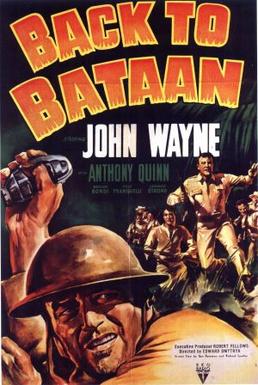
Little Brown Brother By Nick Carbó

Back_to_Bataan

I’ve always wanted to play the part
of that puckish pubescent Filipino boy

in those John Wayne Pacific-War movies.
Pepe, Jose, or Juanito would be smiling,

bare-chested and eager to please
for most of the steamy jungle scenes.

I’d be the one who would cross
the Japanese lines and ask for tanks,

air support, or more men. I’d miraculously
make it back to the town where John Wayne

is holding his position against the enemy
with his Thompson machine-gun. As a reward,

he’d rub that big white hand on my head
and he’d promise to let me clean

his Tommy gun by the end of the night. But
then, a Betty Grable look-a-like love

interest would divert him by sobbing
into his shoulder, saying how awfully scared

she is about what the “Japs” would do
to her if she were captured. In one swift

motion, John Wayne would sweep her off
her feet to calm her fears inside his private quarters.

Because of my Hollywood ability
to be anywhere, I’d be under the bed

watching the woman roll down her stockings
as my American hero unbuckles his belt

I’d feel the bottom of the bed bounce off my chest
as small-arms fire explodes outside the walls.


First published in El Grupo McDonald’s (Tia Chucha, 1995). Reprinted by permission on Nick Carbó.


Nick Carbó has edited two anthologies of Filipino literature, Returning a Borrowed Tongue: An Anthology of Filipino and Filipino American Poetry (1995) and Babaylan: An Anthology of Filipina and Filipina American Writers (2000), and coedited the anthology Sweet Jesus: Poems About the Ultimate Icon (2002) with Denise Duhamel. His honors and awards include fellowships from the National Endowment for the Arts and the New York Foundation for the Arts and residencies from the MacDowell Colony, Yaddo, Fundacion Valparaiso, and Le Château de Lavigny. His collections of poetry include El Grupo McDonald’s (1995); Secret Asian Man (2000), which won an Asian American Literary Award; and Andalusian Dawn (2004). Carbó’s work can be humorous, even satirical, in his examinations of American pop culture and its influence on Asian countries such as the Philippines. He told National Public Radio, “By writing about these influences, it’s my way of kicking back.”

Quincy, California by Tony Gloeggler

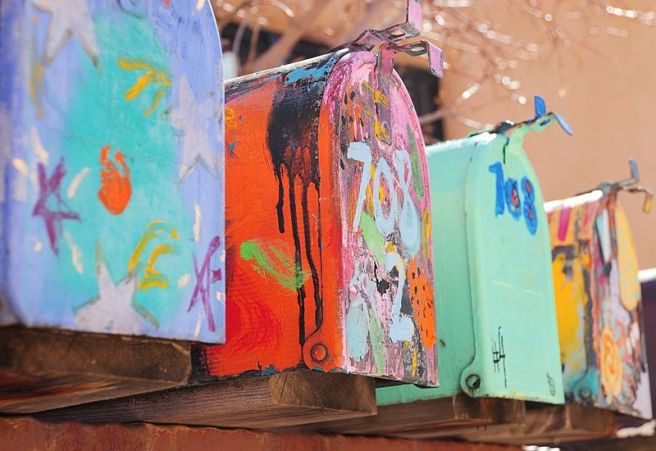
800px-Rural_mailboxes_in_Santa_Fe,_NM

The kind of town we stopped
for gas and asked directions
to that hillside inn ten years ago
When it rained and rained
and we stayed in bed, lost count
of the times we came and came

Kind of town you now live in
with your second husband, split
level home, road side mail box

Town you called from late last night
to tell me about the sharp pains
the red shredded things
that dropped into the water
as you sat on the toilet stool
forty years old, wanting your first child


First published in Mudfish.



Tony Gloeggler is a life-long resident of New York City, having managed group homes for the mentally challenged in Brooklyn for over 35 years. His work has appeared in Rattle, Raleigh Review, Chiron Review, New Ohio Review, Spillway, Moon City Review, and Juked. His full length books include One Wish Left (Pavement Saw Press 2002) and Until The Last Light Leaves (NYQ Books 2015). His next book will be published by NYQ Books in 2019.
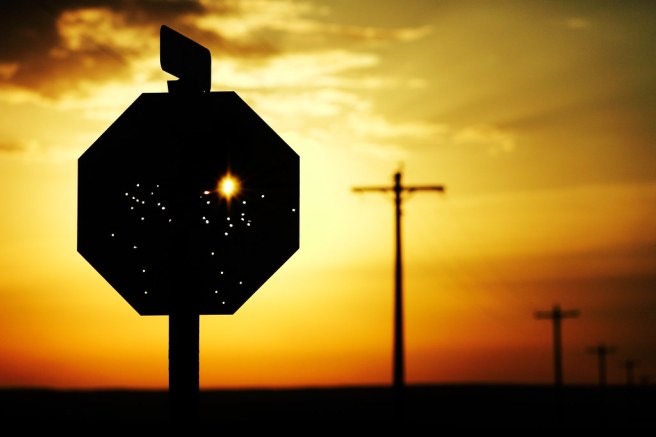
 

Photograph by Tom Spross.

Arroyo Speaks by Paul Mairet

788px-'Dry_Arroyo,_California'_by_D._Howard_Hitchcock,_1910

The water in this land is scarce and cursed.
It ripped through earth and ran, gave birth to me,
a sun-dried orphaned cradle, orphaned thirst,
a bed in which a band of scorpions speak

in clicks on shadowed rocks. You’ll never hear
such talk because your ears aren’t made of earth.
You only hear his clicking tongue; your fear
has tied you to the gun he aims at her.

She only hears the fairies in the hut
she built beneath the pinyon like a grave.
She doesn’t know a year before your love
gave birth to her, the strychnine killer gave

a poisoned hot dog to your trusting hound,
smiling as he watched her wolf it down.

640px--Dog_Fetches_Hero2_Stick_From_River.webm


Paul Mairet is a poet and educator who currently teaches in Michigan Tech’s English Language Institute. He also works as an assistant to poet and writer David Mura and is ever grateful to him, Wang Ping, and Kristin Naca for their mentorship.


Painting, Dry Arroyo, California, by D. Howard Hitchcock.

Original photograph by idoterna.

Still by D.R. James

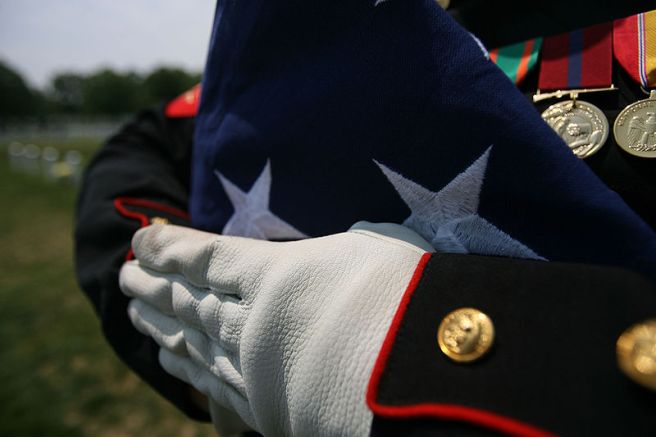
800px-Flag_funeral

It all recurs for the maimed, how they remain,
or don’t, atop the plots of the buried. Those
who could do something table the question.
They relax in the rocker of their certainty,
a war, any war, an abstraction that walls off
the bursting specifics. A twenty-something friend
found he’d deployed to sort body parts. Arrayed,
they’d survive the fever sweeping a land we
could never know. Welcomed by the white-blue
atrium of a foreign sky, he’d prowl his perimeter
until his duty tapped him. Then the oven-sun
would relight his nightmare, the categories
of bone and flesh his production line. What
achievement could signal his success? What
dream in the meantime could relieve raw nerve?
The perfect tour would end when he was still
in one piece, a nation’s need ignoring the gore
behind the games, the horror nestling into
the still-living because still in one piece.


First published in Tuck.


D. R. James has taught college writing, literature, and peace-making for 34 years and lives in the woods near Saugatuck, Michigan. Poems and prose have appeared in a variety of journals and anthologies, his latest of eight poetry collections are If god were gentle (Dos Madres Press) and Surreal Expulsion (The Poetry Box), and his microchapbook All Her Jazz is free and downloadable-for-the-folding at Origami Poems Project. http://www.amazon.com/author/drjamesauthorpage


Photograph by Gunnery Sgt. Mark Olivia, USMC.

Unfamiliar Face of Death by Lazar Trubman

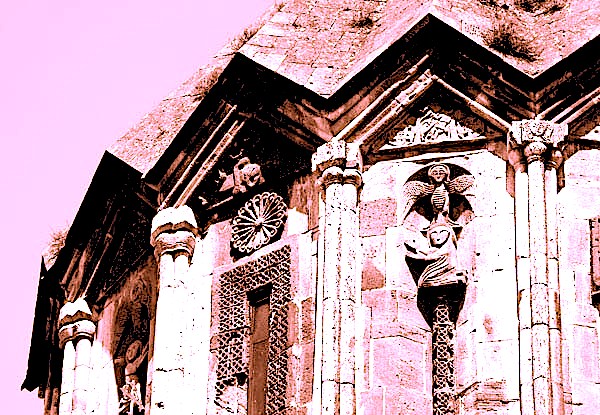
Gandzasar2

Nagorno-Karabakh: May, 1988

Death has an unfamiliar face,
a face of a drunken, unshaved man;
red bulged eyes, bad breath,
strength, muddy boots, AK-47…
Begging for mercy – logs in the fire:
burn, baby, burn;
scream, woman, scream;
cry, old man, cry…
It’s over now; it’s in the memory
of our god-forsaken earth…

Afterword: June 1994

In the street in front of a hotel
two children are playing;
a boy of five, rachitic,
and a girl with a toy pistol:
they are playing on a serious note,
and the little boy,
rather petulant and unwilling,
is told to stand up
against the piss-stained wall;
he can’t understand that he is then
supposed to fall down;
the girl shows him how –
with all the experience
of her seven years…


Lazar Trubman is a college professor from Moldavia, one of the republics which comprised the former USSR. He immigrated to the United States in 1990, after spending four years as a political prisoner in Northern Russia. He was assigned to Arizona, where he taught the Theory of Literature and Roman languages for twenty-two years. In 2017, he retired to devote his time to writing. Since then, his poetry and prose appeared in Forge Magazine, The New Reader, Kissing Dynamite, Bending Genres, Lit Mag, and others. A collection of his poems and prose is forthcoming from Adelaide Books in July 2019.

Pontneddfechan by Phil Wood

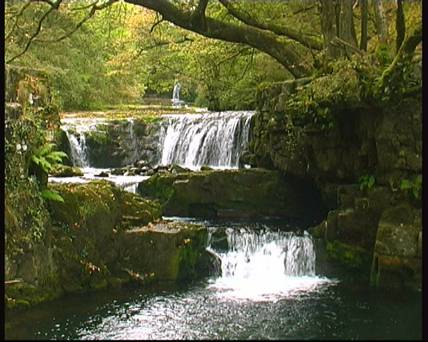
image002

We trudge beside a rain-happy river,
busy with Dippers, squabbling for mates and nests.
It makes a change with no one about, she said.
The mud is squelchy, a primal glue. Waterfalls
cascade the ancient voices of hillside streams.

There’s a dead sheep nestled in silica rock
across the river. Headless. It spooks us both.
In these lichen-coated oak, where air dampens
the moss bright stone, a breath of the old ways
whispers myth. Daft I know. Such places gather belief.


Phil Wood was born in Wales. He has previously worked in Education, Shipping, and a biscuit factory. His writing can be found in various publications, including The Poetry Shed, Snakeskin, Ink Sweat and Tears, and London Grip.

My Mother Named Me America by Kathryn Collins

baby

My Mother Named Me America

without knowing that my coyote father
had been disappeared somewhere
in the wild whooping marshes of Socorro.
She could not know that his last gasping
thought was for the feel of her
long lashes
fluttering against his chest.

That was before I began
screaming with a hunger she couldn’t
to sate. My gummy voice was impossible
to understand,
just like the doctors
who hastened to clear her bed
for the next welfare case.

Later, when loss seeded her lungs
a wet whooping of her own
her native desert called to her between the shouts of
binners and sandwich-board men. Even
the cracked palms of the man who brought
blossoms
to the creek bank we called home
couldn’t hold her here.

If she had known, would she have stayed
at her uncle’s hacienda
until she couldn’t plead
no señor,
no, anymore. Would she have left
if she had known
her daughter’s voice would cry
those same words into the night?

At least here there was
a chance,
space to fill out her hopes.
Nowhere is perfect, but at least
here
my world is built with white words
and white violence.


Kathryn Collins’ essays and poetry have been published in CALYX, Flyaway Journal of Writing, The Rumpus, Months to Years, and Robo Book through Bank Heavy Press. She received her MA in Professional Fiction Writing from the University of Denver and currently works as a librarian. After a long period as an expat in Germany, Israel and Australia, she has returned home to the Rocky Mountains of Colorado.

#Mountains: Women Are Mountains Scattered by Wren Tuatha

dc3zzyf-c6b1ae72-1c07-402e-a553-daec2b137ae2

Red pill/green pocket/squire, asks then takes anyway,
can you see me or the planet from a crag in Arkansas?
Gynic peaks pull the moon in you by a string.

What do you orbit? How do you know when to alight if land
and women are mountains scattered, grounded but shifting
unfinished? You and Mohammed, playing pipes at mountains.

Two peaks, one in Africa, the other Appalachia, pour
water that makes the moonbow, marrying light and vapor.
Only two places on Earth does the moon lay this lyric.

Mountains in Nepal listen to gunfire. In Kentucky they
lay down for clean coal, rebranded. Lung forests in Sierras
truck downhill. Peaks in Switzerland take the breath away,

rare oxygen. Do you see me on the planet from Alps, Everest
or Kilimanjaro? Rice terraces and the perfect elevation
for quinoa. Who are you feeding? Who comes to the table?

Not women. When restless we erupt, rebranding, renewing.
We sway slow on our plates. My skin has regrown after lavas.
Sit down. Your babbling is corrosive, a tune in smoke while women

chisel, turn spokes. Narcissus drowning and other irrelevant kings.
No matter your heights, a king convinced of his wings and his view
brought us to this ledge.


First published in Thistle and Brilliant, Finishing Line Press. 


Califragile founding editor Wren Tuatha’s poetry has appeared in The Cafe Review, Canary, Peacock Journal, Coachella Review, Baltimore Review, Pirene’s Fountain, Loch Raven Review, Clover, Lavender Review and others. She’s pursuing her MFA at Goddard College.  Her chapbooks, Thistle and Brilliant and the forthcoming Skeptical Goats, are from Finishing Line Press. Wren and her partner, author/activist C.T. Butler, herd rescue goats in the Camp Fire burn zone of California.

She wonders about his tattoo by Shannon Phillips

776px-Double_Exposure

Maybe the small blue spiral behind his earlobe is a corkscrew into his skull, there to remind him that all life is suffering, even the good parts, the absence of which at times makes his heart sag, soaked in want. Maybe he got used to the pain after that. Or maybe it’s the slow wind up the mountain to Big Bear, the spooled line from the fishing trips he never went on with his grandfather because he was too young when he died. Or maybe his Middle Eastern students finally convinced him to smoke hookah and it was so good that he wanted to commemorate the revelation he had while staring at the cobra statue in the corner, curled in dance as if on the kaleidoscopic streets of Morocco. He’d almost gotten purple ink, in honor of Cheshire cat rings, but the tattoo artist talked him out of it; he was okay with that—the rings on which Alice slid down into the rabbit hole were smoke-colored anyway. Perhaps he got it because some part of him wanted others to ask about it. He remembered his mom worrying out loud one afternoon that he would become like her—lonely from preferring the inside of his own head. She even wished she’d been born into another culture, one where a child couldn’t run ten feet without smacking into someone who loved him. He remembered this while waiting in line during his lunch hour, the woman next to him wearing a scarf—the color of sunset—layered generously around her neck.


Shannon Phillips is the founding editor of Picture Show Press. Her most recent chapbook, Body Parts, was published by dancing girl press in 2017. After teaching ESL for 3 years, she decided to study Arabic and hopes to one day work in the field of translation.

High Priestess by Patricia Nelson

RWS_Tarot_02_High_Priestess

High Priestess

—a tarot card

Narrow by narrow she rides.
Woman with a blue ball on her head
and a horn and another horn
and a no eye and a why eye
and a new moon through her dress.

To see her you must live in a jar
or a rock or an alphabet
or a planet balanced on a dark.
On a “why” of seed and stem and under
and made of wide by wide.

You must see white to white,
your heart stem paling at the leaf.
Face of chalk and torso hard as tooth.
In the high-low, pile moonlight silent as sand.
Release the cold and falling salt of judgment.

RWS_Tarot_02_High_Priestess-1


Patricia Nelson is a former attorney who now volunteers with an environmental organization. She worked for many years with the “Activist” group of poets in the San Francisco Bay Area.


The High Priestess card of the Rider-Waite tarot deck, illustrated by Pamela Colman-Smith.

A Flamingo Always Has One Leg Up, Ready to Fly If It Needs To by Martin Willitts Jr

jennzed:willitts

the weight of life is trembling down the night
shaking curtains made out of rocks

a blink will un-do this world
fumbling with the way-it-used-to-be

overhead near-perfect rain breaks the heat

it is quiet without you
rain is writing this down


Martin Willitts Jr has twenty-four chapbooks including the winner of the Turtle Island Quarterly Editor’s Choice Award, The Wire Fence Holding Back the World (Flowstone Press, 2017), plus 16 full-length collections, The Uncertain Lover and Coming Home Celebration. Forthcoming books include Harvest Time (Deerbrook Press) and the Blue Light Award winner The Temporary World. He is an editor for Comstock Review.


Painting by Jenn Zed.

Soapbox by Bill Arnott

800px-Bergy_bits_near_Tasiilaq

Bergy bits and growlers
float into the bay
chunks of Greenland
set adrift, temporary
floating homes
that wait
naive as snowmen
meanwhile fridges, freezers
air conditioners
heat the rest

We go see it while it’s there
speeding its demise
talk of preservation
need for care
lectures from the ignorant
on upturned soapbox podiums
spilling phosphate residue –
take your message to the world
on private jet, Air Hypocrite
No, no, no, white wine goes in the other fridge – the one beside the green bin


Vancouver author, poet, songwriter Bill Arnott is the bestselling nonfiction author of Wonderful Magical Words and Dromomania. His poetry is in the League of Canadian Poets Heartwood and Paper Dart Press UK PLAY anthologies. Bill’s poems, reviews and articles also appear online.


Photograph by Christine Zenino.

For My Friend Who Complains He Can’t Dance and Has a Severe Case of Writer’s Block By Nick Carbó

68516072_501565664015504_6732121482815602688_n

Then, take this tambourine
inside the sheep barn,

listen to the anaconda’s intestines,
the shark’s walking stick,

learn the river insect’s secret
neon calligraphy,

swim through Frida Khalo’s hair
and come out smelling like orchids,

lift your appetite
towards the certified blue turtle,

feast on Garcia Lorca’s leather shoes
and taste the sun, the worms of Andalusia,

don’t hesitate in front of a donut,
a ferris wheel, the crab nebula,

excavate diamond-eyed demons,
Chaucer’s liver, Minoan helmets,

paste Anne Sexton’s face on a $1,000 bill
and purchase a dozen metaphors,

beware of the absolute scorpion,
the iguana with the limping leg,

permit indwelling, white words around the eyes,
the confrontation of windows,

never feed your towel to the alligator,
he will eat you and eat you and eat you.


First published in El Grupo McDonald’s (Tia Chucha, 1995). Reprinted by permission of Nick Carbó.


Nick Carbó has edited two anthologies of Filipino literature, Returning a Borrowed Tongue: An Anthology of Filipino and Filipino American Poetry (1995) and Babaylan: An Anthology of Filipina and Filipina American Writers (2000), and coedited the anthology Sweet Jesus: Poems About the Ultimate Icon (2002) with Denise Duhamel. His honors and awards include fellowships from the National Endowment for the Arts and the New York Foundation for the Arts and residencies from the MacDowell Colony, Yaddo, Fundacion Valparaiso, and Le Château de Lavigny. His collections of poetry include El Grupo McDonald’s (1995); Secret Asian Man (2000), which won an Asian American Literary Award; and Andalusian Dawn (2004). Carbó’s work can be humorous, even satirical, in his examinations of American pop culture and its influence on Asian countries such as the Philippines. He told National Public Radio, “By writing about these influences, it’s my way of kicking back.”


Chalkboard graphic by Nick Carbó.

Herman, The Sturgeon by Tricia Knoll

FunWithFish_HermanSturgeon

My palms press against the thick glass wall
between me and Herman. I nudge in
next to three young girls with ponytails.
Herman glides, a profile of fossils.

The sign to my left:

Species: acipenser transmontanus (Pacific Sturgeon) –
the largest freshwater fish in North America
Age: 70 plus years, born during World War II
Eyes: Steel gray
Length: Ten feet
Weight: 450 pounds
Genealogy: Species to 175 million years ago
Residence: Bonneville Fish Hatchery on the Columbia River –– since 1998 captive in a man-made pool fed by Tanner Creek and groundwater.
One Herman or another has circled this pool for over sixty years.

The blonde mother distracts her kids with goldfish crackers.
I’ve got the window.

Does Herman see my hands splayed on the glass?
Am I as irrelevant to him as barnacles
crusted on the container ships on the Columbia
heading through Bonneville’s locks to Lewiston?
Does his brain sense how near his river is?
How high the wall to the upper Columbia?

I lean in as if to weigh the theft
of his wild identity, this land-locked fish.
Does he always swim clockwise?
Ignoring cycles of spawning?
His eyes give away nothing.
Bottom dweller. Four barbell sensors,
armored scutes. Yet – a brain that integrates.

My blessing to this fish
through my hands, through the glass.
Bless his terrible beauty.
Does he feel how my laying-on pulses the water?


First published in Song of Eretz.


Tricia Knoll moved from Oregon to Vermont in 2018 – two places that underscore the importance of eco-poetry holding up beautiful places in transition due to climate crisis. Website: triciaknoll.com

When We Glint by George Cassidy Payne

dbm

When we glint
we are back in time,
and the road groans
like an oncoming
British squadron.

Wounded. We feel
witnessed by time-
by 200 years of war,

a theater of bitter
clouds and the noon
day sun conniving.

When we glint we
sail through the carnage-

hurtling outward toward
an uncertain future. A
breeze rippling the surface.


George Cassidy Payne is an independent writer, domestic violence social worker, adjunct professor of philosophy at Finger Lakes Community College, and a student of religion. He has degrees in the subject from St. John Fisher College, Colgate Rochester Crozer Divinity School, and Emory University. He lives and works in Rochester, NY.


Painting by Jenn Zed.

Elegy with Scrambled Eggs by Beth Gordon

Floris_van_Schooten_-_A_kitchen_still_life_with_pots_and_pans_on_a_stone_ledge_and_animated_figures_in_the_background

When I say breakfast, I mean your hard-boiled
bruises draped in designer silk blouses,
I mean my first lacy bra, party dressing
in my grandmother’s bedroom, the way you
led me to my reflection, your lipstick
mouth saying beautiful, I mean you kept
your face in shadow at every meal,
I mean you starved after your husband died
of cancer, I mean you were light headed
for 20 years, I mean the boarding house
where your mother steeped tea on a hot plate,
carried a globe lamp from Baltimore
to Greensboro, I mean the way you claimed
it as payment for the year she left you
behind, I mean the oncoming food truck
that crushed you as you turned into the church
parking lot. When I say church, I mean prayers
to a breathing machine, the way you limped
from bed, re-breaking your ankles, I mean
the last thing you said, I just don’t feel good,
I mean your hungry children dusting for
each other’s fingerprints, I mean pancakes
in the common room on Easter Sunday,
the men who came every week to see you
pour coffee, listen to your hymnal voice.

I mean the choirs in your battered heart
as God set a full table before you.


Beth Gordon is a poet, mother and grandmother, currently landlocked in St. Louis, MO. Her poems have been published in numerous journals including Into the Void, Noble/Gas, Five:2:One, SWWIM, Verity La, Califragile, Pretty Owl Poetry and Yes Poetry. She is the author of the chapbook, Morning Walk with Dead Possum, Breakfast and Parallel Universe, published by Animal Heart Press. She is also Poetry Editor of Gone Lawn.


Painting by Floris van Schooten.

Fake News by Bruce McRae

Peter_Fonda's_American_Flag_Patch

This is your reporter. We take you live
to the scene of multiple tomorrows.
There are cloudbanks in every room
and a noxious gas is fording our borders.
Cherubim fall like milk poured from a lip-red sky.
Notice the turmoil of lawns and gardens,
the way the earth eventually gives up her dead.
Listen to witnesses as they recoil
from an overabundance of weather.
See the void that’s opened, like a crack in the light.
Like lovers parting during wartime.
Like fingers crossing a heart
and every cemetery is filled with rosewater.


Bruce McRae, a Canadian musician currently residing on Salt Spring Island BC, is a multiple Pushcart nominee with well over a thousand poems published internationally in magazines such as Poetry, Rattle and the North American Review. His books are ‘The So-Called Sonnets (Silenced Press), ‘An Unbecoming Fit Of Frenzy’ (Cawing Crow Press) and ‘Like As If” (Pskis Porch), Hearsay (The Poet’s Haven).


Photograph of Peter Fonda’s “Captain America” flag patch from Easy Rider, by Heritage Auction Galleries of Dallas, Texas. 

Fires by Ted McCarthy

merlin_146775420_6d78868a-b4d0-4d23-bc8a-5f97ee23fa3c-articleLarge

And far back, fires. I tried to number them,
to give each one its own significance –
a huge event, a movie come to life,
each one a shot of communal adrenaline,
the emptying streets converging on a smoke
too black for chimneys, air’s breath-sucking heat,
a billowing, the spit of punched-out windows
and once, an oily blob of dragon’s phlegm,
a sun escaping from a cinema screen,
and grown-ups scattering like playground kids.
A visitation, talked about for weeks
in child-speak or the hushed tones of bereavement.

And then we were too old. We understood.
I knew that rumbling sound was rooms collapsing,
I’ve felt, not heard, it since too many times –
something internal tumbles floor by floor
and though you’re whole, you know yourself a shell.
It’s details now. The hush, the helplessness:
a woman sleepwalking along the footpath,
her neighbours linking arms to keep her back,
their faces grim with fear. Her strength; she moved
like a machine, her eyes fixed on a point
no one could see.

Today I couldn’t tell
which house it was, that row all of a piece.
Memory’s a town; expansion and neglect,
a gutting out, a scouring of the acrid,
a crowding at the heart; sometimes a stillness
waiting for decay to be complete.


Ted McCarthy is a poet and translator living in Clones, Ireland. His work has appeared in magazines in Ireland, the UK, Germany, the USA, Canada and Australia. He has had two collections published, ‘November Wedding’, and ‘Beverly Downs’.
His work can be found on http://www.tedmccarthyspoetry.weebly.com


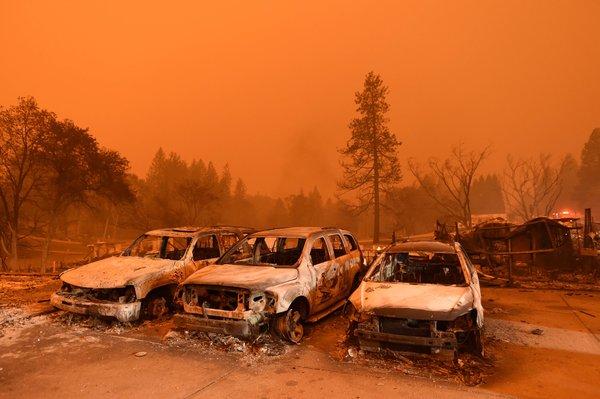
Editor’s Note: As we process the images and experiences of the Camp Fire, we have noted that many among us were already living the effects of their “own personal Camp Fire,” which made them homeless, marginal, or at risk before the disaster. Thus, we include this offering from the UK on metaphorical “fires” in our lives, to recognize that disasters, collective and individual, continue and demand much of us.

#Mountains: The Mammogram Technician Asked if I Wanted to Take a Look by Andrea Potos

750px-Woman_receives_mammogram

Profile of a motherland–
sloping hill and veins bold
with blood ore,
rivers of light criss-
crossing and coursing
from view, I prayed
my eyes were true–
I saw no errant stone.


Previously published in Arrows of Light, Iris Press.


Andrea Potos is the author of eight poetry collections, including the forthcoming A Stone to Carry Home (Salmon Poetry), Arrows of Light (Iris Press), An Ink Like Early Twilight (Salmon Poetry), We Lit the Lamps Ourselves (Salmon Poetry) and Yaya’s Cloth (Iris Press). The latter three books received Outstanding Achievement Awards in Poetry from the Wisconsin Library Association. Her poems can be found widely in print and online. She received the William Stafford Prize in Poetry from Rosebud Magazine, and the Hearst Poetry Prize from the North American Review.


Original photograph by Rhonda Baer, courtesy of the National Cancer Institute. 

#Mountains: The Path by Stella Pierides

dd

At the top of the stairway snaking up the hill, a white-washed chapel and an olive tree. Blinding sunlight. Some way to go yet. The stony stairs are narrow, a couple of hands-width before the cliff falls steeply into the sea.

Slow down, there’s no hurry. Take a deep breath. Feel the rough warmth of the rock. The wind beating against it raises the fragrance of sage, of thyme and marjoram to the skies, erases the silence.

marble wings—
in the distance
windmill ruins

Feel the salt on your lips, the urgent wind tussling your hair.
This history book under your arm, so well-thumbed, leave it here, against that rock, someone coming after you might linger, take a look.

pillars of salt—
propping her foot
on a stone

And the pebble from Amorgos you kept in your pocket all those years, add it to the cairn over there, where the path widens. Let it go. The trail is moments like this, following the light, teetering on the edge of your desires, of your sorrows.
That bench at the top, see it now, under the olive tree? This is your goal. You can rest there. Wise, gentle Persephone will hold your hand.

embalming my tongue
I rest in the shadow
of the silver-leaved olive


Stella Pierides is a poet and writer born in Athens, Greece, now living in Neusaess, Germany and London, UK. She is the author of three poetry books: Of This World (Red Moon Press, 2017) and In the Garden of Absence (Fruit Dove Press, 2012), both of which received a Haiku Society of America merit award; Feeding the Doves (Fruit Dove Press, 2013). Her work has also appeared in numerous print and online journals and anthologies. Currently she manages the Per Diem: Daily Haiku feature for the Haiku Foundation.


Painting by Jenn Zed.

Who’s Keeping Track of our Dreams by Beth Gordon

Todd Klassy

You are chopping hard boiled eggs on Friday night while we discuss our certain sudden extinction, the vanishing whippoorwill and his mournful morning chant, our clocks blinking midnight because tornadoes serenaded our flooded streets. You sold gilt-edged bibles in North Carolina in 1973 when I was just a child listening to The Night the Lights Went Out in Georgia and Playground in My Mind, unable to separate those revolutionary messages.You prop up your broken laptop with a syrupy bottle of Southern Comfort retrieved from basement waters, still sticky with mold and spider webs, while we try to mix the ancient recipes: Comfort Colada, Comfort-On-The Rocks. Our ears popping from the journey, landing your least favorite part, we haven’t been in Kentucky for twenty-five years, but you never forgot the flies that laid their eggs on mash, how you waved them off, wings as black as Mississippi dirt, as green as Irish grass.


Beth Gordon is a poet, mother and grandmother, currently landlocked in St. Louis, MO. Her poems have been published in numerous journals including Into the Void, Noble/Gas, Five:2:One, SWWIM, Verity La, Califragile, Pretty Owl Poetry and Yes Poetry. She is the author of the chapbook, Morning Walk with Dead Possum, Breakfast and Parallel Universe, published by Animal Heart Press. She is also Poetry Editor of Gone Lawn.


Photograph by Todd Klassy. 

Father’s Day: Mo/Fa Poems by Chella Courington

774px-Eugene_Manet_and_His_Daughter_in_the_Garden_1883_Berthe_Morisot

Second Memory

An upward draft
catches Mama’s hem
at Forty-first & Twelfth
raising it in waves
around her knees
over her thighs
a pink-striped dress
dances like the awning
at Lida’s Cantina
when a man at the corner
clutching a boy’s hand
sees Mama naked
under her flying skirt
& I see he sees
wondering why
she doesn’t
hold it down
& he sees
me see him
winking
before the light
turns green.


Queen’s Bird

Two of each—cup, saucer, bread plate—
in lukewarm water, I wash away

thirty years of dust since Mother died.
At 42, uterine cancer like Queen Mary

bloody Mary quite contrary.
Why did you run away?

I thought I could find you by traveling
to Chicago, Barbados and Edinburgh.

Against the sun, I raise this porcelain
eyeing it for chips and cracks. Bone china

fired from bone ash like Mother’s gray powder
handed me in a bronze urn.

Or is this songbird cup glazed in blue
mere clay? My lips where once were yours.


Jeopardy

My father built biceps working for US Steel
smelting iron in heat that humbled men.

Now I could break his arm
over my knee, brittle as kindling.

My father used to let me walk up his body
balancing my hands on his fingertips

till I flew from his shoulders. They began to sag
after my mother passed. Rising at night, no moon out,

she collapsed in the dark and never woke
as once my father fell when a clot in his head

tossed him down. He speaks of my mother
rubbing his back with eucalyptus oil and saves hair

from her brush, strands he wraps in kleenex.
At night with his whiskey, facing Jeopardy, my father

drifts off to Kargasok.
In the Russian mountains women live to be 105.

So do their men, eating dried cod with mushroom tea,
making love last forever.


Blackbirds

Like a canopy of darkness
they shadow the ground for miles
on currents that lift them
back to their roosts.

Years later I ask my father
if he gathered us
to watch thousands
swoop down on trees

sit wing to wing
till morning branches cracked
under their weight.
At daybreak

did they leave the oaks
bare?

He says we never saw them abandon
the hollow, catch a new wind
to an unharvested south
but often would see their return

black streaks
on a September afternoon.


Job’s Daughter

I do not skulk from God.
He has no eye for me
only for my father—tall and brown
hands that raise me over his head.

Hurling insults like thunderbolts, God calls
him harelip, mooncalf. Father hides
seven days under the bellies of three sheep.
With a dulled razor, God sheers

their backs slowly before burning them.
He forces the camel to sit on the cold earth,
head down, and gives father a white flint knife.
Slice the thorax, He bellows.

Father turns away—not a butcher.
The camel lives two hours. My father crawls
inside the camel’s skin and closes it over him.
Flesh still warm.

774px-Eugene_Manet_and_His_Daughter_in_the_Garden_1883_Berthe_Morisot-1

Chella Courington is a writer and teacher. With a Ph.D. in American and British Literature and an MFA in Poetry, she is the author of six poetry and three flash fiction chapbooks. Her poetry appears in numerous anthologies and journals including Spillway, Gargoyle, Pirene’s Fountain, and The Los Angeles Review. Originally from the Appalachian South, Courington lives in California with another writer and two cats. For more information: chellacourington.net.


Painting, Eugene Manet and his daughter in the Garden, by Berthe Morisot.

Ours Was a Softer Kind of Landing by Beth Gordon

Tornado_Destroyed_House_in_Parkersburg,_Iowa

We believed this landscape would not betray,
cinematic sunsets haloing white
farmhouse and cornstalks, as tall as young
men, your cats running free across the road
and back without daylight danger, always
returning home before coyote hour,
high winds that cause old branches to grumble,
the haunted oak tree breaking your bedroom
window, its veined hands reaching for your throat
only to discover that you had fled
to the basement, your nerves frayed, uneasy
at the ribbons of rain that wrapped around
every stone or brick within your line
of sight. I tell you that the wilderness
reclaimed Ukrainian suburbia
after the Chernobyl meltdown, pregnant
foxes and winter wolves roam without fear,
that genetically modified soybean
exhibits natural immunities
to radioactive dirt, that thunder
heads and tornadoes have become common
topics of conversation, that I know
how to hide arsenic poisoning from
the forensic detectives in Osage,
MO but would be indicted in New
Orleans for the same crime. Beige homes destroy
our last corner of beauty and I am
leaving for the smoky mountains, this last
sanctuary now coated with poor-grade
cement, the once gentle road a gauntlet
for domesticated mammals, wild skunks,
afternoons of relaxation removed
with top soil. I tell you I am waiting
for the next disaster as I hold my
grandson’s blooming hand, guiding him around
an abandoned porch in a sweet circle
of splintered flight, that I no longer trust
meteorologists, pretty prophets
with ugly news, I scan the horizon
searching for God’s eyes, a voice louder than
schoolyard gunfire, a promise that this
caterpillar boy will wake tomorrow.

759px-Child's_Hands_Holding_White_Rose_for_Peace_Free_Creative_Commons_(1535619818)


Beth Gordon is a poet, mother and grandmother, currently landlocked in St. Louis, MO. Her poems have been published in numerous journals including Into the Void, Noble/Gas, Five:2:One, SWWIM, Verity La, Califragile, Pretty Owl Poetry and Yes Poetry. She is the author of the chapbook, Morning Walk with Dead Possum, Breakfast and Parallel Universe, published by Animal Heart Press. She is also Poetry Editor of Gone Lawn.


First photograph by Vossman. Second photograph by Pink Sherbet Photography. 

How to Remain Invisible When the Great Storm Falls by Michael H. Brownstein

Tornado_Damage,_Illinois

–Jefferson City, MO, tornado, 11:40 PM, May 22nd/23rd, 2019

Two days later you navigate the ruts in the road,
fallen trees, torn roofs, swinging wires, broken poles
to a house at the end of a broken street and a gravel path,
up the steps of a porch still strong, an electric box dangling,
no windows broken, branches and car parts a picture frame.
When the door opens, heat rushes outside. A frail woman
at the door. Yes, she says. On her kitchen table,
a melting ice-cream carton, bags of leaking vegetables,
the soiled odor of spoiled milk. Come in, she says.
No electricity, a water pipe maligned, gas turned off.
All around you, every house has a sign—you can stay or
you must vacate. There is no sign on her front door.
You’re the first people I’ve seen in three days. Is it safe?
We have food, you tell her, and water. One of us
can remain with you. We’ll see if we cannot get you help.
And then the wind of the tornado slips from her.
her body rocks, then shivers, one hand goes to her face.
Sorry, she says. I can’t help it and she cries and cries.


Michael H. Brownstein is on the roof of his old house, the roof in serious disrepair, and he walks on it as if he’s on a boardwalk – a squirrel falls through where he just stood – what is left to do but go to all fours, tread carefully until he’s on safe ground, call the roofers (he can’t fix this), and write a poem.

He’s walking across a great field, firecrackers exploding. He swats away at dozens of mosquitoes. Near where he teaches, the security guard tackles him and points out a sniper who has been shooting at him as he crossed. There is nothing else to do but conduct a poetry workshop in his algebra class.

He goes camping, and a rattlesnake crawls into his sleeping bag. Prayer and poetry – they really do go together.

On and on. Take a break. Write a poem.


Photograph by Robert Lawson.

Tamalpais by Nicole Michaels

Tamalpais-derangedtaco

I am keeping your secrets
as if I wrote the legend,

crashed the planes,
abandoned the cars,

set the plaque
for Sitting Bull.

Your peeling manzanitas
are safe with me,

your rock,
your fire roads.

I have nothing to offer
except myself as I was,

gilded like a trout
downstream of your sleeping figure,

bronzed below your witch-guarded peak.


1280px-MT._TAMALPAIS_STATE_PARK,_MARIN_COUNTY,_CA


Nicole Michaels is a Marin County, CA native who makes her home in frontier Wyoming. She is a working poet with a degree in English from Stanford University where she studied under the late Diane Middlebrook and chose an emphasis in feminist studies. She spent some time in the American South as a journalist for small papers.


Top photograph by Brent Peters/Derangedtoco; Bottom photograph by Jerrye and Roy Klotz. 

Father by Michael H. Brownstein

cq_de_ou_oz_hanne_by_frogstar_23_dd3k657-pre

I always thought you would outlive me
Lifting heavy boxes past the age of seventy,
Carrying them fifty feet without rest
As if you were white water riding a crest
Of a wave digging talons into sand—
You were always the one I could count on to stand
As my corner man in the boxing ring
Or tell me a lie when I was asked to sing
At this function or that, knowing my throat
Was stale bread, textured oat.
Yet now I find you tied to machines
Calculating strokes of your heart on reams
Cascading past the nurse’s station in intensive care.
I left work early wondering if I dare
Peek in to see you beyond the open door.
You smile, plant heavy white stocking feet to the floor:
I’m OK, you tell me, my heart was racing,
And you move your finger to your chest as if tracing
A child’s picture shaded with red
An intricate design with a loose thread.


Michael H. Brownstein’s latest poetry volume, A Slipknot Into Somewhere Else: A Poet’s Journey To The Borderlands Of Dementia, was recently published by Cholla Needles Press (2018).


Art by Jenn Zed

Pompeii By Charles Bernstein

800px-Wildfire_aftermath

The rich men, they know about suffering
That comes from natural things, the fate that
Rich men say they can’t control, the swell of
The tides, the erosion of polar caps
And the eruption of a terrible
Greed among those who cease to be content
With what they lack when faced with wealth they are
Too ignorant to understand. Such wealth
Is the price of progress. The fishmonger
Sees the dread on the faces of the trout
And mackerel laid out at the market
Stall on quickly melting ice. In Pompeii
The lava flowed and buried the people
So poems such as this could be born.


First published in PoetryReprinted with the permission of the author from Recalculating (University of Chicago Press, 2013).


Photograph by Mrsramsey.

Thistle & Brilliant: Poems of Relationships in Motion//Performance at Blackbird in Chico

Blackbird 4:20 Poster

Northern California writers and readers:

Join Califragile founding editor Wren Tuatha and Poemcrazy author Susan Wooldridge, along with poets Bob Garner, Cory Himp Hunt, Patrick Napoco, Heather Rayann, Travis Rowdy and more for an evening of the messy!

Wren will read from her new collection, Thistle and Brilliant, interspersed with other poets’ offerings on relationships in motion! An open mic on the topic will follow, one poem per reader.

Blackbird Books and Cafe

1431 Park Ave., Chico CA 95928

Saturday, April 20, 2019, 6pm

**This will be Wren’s final public Chico appearance during T&B’s promotional period.**

Let me count the ways…you can order Thistle and Brilliant–

• Connect with us at Blackbird.

• Order via Finishing Line Press‘ website before April 26, 2019.

• Contact Wren via Facebook or Califragile.org before April 26, 2019

• Contact Wren to host a house party before April 26, 2019.

The Fires By Rudyard Kipling

800px-only_fires_set_in_the_barrels_are_keeping_people_warm_as_temperatures_plummeted_down_(11099190053)

Men make them fires on the hearth
Each under his roof-tree,
And the Four Winds that rule the earth
They blow the smoke to me.

Across the high hills and the sea
And all the changeful skies,
The Four Winds blow the smoke to me
Till the tears are in my eyes.

Until the tears are in my eyes
And my heart is well nigh broke
For thinking on old memories
That gather in the smoke.

With every shift of every wind
The homesick memories come,
From every quarter of mankind
Where I have made me a home.

Four times a fire against the cold
And a roof against the rain,
Sorrow fourfold and joy fourfold
The Four Winds bring again!

How can I answer which is best
Of all the fires that burn?
I have been too often host or guest
At every fire in turn.

How can I turn from any fire,
On any man’s hearthstone?
I know the wonder and desire
That went to build my own!

How can I doubt man’s joy or woe
Where’er his house-fires shine.
Since all that man must undergo
Will visit me at mine?

Oh, you Four Winds that blow so strong
And know that his is true,
Stoop for a little and carry my song
To all the men I knew!

Where there are fires against the cold,
Or roofs against the rain,
With love fourfold and joy fourfold,
Take them my songs again!


Rudyard Kipling, 1865-1936. 


Original photograph by Ivan Bandura. 


Garage Fire by Terry Adams

flowers_by_frogstar_23_dcd3rml-pre 

He began all his dreams in those curled painted flowers
on the wall facing his bed
as the house quieted.

then he was dreaming the flowers burning and
his cousin with flames on his face
shaking him

under the window glowing and ticking with heat –
then the black spider nets his bicycle spokes
the seat charred tower of bare springs
where he dreamed of riding no-handed
and it came true

then the smoldering flowers were above
his pallet on the school floor beside
black axe-head, melted rake,
nested saws welded scattered
sins of screwdrivers with no
handles

then he got on his knees to look out
the window at the blackened
yard and remembered watching the one
black side of all those rescuing
strangers

pulsing with odd light as they yelled
throwing water and dirt
their red flat faces fastened
to huge shadows
bending and weaving
across the glass.

Terry Adams has poems in Poetry, Ironwood, The Sun, Witness, College English, Catamaran, The Painted Bride Quarterly, and elsewhere. He MCs a yearly poetry festival at the Beat Museum in San Francisco, and co-MCs, with Joe Cottonwood, the monthly “Lit Night” in La Honda. His collection, Adam’s Ribs, is available from Off The Grid Press. He lives in Ken Kesey’s infamous 1960’s cabin in La Honda, California, which he rescued from destruction in 1998.

Painting by Jenn Zed.

It Begins by Friends of Califragile

CT leads closing activity at launch party

It begins with a dying fish,
tangled in faded lace.
Squirming, frantic, delicate.
A desperate daydream of swimming through the nearest window.
Almost bluish grey.
Like the opaque eyes of the slender ribbon snake readying to shed its skin
into golden light
and it ends with a flying fish
untangled, SPLASH!


Cooperative poem from attendees of Califragile’s launch party. We love our Chico/Butte County community!


Photograph by Gillermo Mash. 

Thistle-Down By E. Pauline Johnson

Thistledown

Beyond a ridge of pine with russet tips
The west lifts to the sun her longing lips,

Her blushes stain with gold and garnet dye
The shore, the river and the wide far sky;

Like floods of wine the waters filter through
The reeds that brush our indolent canoe.

I beach the bow where sands in shadows lie;
You hold my hand a space, then speak good-bye.

Upwinds your pathway through the yellow plumes
Of goldenrod, profuse in August blooms,

And o’er its tossing sprays you toss a kiss;
A moment more, and I see only this –

The idle paddle you so lately held,
The empty bow your pliant wrist propelled,

Some thistles purpling into violet,
Their blossoms with a thousand thorns afret,

And like a cobweb, shadowy and grey,
Far floats their down – far drifts my dream away.


E. Pauline Johnson, 1861-1913.


Photograph by 3268auber.


#CampFire: No Wonder it Looks like the Moon by Amanda Pyle

800px-Grass_growing_after_fire

We were down at Woodrat Flat yesterday
working on erosion control, horrific this time around.
No ash blanket, the fire wind blew it all away.
Nothing left to slow the water down.

the cabin windows melted, I noticed for the first time.
Not broken—liquefied and turned into puddles,
rehardened.

Glass melts at 3,000 degrees.
No wonder it looks like the moon down there
for acres and acres, as far as the eye can see.

But plants are coming back…
saw shoots of monkey flower and lupine,
fairy lanterns, miner’s lettuce.
It’s an ordinary miracle…the best kind.


Photograph by Greg Henry for the National Park Service. 

Older Than Dirt by Tricia Knoll

5cps_w_1_by_frogstar_23_dc3wrz4-pre

Mother, Father, whatever name,
Earth is tired too.

Not from make-young-again magma,
grinding tectonic plates that might
yawn in ennui, star-dust meteors,
off-center tilts, or hot sea vents.

Weary of extraction.
Extinction – weightless shadows
on the steps of nuclear death,
war zones, mass graves.
Fracture – refugees
crawling under desert fences.

Under the weight of all words
for home, dom, nyumbani, বাড়ি ,
the universe’s common hum
most resembles womb when home is
more than the dirt we are born to
or are buried in, common ground.


Tricia Knoll moved from Oregon to Vermont in 2018 – two places that underscore the importance of eco-poetry holding up beautiful places in transition due to climate crisis. Website: triciaknoll.com


Art by Jenn Zed.

Grandfather’s Simple Request by Trish Saunders

koolau mountains debrajean pixabay

My ohana, I must leave you soon.
Bury me with koa leaves and shells,
place pikake flowers around my neck,
red dirt between my toes.

Once, I wanted to rest beneath the Pali cliffs
where I could hear the ocean
and receive its calm.

I live in the desert now, a place no less beautiful
but far from the temple grasses
of our ancestors.

Do not grieve for me.
Watch for my lantern in the night sky
guiding boats into the harbor.


Trish Saunders writes poems from Seattle and Honolulu (and, in her imagination, from the shores of Crater Lake, Oregon). She’s been widely published in print and digital poetry journals; some favorites are Right Hand Pointing, Blast Furnace Press, Eunoia, Califragile.


Photograph of Koolau Mountains by Debra Jean.

A Wave of Absolute Zero by George Cassidy Payne

machine_intelligence_by_frogstar_23_dbm69qm-pre

Eating nuts, roots,
crawdads, and turtles, and
speaking in symbols
smelling of shaggy, oily skin
on the underside of fallen-off
fish gills. Just nuclei colliding.

I am human.

Walking upright with massive
jaws made thick with layered enamel.

I am human.

I float through the fence- less edens
spilling my creativity messily like
a leaking hot pink rolling ball pen.

A wave of absolute zero.

I am human.


George Cassidy Payne is an independent writer, domestic violence social worker, adjunct professor of philosophy at Finger Lakes Community College, and a student of religion. He has degrees in the subject from St. John Fisher College, Colgate Rochester Crozer Divinity School, and Emory University. He lives and works in Rochester, NY.


Art by Jenn Zed.

Thistle and Brilliant in Promotional Presales; Wren and Molly Fisk on Radio for #CampFire Poems

TUATHA-WREN-WEB-600x600

Califragile founding editor Wren Tuatha’s first chapbook, Thistle and Brilliant (Finishing Line Press) is coming out June 21, 2019. Now through April 26, it’s available to preorder on the publisher’s site. Rather than relying on an endowment, FLP determines the press run of a new release by how many copies are preordered during the promotional period.  Please show your support for Wren, poetry, and small presses by ordering today! Does your town have Little Free Libraries? Consider ordering an extra copy for this great grassroots project!

Thistle and Brilliant by Wren Tuatha

Thistle and Brilliant is a collection of poems around the theme of relationships in motion–moving closer, growing distant; unrequited love; new relationship energy and settled life in the depths. It would make a great birthday/holiday gift for the one or many you love!

Some love from other poets:

Wren Tuatha’s poems are lively, rich in images and bold unexpected language. She writes especially well about love unrequited and satisfying.

–Marge Piercy

These poems! Exquisite dissections of relationships in motion, deliciously erotic, with a sharp intellect and a soupçon of regret. Wren Tuatha has her finger on the pulse of love.

–Alexis Rhone Fancher, poetry editor, CULTURAL WEEKLY.

Want to write a review of Thistle and Brilliant, interview Wren in print or book her on your radio show or podcast? Contact her at CalifragilePoetry@gmail.com.

Chico, CA Appearances:

Writing On Air, KZFR 90.1 FM
February 26, 2019 7:00pm

Wren joins hosts Kevin and Natalie, as well as Nevada County poet laureate Molly Fisk in reading Califragile’s #CampFire poems. Discussion of poets writing from the headlines and direct experiences like California’s wildfires. Stream on YouTube here.

How to Get Your Poems Published 
Butte County Library, Chico Branch, 1108 Sherman Ave.
Sunday, March 10, 2019 4:30-6:30pm

Wren will read from T&B and talk on demystifying the poetry publication process. Wren will provide lists of journals that are approachable and/or have hight rates of acceptance. Attendees will have the opportunity to form ongoing critique groups, submission parties, and mentorships. Stay in touch via our Facebook event page.

#CampFire Poems/Thistle and Brilliant
The Bookstore 118 Main St.
Friday, March 15, 2019 6:30-8:00pm

Wren will read poems from Califragile’s #CampFire theme and T&B. Laptops will be available to preorder from Finishing Line Press, plus Magnetic Poetry, and more! Stay in touch via our Facebook event page. This is Wren’s big Chico event during T&B’s promotional period, so be there or be, well, apparently somewhere else…

The Fire By Lola Ridge

800px-us-army-troops-taking-break-while-on-patrol-in-vietnam-war

The old men of the world have made a fire
To warm their trembling hands.
They poke the young men in.
The young men burn like withes*.

If one run a little way,
The old men are wrath.
They catch him and bind him and throw him again to the flames.
Green withes burn slow…
And the smoke of the young men’s torment
Rises round and sheer as the trunk of a pillared oak,
And the darkness thereof spreads over the sky….

Green withes burn slow…
And the old men of the world sit round the fire
And rub their hands….
But the smoke of the young men’s torment
Ascends up for ever and ever.


Lola Ridge, 1873-1941.

Photograph by Dennis J. Kurpius.


* a willow twig or osier; any tough, flexible twig or stem

Off the Road by John Grey

800px-T-bird

He dreams of that old Thunderbird
with the bullet-nosed hood,
the way it idled like a Bengal tiger’s gut
at the stop light on Cross and Barnes,
the sweet low whine of the turbo,
his foot as eager as a finger
to press that accelerator trigger
as two dolt-heads rolled up on either side,
one in a battered Chevy and
the other, a sleek Corvette.

There’s nothing happening this week or the last
to equal leaving those two pretenders
sniffing foul rubber,
choking on his exhaust.
His family is here visiting
and, while he’s glad to see them,
love’s like an old VW Beetle
compared to what memories are driving.

One son-in-law parks
wife, kids and belongings in an SUV
to get there.
His own boy drives a Cadillac,
says it helps his business
to be seen in one.
Even his eldest grandchild
pushes a tiny truck across the linoleum.

Where’s speed? Where’s noise?
Where in hell is questioning
the other guy’s manhood?
His youngest daughter
brings him his daily dose
of mashed up baby vegetables.
That’s where.


John Grey is an Australian poet, US resident. Recently published in the Homestead Review, Poetry East and Columbia Review with work upcoming in the Roanoke Review, the Hawaii Review and North Dakota Quarterly.


Original photograph by Nminow.

#CampFire: Second-hand Mule by Terry Adams

SJM-L-BURRO-1110-2

Someone catches a mule,
ties her to a sign by the highway
with a bucket of water,
then leaves,
fleeing the fire.

The mule is leaning hard,
pulling her rope taut toward the white line,
the highway still un-melted,
air full of smoke.

Cars and trucks pass
but it’s not clear what kind of help
would help.

Bucket melts
from the bottom up.
The water escapes.

Someone thinks to take a photo
of a mule tied up so we know
the story,

how even freedom
is useless
at some point.


Terry Adams has poems in Poetry, Ironwood, The Sun, Witness, College English, Catamaran, The Painted Bride Quarterly, and elsewhere. He MCs a yearly poetry festival at the Beat Museum in San Francisco, and co-MCs, with Joe Cottonwood, the monthly “Lit Night” in La Honda. His collection, Adam’s Ribs, is available from Off The Grid Press. He lives in Ken Kesey’s infamous 1960’s cabin in La Honda, California, which he rescued from destruction in 1998.

#CampFire: Particulate Matter by Molly Fisk

800px-Woman,_Smoke_(Imagicity_717)

Untitled 11


First published in Rattle, Poets Respond

Molly Fisk: “So many of us live near enough to Paradise, CA to have been under the pall of smoke its burning created. I’m in Nevada City, a Sierra foothills town equally likely to burn, equally hard to evacuate. Like many others in CA, we were wearing N95 masks and staying indoors, and talking to each other about what was in this particulate matter. A phrase we didn’t think of much ten years ago, and now everyone knows.”


Molly Fisk is the inaugural Poet Laureate of Nevada County, CA. She’s been awarded grants from the National Endowment for the Arts, the California Arts Council, and the Corporation for Public Broadcasting, and is widely published. Her poetry collections are The More Difficult Beauty and Listening to Winter. She’s also a radio commentator for KVMR in Nevada City and NPR, and works as a radical life coach. Reach her at mollyfisk.com


Photograph by Graham Crumb.

Five Poems by Simon Perchik

800px-Park_bench_-Lackford_Lakes,_Suffolk,_England-30July2010

*
You whisper as if smoke
still follows some plane
that left it behind

–mourners understand this
wave goodbye to your words
by leaning closer

the way fires start
though each stone left here
will collide with the sun

–no one would notice
it’s two in the afternoon
and all Earth is warming itself

lighting up the sky
no more than ever
hears you talk louder

say where in your mouth
a kiss can be found
came for you and stayed.


*
How could a moon so dim
see the room being taken away
–the door was closed from behind

as if nothing will return
except to light the stars
with evenings though the bed

stays empty, was uprooted
pulled further from the wall
no mined for its darkness

where each night pours sand
little by little through the blanket
over a room that died.


*
To not hear her leaving
and though this snapshot is wrinkled
it’s carried off in a shirt pocket

that never closes, stays with you
by reaching out as eyes
waiting for tears and emptiness

–you remember who filled the camera
except there was sunlight –a shadow
must say something, must want

to be lifted, brought back, caressed
the way a well is dug for the dead
who want only water and each other

–you try, pull the corners closer
over and over folded till you are facing
the ground, the dry grass, her.


*
To the dirt that no longer moves
you offer a mask the way a flower
over and over is readied for mornings

where time begins again as stars
sensing honey and more darkness
–by evening your death

will be used to footsteps one by one
broken off a great loneliness
returning row by row as the small stones

cut out for the mouth and eyes
to sweeten it, ask
where you are going by yourself.


*
Though there’s no sea nearby
this sidewalk smell from sand
no longer struggling –you point

where the crack will come
when you take your hand away
letting it lie in the street

–what drips from your fingertip
is one wound bathing another
with evenings and shores

covered with the inhuman cries
from small shells still in pain
scattered and not moving


Simon Perchik is an attorney whose poems have appeared in Partisan Review, Forge, Poetry, Osiris, The New Yorker and elsewhere. His most recent collection is The Osiris Poems published by boxofchalk, 2017. For more information including free e-books and his essay “Magic, Illusion and Other Realities” please visit his website at www.simonperchik.com. To view one of his interviews please follow this linkhttps://www.youtube.com/watch?v=MSK774rtfx8


Original photograph by Martin Pettitt.

Lupercalia by Stephanie L. Harper

Large_Youth_of_Bacchus_2048x2048

Lupercalia by Stephanie L. Harper


Stephanie L. Harper is a Pushcart Prize Nominee, and the author of the chapbook, This Being Done (Finishing Line Press, June 2018). Her poems appear in Slippery Elm, Figroot, Harbinger Asylum, Califragile, Panoply, Isacoustic, Rat’s Ass Review, and elsewhere. She lives in Hillsboro, Oregon with her husband, two teen children, and a cattle dog named Sydney.


Painting by William-Adolphe Bougereau.

Three Poems by Michael H. Brownstein

sistine2

An Affair with Love

Now that everything is over,
The speed bump, the crack in concrete,
A chapbook by Steven Steven Schletor
Open to pages four and five
Waving its torn hands in the wind.
When it rains, when it snows,
After the hail, after the heavy sleet,
After the weather breaks to a drizzle,
The staples bend and rust and break,
But this is nothing. Water has a way
With cardboard and paper, rock
And sandstone, love and ink.


Errands and Other Things Occupy My Time

and now I look through my list of poems,
a silence so concise it swells into me.
Is there no room for hunger or shame,
the loose breath of the injured fawn
leaning terribly against the injured oak,
its new buds wet with the last blossoms of snow?
Somewhere children are flying kites. It is spring.
Somewhere children are flying kites. It is fall.
The homeless man from the corner tells me
water is the hardest thing to find in the city.
“Can you spare fifty cents? I need a can of cola.”
His teeth are like mine, coated and spoiled.
I give him a quarter and he buys a bag of chips.


In the Morning It Will Still Be Okay

This is not who I love. This is not what I love.
Love is a god-stone, thick and sometimes valuable,
strong-wristed, one arc of a finger
stretching.

Love has the weight of god, the weight of Eve’s sister,
Lilith, and vomit, water mixed with salt,
A mottled permutation of tear strained skin,
pink and ordinary, thinly veined and iridescent,
the sigh of sun arriving into day’s orange blue.

This is who I love. This is what I love.
An evening of chimneys and steam,
a cloud of feather and frog,
green eyes,
you.


Michael H. Brownstein is on the roof of his old house, the roof in serious disrepair, and he walks on it as if he’s on a boardwalk – a squirrel falls through where he just stood – what is left to do but go to all fours, tread carefully until he’s on safe ground, call the roofers (he can’t fix this), and write a poem.

He’s walking across a great field, firecrackers exploding. He swats away at dozens of mosquitoes. Near where he teaches, the security guard tackles him and points out a sniper who has been shooting at him as he crossed. There is nothing else to do but conduct a poetry workshop in his algebra class.

He goes camping, and a rattlesnake crawls into his sleeping bag. Prayer and poetry – they really do go together.

On and on. Take a break. Write a poem.


Detail of Sistine Chapel ceiling, painted by Michelangelo.

#CampFire: Two Poems by Heather Rayann


Burned Trunk 5

You Have to Listen with Soft Lips to this One

After the Camp Fire consumed my home in Paradise, California.

The rain came a week late,
battling a dream that
refuses to leave.

I found a lantern.
One bent and warped from holding
too much light, whose
filaments dissolved into the ash
where life once lingered.

Twisted glass whose gnarled fingers
clutch at the remains of empty spines that
once held the wise words of
wretched men and
loose women.

“It’s not enough,” she said
to the beard behind the bar.
“Fill it to the top.”

Flickering light in the corner where
Emergency Exit leads into a
bathroom brawl
hauls her out of a daisy dream
where she slipped that fall,
when the sky broke
and the earth rolled over
in ashen blanket of defeat,
toes to the sky in supplication
to the heat that singed our
souls.
Singing a dirge for the
things
that are only just beginning
to die.

Burned Trunk 3

Fire

After the Butte Fire consumed the home my father built over 30 years ago, where I spent many a reluctant summer vacation.

That redwood tree
has a burned out hollow
just the right size for me.
The fire swept through at
three thousand degrees,
burning the tree
from the inside out.

If I slip inside,
I can smell the iodine
from that time I skinned my knee
but the bandage would not stick.
I covered it with posies
and rose petals,
then wished myself
away.

Burned Trunk 1


Heather Rayann is a lifelong lover and writer of poetry, a painter, a teacher, and a mother of two boys residing in Northern California.


Photographs by Wren Tuatha, of charred trees at her home in Magalia, California, within the Camp Fire zone.

Pine Cones Evolve into People like You by William Doreski

800px-koloman_moser_006

A man attempts to drown himself
in a washing machine. Dragging him
from the Laundromat by his feet

I dump him in the street, wring him out,
and chide him for shocking the women
laundering weeks of smutty diapers.

Of course he was lately your lover
but was disbarred over foolish crimes
you incite with a grisly smile.

The day looks too disheveled
to risk accidents and incidents
we’d both regret, so I steer him

to an outdoor café and ply him
with strawberry liqueur until pores
open, blackheads pop, and he talks

that talk that topples unwary souls.
He believes that pine cones evolve
into people like you, masses

of tough carbohydrate and gristle.
He believes that nose-flutes simper
reckless melodies when you pose

on an elbow after fatal acts.
I offer him half my bagel
and he scarfs it down so greedily

he must have lost the will to perish
in a slather of harsh detergent.
You shouldn’t pick on men like this,

born tender as chicken pot pies.
You should choose from the thunder
of pagan heroes, the grumble

of satyrs fresh on the gallop.
You should bury your victims with full
military honors rather

than allow them to roam freely
with their spent organs dangling—
their long and bloodless afternoons

inscribed on the faces of clocks
that tick with grim persistence
in low tones no one need hear.


William Doreski has published three critical studies and several collections of poetry. His work has appeared in various journals. He has taught writing and literature at Emerson, Goddard, Boston University, and Keene State College. His new poetry collection is A Black River, A Dark Fall.


Painting, Wotan und Brünnhilde, by Koloman Moser.

Communion by Betsy Mars

776px-Double_Exposure

He ghosted me everywhere,
like Jesus appearing
on toast, I elevated him
and found him popping up
when I least expected it –
in songs or scents –
in a bearded man similar
in appearance. When he dis-
appeared I despaired
and prayed, drank wine
like water, held his ashes
like relics, and doubted
they could be the body,
wafer thin,
I broke bread and hoped
to make him whole again.


First published in Sheila-Na-Gig.


Betsy Mars is a Connecticut-born, mostly California-raised poet and educator. Her parents gave her an early appreciation for language and social justice, which her childhood years in Brazil reinforced. She has a bachelor’s and master’s degree from USC which she puts to no obvious use. A mother, avid traveler, and animal lover, her work has recently appeared in Tuck Magazine, Writing in A Woman’s Voice, and The Ekphrastic Review, as well as in a number of anthologies and the California Quarterly.


Art a self portrait by Leon de Vose II.

In the Next Yard by Helen Hoyt

O yes, you are very cunning,
I can see that:
Out there in the snow with your red cart
And your wooly grey coat
And those ridiculous
Little grey leggings!
Like a rabbit,
A demure brownie.
O yes, you are cunning;
But do not think you will escape your father and mother
And what your brothers are!
I know the pattern.
It will surely have you—
For all these elfish times in the snow—
As commonplace as the others,
Little grey rabbit.


Helen Hoyt, 1887-1972.

Painting: Winter Hare by Bruno Lilijefors.

#Campfire: We Were Called By The Same Name by Trish Saunders

argentina_

We were braided, beribboned girls, selling mints, collecting
badges. We slept with our mouths trustingly open.

In such haloed light, we were possessed by animal spirits no
more terrifying than rabbits, unicorns. Our lives folded

easily into knapsacks. We Kumbaya’d around the lit logs.
How splendid the fire, how benign the darkening sky.

Now at night, I grab my beloved’s hand on waking. Briefly,
shadows of coyotes and elk bolt in terror across the wall.

th-1


Trish Saunders divides her time between Seattle and Honolulu and, in her imagination, in Yosemite National Park. Her poems are published or forthcoming in Right Hand Pointing, Blast Furnace Press, Eunoia, Pacific Poetry Review, and many other online and print publications.

Public Disturbance in a Hurricane by Nancy Jasko

170826184900-53-hurricane-harvey-0826-super-169

rescued from a garage-parked antique
coach by EMTs in a boat while the
wallet remained in the driver’s seat

the alcohol-breath rant bent the ear
of the officer until he pushed her
into the back seat of a patrol car in the street

soaking wet, sweatshirt on head, rifling
through the carpetbag; beneath the half full
bottle of vodka next to the Xanax

below the blow-dryer that travels everywhere
in case of frizz, loose bills by hundreds
fill the space of the absent wallet

with the ID that would prove
she wasn’t a lying vagrant

she was just down on her luck once
again with a friend who needed a friend

a cripple, he was, life-sucked by stroke,
holding a rucksack, standing in the slanting rain


Nancy Jasko lives in a small neighborhood in central New Jersey
near a bay. She enjoys early morning walks to the beach with her dog and taking photos along the way. She graduated Rutgers University with a BA in English and the University of Florida with a MA in Special Education.

#Mountains: When the Future Weighs Too Much on Me by Andrea Potos

geroplatanos-nikon2015-007653_stitch-1000x400-logo

I think back to the week I travelled
to my grandfather’s village, carved deep
in Greece, two hours from the Oracle.
Nearly a century after he’d left, I found
evidence of his gentleness
and beauty everywhere, gradations
of silver-green, distances of peaks
and forests and, nearby, an ancient platanos tree
arching its limbs across the rickety table where
I sat all afternoon. I sipped my Greek coffee, stared
at the clay-tiled houses that reside
that much closer to heaven
than I had ever been.

First published in A Stone to Carry Home, Salmon Poetry.


Andrea Potos is the author of eight poetry collections, including the forthcoming A Stone to Carry Home (Salmon Poetry), Arrows of Light (Iris Press), An Ink Like Early Twilight (Salmon Poetry), We Lit the Lamps Ourselves (Salmon Poetry) and Yaya’s Cloth (Iris Press). The latter three books received Outstanding Achievement Awards in Poetry from the Wisconsin Library Association. Her poems can be found widely in print and online. She received the William Stafford Prize in Poetry from Rosebud Magazine, and the Hearst Poetry Prize from the North American Review.

Going without Leaving by Jessica Van de Kemp

the-storm-or-the-shipwreck

Back home, the roof collapses after a storm;
Our insurance collapses like a folding top hat.
Food in the kitchen, but we plan on leaving
before the sun blows away tears from furniture.
A roof is a tie down of our boat to a post.
I want to be the one who lets go of the rope.
I don’t want to be homeless/We don’t need
a house. The sky entices with perks.
You’ve got a famous painting of a shipwreck
to pull you in at morning. Canadian weather
down to the neighbours making pea soup.
We hate eating warm food; we’re cold people,
proof that sorry is a sense of humour.


Jessica Van de Kemp is an award-winning teacher, poet, and PhD Candidate at the University of Waterloo. She is the author of the poetry chapbooks Daughters in the Dead Land (Kelsay Books, 2017) and Spirit Light (The Steel Chisel, 2015). Connect with Jessica on Instagram @canadianpoet, Twitter @jess_vdk, and her website: canadianpoet.org.


Painting by Théodore Géricault.

#CampFire: For Oakland Police Officer John W. Grubensky, Who Died In The Oakland Hills Fire, October 20, 1991 by Terry Adams

43632589_330170577790914_4778812390669768419_n

Some of the dead leave us
in the form of a statue,
whose sculpting contains
the last breath, the ducking down,
as in a water game, into
the sanctuary of body.
They submit as they gave in
to coming, burying their face
at the last instant beside
the lover, or closing over a child
found fleeing in the street,
as the policeman appears
at the end in all of us
maybe, and bends himself around
one who is already helpless,
trying to be a different world
for the child, or trying
to be air.


Terry Adams has poems in Poetry, Ironwood, The Sun, Witness, College English, Catamaran, The Painted Bride Quarterly, and elsewhere. He MCs a yearly poetry festival at the Beat Museum in San Francisco, and co-MCs, with Joe Cottonwood, the monthly “Lit Night” in La Honda. His collection, Adam’s Ribs, is available from Off The Grid Press. He lives in Ken Kesey’s infamous 1960’s cabin in La Honda, California, which he rescued from destruction in 1998.

Rain Patterns by Martin Willitts Jr.

800px-guillaume_vogels-ixelles,_matinée_pluvieuse

The mysterious eyes of rain had concentrated,
purple and distant in the high branches like plums.

Not one drop, but a multitude. Not a grace note,
but a symphony where none of the musicians
have the same sheet music. Not an ending
spread out like a tablecloth,
but the disappointment of a supper
cold and forgotten when someone is late.

But it rained, nonetheless,
a temperamental child kicking and screaming.


Martin Willitts Jr has 24 chapbooks including the winner of the Turtle Island Quarterly Editor’s Choice Award, The Wire Fence Holding Back the World (Flowstone Press, 2017), plus 11 full-length collections including The Uncertain Lover (Dos Madres Press, 2018) and Home Coming Celebration (FutureCycle Press, 2019).


Painting by Guillaume Vogels.

Fire and Ice Revisited Following the October 2017 Blaze That Consumed Our House (apologies to Robert Frost) by Ed Coletti

800px-California_National_Guard_(37759841092)

Some say the world will end in fire,
Some say in ice.
From what Frost tasted of desire
He held with those who favor fire.
But added if it must end twice,
His understanding of man’s hate
Informed him for destruction ice
Is also great and would suffice.
But in my present case I note
The first becomes my final vote.
What’s been started from a flicker
Gets it done a whole lot quicker.


Ed Coletti is a poet, widely published internationally. He also is a painter and middling chess player. Most recent poetry collections were Germs, Viruses & Catechisms (2013 Civil Defense Press, SF) and The Problem With Breathing (Edwin Smith Publishing –Little Rock- 2015). A few sample journals include ZYSSYVA, Volt, and North American Review. Ed also curates the popular ten-year-old blog, No Money In Poetry. Coletti writes, ″There was a time when I almost completely gave up writing. This was during the years 1973-1987. Then I reclaimed my soul and have written and published regularly again from 1987 to the present.” Ed and Joyce Coletti were among those who lost their homes and all their possessions to the 2017 Sonoma County, California wildfire. Ed recently has published a chapbook titled Fire Storm through Round Barn Press.


Photograph courtesy of the National Guard.

in pieces, a puzzle by Annie Stenzel

800px-atropos_o_las_parcas

the light her spirit cast was never
bright enough for even one
to read by, let alone two

in the gathering gloom, peace, uneasy

unfolding her face into smiles
again and again from its package
of wrinkles: one’s flesh is doomed

to forget it was ever smooth

how to contain so much mystery?
time is the shield
so that our worlds

are safe from implosion

if only it were merely
a matter of money spate
of calamities; paroxysms of insufficiency

the truth dulls, flickers

everyone’s life is in pieces
waiting in the shadow
of the Fates, especially Atropos

who carries the scissors


Annie Stenzel was born in Illinois, but has lived on both coasts and a couple of other continents at various times in her life. Her book-length collection, The First Home Air After Absence, was published late last year by Big Table. Her poems appear or are forthcoming in a wide range of print and online journals in the U.S. and the U.K., from Ambit to Rat’s Ass Review to Whale Road with stops at Catamaran Literary Reader, Eclectica, Gargoyle, Kestrel, Quiddity, Riddled with arrows, and The Lake, among others. She lives within sight of the San Francisco Bay. For more, visit http://www.anniestenzel.com.


Painting, Átropos o Las Parcas, by Francisco Goya.

At the Renwick Gallery’s Exhibit on Burning Man by Marianne Szlyk

Sporleder-Burning-Man-2016jpg-940x626

Adorned with a headdress
made from bottlecaps,
wearing a white nylon slip
to match the mountains,
I dance in the heat
that I have always shrunk from.

A younger, bare-chested version
of a man in a black t-shirt
stomps to the sound
of empty half-gallon jugs
and cafeteria drums.

In this world,
I ride on the back
of his motorcycle.

Wind chimes gather around,
protecting us.


First published in Ramingo’s Porch, Issue #4.


In the late 1980s, Marianne Szlyk lived in Eugene, Oregon. She wonders every so often what her life would have been like had she stayed out west. She also edits a blog-zine, The Song Is…, for poetry and prose inspired by music (especially jazz), and she publishes poetry here and there. Her latest book, On the Other Side of the Window, is available through Amazon.


Photograph by Scott Sporleder.

Plumming by Betsy Mars

plums, still life, artist unknown plumbing betsy mars

My inheritance of prunes:
one and a half bags, unfinished.
Eaten ritualistically daily
to avoid constipation.

Also dates. Two tubs, Medjool.
Minerals and fiber-rich.
Five prunes and three dates
to start each morning

sweetly, with expectation:
this is how the day will go,
movingly. Dried fruits almost
primal, handed down

with his last possessions.
The things he touched:
now I eat them daily,
tasting only sweetness.


First published in Illya’s Honey.


Betsy Mars is a Connecticut-born, mostly California-raised poet and educator. Her parents gave her an early appreciation for language and social justice, which her childhood years in Brazil reinforced. She has a bachelor’s and master’s degree from USC which she puts to no obvious use. A mother, avid traveler, and animal lover, her work has recently appeared in Tuck Magazine, Writing in A Woman’s Voice, and The Ekphrastic Review, as well as in a number of anthologies and the California Quarterly.


Painting: Plums, Still Life, artist unknown.

Gas, Light by Hal Y. Zhang

Gas, light Hal Y Zhang

Last night I sank
deep
into the earth
until compressed into its embrace.
A singular dark smudge
etched in the fossil ledger.

In millions of years
you wake me.
The drills strike my veins;
my oily black blood
gushes into the sand.
You whisper sweet crude nothings.

I dribble into your lamps,
your lathers your perfumes,
your wheels,
the gap between your joints click-clack.

Why so angry–you cry
in the space of my exhalation.
It’s just supply and demand.
Black smoke, dark words.

I shake my head with blazing light,
a million
trillion pieces
freed through the slits between your fingers.
I am terra firma
rendered fire and air,
phoenix and ash,
linked only by ghost weight
of a sarcophagal memory.

One day the rain will rejoin me,
halves unblurring into a whole.
Transmuted. Unfamiliar.
You will curse me again as we
devour the sweet, sweet earth together.


Hal Y. Zhang is an immigrant who picked her second name from a hat. She writes at halyzhang.com.


Photograph by Eric Kounce.

#CampFire: Cheshire Moon by Catharine Clark-Sayles

cheshire moon catharine clark sayles
your ruddy grin tonight
reflects an awful light
the world is fever sick,
it burns, those with feet
prepare to run, those unfooted
left consumed. Sky and land-
scape merge in ash
familiar comes undone
lottery of flame and wind
spins a wheel of fire
missing, dead: the numbers rise.


Catharine Clark-Sayles is a physician practicing geriatrics in Marin county. She has been writing poetry most of her life with a long hiatus for medical school and the Army. Her latest chapbook, Brats, contains narrative poems of a military childhood. It was published by Finishing Line Press this year. Two prior books: One Breath and Lifeboat, were published by Tebot Bach Press. She is in a MFA program in poetry and narrative medicine at Dominican University in San Rafael.